

Introduction to ASTM D3039 and ASTM D638
The tensile test is one of the most common mechanical tests for assessing material performance. The test measures properties such as tensile strength, tensile modulus, and elongation of the material, and characterizes the material’s response to tensile loading. ASTM D3039 (Standard Test Method for Tensile Properties of Polymer Matrix Composite Materials) determines the tensile testing of polymer matrix composite materials, applicable to carbon fiber, glass fiber, and aramid fiber-reinforced polymer matrix composites. The standard specifies tensile strength, tensile modulus, Poisson’s ratio, and characteristics of strain at failure. ASTM D638 (Standard Test Method for Tensile Properties of Plastics) is for assessing the tensile properties of plastics, both unreinforced and reinforced thermoplastics and thermosetting plastics. Section 6.1.3 of ASTM D638 states that this test is also used for fiber-reinforced composites including highly orthotropic laminates. The method uses dog-bone-shaped specimens to determine tensile strength, tensile modulus, yield strength, and elongation at break. For this reason, ASTM D3039 is relevant to advanced composite applications, and ASTM D638 is widely used for plastic material characterization and quality control.
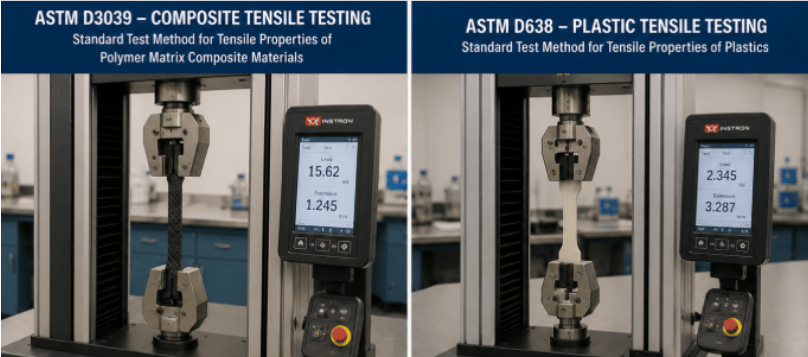
Scope of ASTM D3039 and ASTM D638
ASTM D3039
- Measures tensile properties of polymer matrix composites.
- Determines tensile strength, modulus, and Poisson’s ratio.
- Applies to continuous fiber-reinforced composite laminates.
- Works for aerospace, automotive, and structural composite applications.
- Helps with composite material qualification programs.
ASTM D638
- Carries out tensile testing of plastics.
- Measures tensile strength, modulus, yield strength, and elongation.
- Tests thermoplastic and thermosetting materials.
- Supports material selection and quality control.
- Supports plastic product development and material specification.
Principle of ASTM D3039 and ASTM D638
ASTM D3039 is a tensile test for a rectangular composite specimen that is subjected to a controlled tensile load until failure. Bonded end tabs help distribute gripping forces and reduce premature grip-induced failures, which are common in high-strength composite laminates. During the experiment, load and strain are continuously recorded. Usually, strain gauges or extensometers are attached to the specimen to obtain accurate measurements of strain. As a result of this data, tensile strength, tensile modulus, Poisson’s ratio, and strain-to-failure are calculated. These properties enable engineers to assess the structural behavior of composites.
ASTM D638 applies a specified tensile stress to a standard dogbone-shaped piece of plastic in a controlled environment until failure occurs. The narrow cross-section of the gauge section encourages failure in the gauge section, as opposed to at the grips, and thus, more representative tensile properties are obtained. The testing machine records the load and deformation during the test. Engineers then use the resulting stress-strain curve to calculate the tensile strength, yield strength, tensile modulus, and elongation at break. These properties describe the mechanical properties of plastics.
Test Procedure Overview
| Step | ASTM D3039 | ASTM D638 |
| Sample Preparation | The analyst prepares rectangular composite specimens, often with bonded end tabs. | The analyst prepares dog-bone-shaped plastic specimens. |
| Test Equipment | Universal testing machine with extensometer or strain gauges. | Universal testing machine with extensometer, if required. |
| Measurement Process | The analyst measures load and strain to calculate tensile properties, including Poisson’s ratio. | The analyst measures load and elongation during tensile loading. |
| Specimen Geometry | Rectangular specimen. | Dog-bone specimen. |
| Result | Tensile strength, tensile modulus, Poisson’s ratio, and strain to failure. | Tensile strength, yield strength, modulus, and elongation at break. |
Key Differences Between ASTM D3039 and ASTM D638
| Feature | ASTM D3039 | ASTM D638 |
| Primary Purpose | Tensile testing of composite materials | Tensile testing of plastics |
| Material Type | Continuous fiber-reinforced polymer matrix composites | Thermoplastics and thermosets |
| Specimen Shape | Rectangular specimen | Dog-bone specimen |
| Typical Materials | Carbon fiber, glass fiber, and aramid composites | Polyethylene, polypropylene, ABS, nylon |
| Strain Measurement | Often requires strain gauges or extensometers | The extensometer is optional, depending on requirements |
| Main Properties Measured | Tensile strength, modulus, Poisson’s ratio | Tensile strength, yield strength, modulus, elongation |
| Common Industries | Aerospace, automotive, marine | Plastics manufacturing and consumer products |
Significance of ASTM D3039 and ASTM D638
ASTM D3039 offers valuable information regarding the design and qualification of structural composite components. These results are valuable for the engineer in predicting the performance of the laminate, optimizing the laminate design, and ensuring the reliability of the structure for demanding service conditions. ASTM D638 is the standard that establishes tensile property data for plastics. Manufacturers use the standard as a reference for quality control, material comparison, product development, and specification compliance. These standards are complementary to each other to enable material selection, product development, and quality assurance practices between various industries.
Applications of ASTM D3039
- Assesses aerospace composite materials.
- Helps develop automotive composites.
- Assesses marine and sporting goods composites.
- Supports composite qualification and certification.
- Supports structural design and failure analysis.
- Helps in the R&D of advanced composites.
Applications of ASTM D638
- Evaluates thermoplastic and thermosetting plastics.
- Assists plastic product development.
- Verifies material specifications and supports quality control.
- Helps with material selection and engineering design.
- Supports research and development programs.
- Assesses the performance of plastics for consumer and industrial uses.


