
ASTM D6400 Labeling Plastics Designed to be Aerobically Composted in Municipal or Industrial Facilities

    What is ASTM D6400?  

    ASTM D6400 describes the standard specification for labeling plastics and plastic products designed to compost under aerobic conditions in municipal and industrial composting facilities with thermophilic conditions above 50 °C. The specification outlines the properties that plastics and plastic products must have to break down during composting. The aim is to make them decompose at a rate that matches products already known to be compostable. ASTM D6400 (Standard Specification for Labeling of Plastics Designed to be Aerobically Composted in Municipal or Industrial Facilities) provides rules to ensure that these plastics break down without lowering the quality or usefulness of the compost. This standard works with other global standards, such as ISO 14855. Laboratories often use it together with ASTM D5338 to measure how fast materials biodegrade. Municipal and industrial composting plants, as well as packaging and material manufacturers, rely on ASTM D6400 to prove their compostable claims are accurate and clearly labeled.

    Read more

    Get Certified ASTM D6400 Testing for Reliable Compostable Plastic Labeling 

    Certified ASTM D6400 testing confirms that a plastic material or product meets its biodegradation, disintegration, and ecotoxicity requirements before manufacturers label it as compostable. The reliability of compostability claims affects how much people trust the process and how well city and industry composting programs work when they use compostability labels. This gives peace of mind to product manufacturers and to composting facilities. It ensures that items labeled as compostable break down properly and do not leave residues in the final product. This trust builds confidence. It makes it easier to use more compostable packaging in stores, restaurants, and farming. Over time, it encourages adoption of sustainable options. People feel better knowing that what they use will truly return to the earth without causing harm.

    What is the Scope of ASTM D6400? 

    ASTM D6400 is a standard for plastics and plastic products that are composted in industrial aerobic composting facilities. It sets the criteria required to verify composting performance, such as biodegradation rate, disintegration, and composting impact. This specification establishes labeling requirements to ensure that products labeled as “compostable” behave in a similar manner when applied to large-scale composting. 

    Read more

    The scope of ASTM D6400 includes-

    • Material type: Plastics and products made from plastics, including packaging that uses plastics or polymers as coatings or binders.
    • Purpose: To develop guidelines for labeling materials and products as compostable in municipal and industrial composting facilities. 
    • Properties Measured: Biodegradation rate, disintegration of test material residue and plant growth, and compost quality. 
    • Method: Testing includes applying the material to the municipal waste-derived inoculum and subjecting it to controlled thermophilic composting conditions, including biodegradation testing as per ASTM D5338. 
    • Result: A material is eligible for compostable labeling if it achieves the minimum percentage biodegradation, disintegration, and plant growth criteria during the prescribed testing period. 
    • Test Limitations: The conditions used in the composting specification apply to large-scale municipal and industrial composting operations, not home composting operations. 
    • Environmental conditions: Thermophilic composting conditions (> 50 °C) are required, and the test period is normally 90 – 180 days. 
    • Applications: Compostable packaging labeling, food service ware, agricultural films, and other plastic products used in the composting facility. 

    What are the Uses of the ASTM D6400 Specification?

    ASTM D6400 testing helps manufacturers demonstrate that plastic products have the biodegradation and disintegration performance required to label products as compostable. Additionally, standardized testing assures composting facilities that the materials received for composting will decompose uniformly during their composting cycle. This standard –

    • Supports correct compostability labeling of plastic packaging and products.
    • Validates the degradation rate compared with known compostable materials.
    • Checks for disintegration and ensures that the plastic does not leave behind any pieces in the finished compost.
    • Helps organic waste facilities feel confident accepting labeled materials for composting.
    • Documents substantiation for regulatory/comsumer claims. 

    What Materials Can Be Tested Under ASTM D6400? 

    ASTM D6400 is used to test plastics and products containing plastics, such as packaging containing plastics or polymers as coatings or binders. Common items tested in laboratories include compostable food service ware, packaging films and bags, and agricultural products that are intended for use in municipal or industrial composting facilities. The specification encourages use of bioplastics as the material type, and testing laboratories use the same biodegradation and disintegration requirements for all plastic products submitted for compostability certification. 

    Why is ASTM D6400 Important? 

    ASTM D6400 is important because ASTM D6400 provides a standard for manufacturers and composting facilities. This standard ensures that plastic products labeled compostable can actually be composted in composting applications. Plastic products must truly be compostable. Materials that turn into compost as expected help keep operations running smoothly and produce quality compost in facilities with high volumes to treat and tight operating schedules. ASTM D6400 establishes clear requirements for biodegradation, disintegration, and plant growth, which strengthens consumer confidence in compostable product labeling. 

    ASTM D6400 Equipment and Sample Preparation Guide

    The equipment used in this test is listed in the table below: a controlled composting vessel, municipal waste-derived inoculum, temperature-control equipment, and a sieve for measuring disintegration. Technicians take representative samples of the material that represents the composition of the finished product with any coatings, inks, or additives that are currently in use. Biodegradation and disintegration results are reliable throughout the testing period because sample preparation and particle size remain consistent. 

    Read more

    Sample and Specimen DetailsTechnicians select representative samples of plastics and products made from plastics designed for composting. The test method determines if end items will compost satisfactorily in large-scale aerobic composting facilities.
    Specimen PreparationTechnicians prepare specimens according to the requirements for determining biodegradation at a rate comparable to known compostable materials.
    Specimen DimensionsTechnicians cut test items into flat pieces measuring up to 100 mm × 100 mm for disintegration screening, maintaining standard production thickness up to maximum commercial gauge limits. 
    InstrumentationThe standard utilizes equipment for determining aerobic biodegradation of plastic materials under controlled composting conditions incorporating thermophilic temperatures.

    Testing Procedures and Requirements for ASTM D6400  

    ASTM D6400 testing is a coordinated testing series that combines biodegradation, disintegration, and plant growth. Technicians expose the prepared sample to a municipal waste-derived inoculum under controlled thermophilic conditions, then monitor biodegradation over the test period. The following ASTM documents are also referred to: ASTM D883, D5338, D6002 

    Read more

    Biodegradation Testing Technicians expose the sample to composting inoculum under thermophilic conditions and monitor carbon dioxide evolution per ASTM D5338. 
    Disintegration Testing Technicians recover residual test material after the composting period and pass it through a sieve to measure disintegration. 
    Plant Growth (Ecotoxicity) Testing Technicians evaluate the resulting compost for effects on plant germination and growth. 
    Elemental Analysis Technicians analyze the finished compost for heavy metals and other constituents to confirm compost quality. 

    ASTM D6400 Testing Process and Data Collection

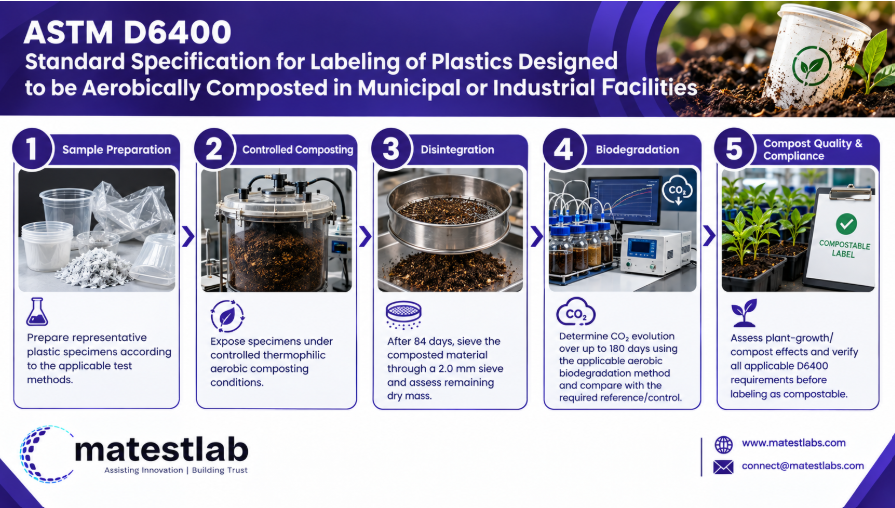
    ASTM D6400 data collection has four steps. First, they make representative plastic samples of the material and perform particle-size checks against the referenced procedures. In an inoculated, controlled composting system at thermophilic temperatures, technicians then expose the samples to an inoculum derived from local waste. Analysts measure the carbon dioxide evolved during the 90- to 180-day test and recover and sieve the remaining material to assess disintegration. Technicians lastly test the finished compost on plant growth and its nutrient content, then create the overall compostability report. 

     Thermophilic industrial composting vessel used for evaluating physical disintegration and microbial biodegradation of plastic samples under ASTM D6400.
    ASTM D6400 Industrial Composting Test Setup

    Common Challenges and Troubleshooting

    Three common problems with ASTM D6400 testing are inconsistent inoculum activity, unstable thermophilic temperatures, and incomplete residue recovery. Biodegradation rate measurements can be influenced by inconsistent inoculum activity, as the microbial community changes the rate of breakdown of the material. Additionally, the thermophilic temperature must be maintained during the long testing period, and the stability of the temperature needs to be monitored carefully, as it may affect the results. A complete disintegration test of residual material helps to achieve a valid final sieve measurement. The answer is to use a well-characterized, active inoculum, to ensure that the composting vessel temperature is monitored on a regular basis, and to carefully recover the material for assessment of composting. 

    ASTM D6400  Analysis Results and Interpretation

    ASTM D6400 provides results for the biodegradation percentage level and compost quality effects of the plastic under test.

    Read more

    • Biodegradation results compare the test material’s carbon dioxide evolution against known compostable material benchmarks over the testing period.
    • Disintegration results are the percentage of the test material that does not pass the indicated sieve.
    • The plant growth test determines if the finished compost is suitable for normal germination and growth.
    • If a material satisfies all three requirements, it is compostable in aerobic municipal and industrial composting facilities.

    Link to ASTM D6400

    FAQ

    What is the typical time of ASTM D6400 testing?
    ASTM D6400 testing usually lasts between ninety and one hundred eighty days, depending on the specifications of the material being tested.
    ASTM D6400 evaluates the biodegradation rate, the breakdown of residue from the test material,l and the impact of the compost on plant growth.
    ASTM D6400 represents conditions found in municipal and industrial composting facilities, which usually have higher and more uniform thermophilic temperatures compared to home composting sites.

    Updated on September 28, 2026

    Dr Ruchika Yogesh
    About Author
    Dr. Ruchika Yogesh is a serial entrepreneur, material science and AI/ML enthusiast, medicinal chemistry subject matter expert (SME), scientific/medical copyeditor, and a researcher.
    Know More
    Testimonials
    Real results
    Engineers trust us with what matters most
    Why Choose Matestlab?
    Matestlab is a unified testing services partner based in the USA. Matestlab offers raw material and product testing services through accredited, expert laboratories primarily based in the USA. Matestlab supports physical, thermal, chemical, electrical, mechanical, environmental, and characterization testing needs through its global network of 2200+ accredited testing laboratories. Matestlab's in-house materials science experts curate and design comprehensive testing programs matched to the sample material and specific testing need, with regulatory requirements and confidentiality in mind.

    If you are looking for a managed and trusted testing partner to achieve your research goals, feel free to schedule a meeting with us or send us a request at connect@matestlabs.com to learn more about our services. For a quick quote, call us at (302)244-7710. We are happy to serve you.
    Start Your Testing
    Project Today
    Define your requirements and get access to
    specialized laboratories ready to deliver results
    Partners with us
    Clients
    Vendors
    Process for testing
    • STEP 01

      You share your testing requirements

    • STEP 02

      You share your sample(s)

    • STEP 03

      We deliver your test reports

    Get your testing done

    Let us know your testing requirements and we will be right back with a solution.

      Let us root for each other. Collaborate to grow, expand, and accelerate our businesses.

      Partner with us