
ASTM D5334 describes a standard test method for the thermal conductivity (λ) of soil and rock by a transient heat method with a thermal needle probe. This test method applies to intact specimens of soil and rock and to reconstituted soil specimens and can be used in the laboratory and in the field. The method involves introducing a needle probe into the material, which is equipped with a heating element and a temperature sensor. The probe is then inserted into the specimen, and a known heat pulse is applied, and the temperature rise is measured over time. Thermal conductivity is determined from the temperature response to the applied heat. The method works best with homogeneous materials and also gives a representative average value for non-homogeneous materials.
ASTM D5334 Standard Test Method for Determination of Thermal Conductivity of Soil and Rock by Thermal Needle Probe Procedure
What is ASTM D5334?
What is the Scope of ASTM D5334?
ASTM D5334 specifies a transient heat method for thermal conductivity of soil and rock. The test method applicable to intact and reconstituted soil specimens and rock specimens. ASTM D5334 standard-
- Measures the thermal conductivity of soil and rock materials.
- Uses a thermal needle probe technique to determine thermal conductivity.
- Applies to intact soil or rock specimens.
- Supports laboratory and field testing.
- Applies to dry, unsaturated, or saturated materials that can accommodate the thermal needle probe.
- Covers temperatures below 0 °C to above 100 °C, depending on the construction of the thermal needle probe.
- Provides the most reliable results when the tested material is relatively uniform.
- Can provide a representative average value for non-homogeneous materials.
What are the Uses of ASTM D5334 Testing?
ASTM D5334 testing measures the thermal conductivity of soil and rock. These measurements help engineers in designing systems that transfer heat through subsurface materials. This standard-
- Assists in the design of underground transmission lines.
- Supports applications for oil and gas pipelines.
- Supplies information to radioactive waste disposal systems.
- Supports geothermal applications.
- Supports Solar Thermal Storage facilities.
- Supplies data for thermal conductivity tests in the laboratory and in the field.
What Materials Can Be Tested Under ASTM D5334?
ASTM D5334 applies to soil and rock specimens. Laboratories test both intact soil and rock specimens and reconstituted soil specimens. The method is applicable to dry, unsaturated, or saturated materials as long as the material sustains a hole for the sensor. Laboratories consider water redistribution, hydraulic gradients, and phase changes near 0°C or 100°C because these conditions can introduce significant measurement errors.
Why is ASTM D5334 Important?
Thermal conductivity describes the ability of a material to conduct heat. ASTM D5334 provides a standardized laboratory method for measuring this property of soil and rock. Engineers use these values when analyzing and designing systems involving underground transmission lines, oil and gas pipelines, radioactive waste disposal, geothermal applications, and solar thermal storage.
ASTM D5334 Equipment and Sample Preparation Guide
ASTM D5334 thermal needle probe method generates a linear heat source and records the changes in temperature inside the specimen. The apparatus also contains a constant current source, a temperature read-out/recording unit, and a voltage-ohm-meter.
| Sample and Specimen Details | Analysts use intact or reconstituted specimens of soil, rock, or engineered porous materials. The specimen sustains a hole for the needle probe and may be dry, unsaturated, or saturated. |
| Specimen Preparation | Technicians prepare the specimen to accommodate the needle probe. For field testing, they insert the probe directly into the soil or rock. For laboratory testing, they place the specimen in a suitable container before inserting the probe. |
| Specimen Dimensions | Specimens require a minimum diameter of 50 mm (2 in.) and a minimum length of 100 mm (approx. 4 in.) to prevent boundary effects. Common probes measure approximately 100 mm in length with a 1.8 mm diameter. |
| Instrumentation | The test uses a thermal needle probe with a heating element and temperature sensor. The system includes a power supply, temperature measurement device, and data acquisition system. |
Testing Procedures and Requirements for ASTM D5334
Technicians prepare the specimen and place the thermal needle probe into the material. The probe calculates a predetermined quantity of heat, and the temperature measurement device measures the response. The laboratory uses the temperature response over time to determine thermal conductivity. Technicians calibrate the thermal needle probe before use and apply heat to the specimen to reduce measurement errors. Other referenced ASTM documents include ASTM D653, D2216, D3740, D4753, and D6026.
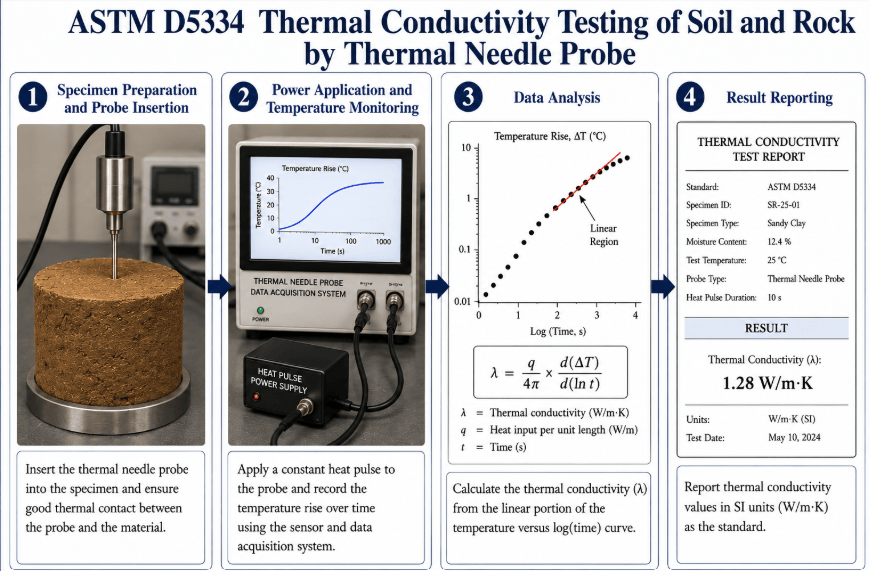
| Specimen Preparation and Probe Insertion | Technicians insert the thermal needle probe into the specimen and ensure good thermal contact between the probe and the material. |
| Power Application and Temperature Monitoring | Technicians apply a constant heat pulse to the probe and record the temperature rise over time using the sensor and data acquisition system. |
| Data Analysis | Technicians calculate the thermal conductivity (λ) from the linear portion of the temperature versus log(time) curve. |
| Result Reporting | Laboratories report thermal conductivity values in SI units (W/m·K) as the standard. |
ASTM D5334 Testing Process and Data Collection
Technicians prepare the specimen and position the thermal needle probe in the material. The testing system controls the heat input into the probe and measures the change in temperature over time. The laboratory analyzes the temperature response to determine the thermal conductivity of the soil or rock. The test provides laboratory measurements of specimens and appropriate in-situ measurements.
Common Challenges and Troubleshooting
Accurate results require suitable specimen preparation, proper probe contact, reliable temperature measurement, and appropriate heat input. Variability results from specimen density, water content, specimen size, temperature measurement accuracy, heat applied, and the relative conductivities of the probe and specimen. Technicians control water movement caused by thermal or hydraulic gradients. Materials in the vicinity of 0 °C or 100 °C must be handled with care, as water may change its state of matter, which can influence the measurement.
ASTM D5334 Analysis Results and Interpretation
The laboratory provides the measured thermal conductivity of the tested soil or rock. ASTM D5334 addresses the thermal conductivity rather than a general overall material-performance rating.
- The laboratory reports thermal conductivity (λ) in W/(m·K) or W/(m·°C), as applicable.
- The technician identifies the material condition tested, including whether the specimen consists of intact soil, reconstituted soil, or whole rock.
- The analyst records the thermal conductivity measured under the specified laboratory or field conditions and relates the result to the tested material and its condition.
- The engineer considers factors such as moisture content, density, temperature, and material condition when interpreting thermal conductivity results for subsurface applications.
- Engineers use the measured thermal conductivity values to support thermal analysis and design of subsurface systems.
Get Certified ASTM D5334 Testing for Reliable Soil and Rock Analysis
ASTM D5334 provides a standardized approach for determining the thermal conductivity of soil and rock. Stable thermal conductivity data are useful for applications such as underground transmission lines, oil and gas pipelines, radioactive waste disposal, geothermal applications, and solar thermal storage applications.
FAQ
Updated on September 4, 2026


Project Today
specialized laboratories ready to deliver results