
ASTM D6026 Standard Practice for Using Significant Digits in Geotechnical Data

    What is ASTM D6026? 

    ASTM D6026 specifies a standard practice for collecting, calculating, and recording measured and calculated geotechnical data using appropriate significant digits. This practice advocates uniformity of numerical data retention methods and rounding reported data for laboratories, technicians, engineers, and data users. It applies to geotechnical data from tests and calculations and can reduce the likelihood of reporting more precision than the measurement warrants or omitting detail that could be valuable for sensitivity and variability analyses. ASTM D6026 (Standard Practice for Using Significant Digits and Data Records in Geotechnical Data) addresses the computer-generated digits from digital instruments, calculators, spreadsheets, and computer systems that may not have meaningful measures of precision. Significant digits can be adjusted for material variation, project objectives, special studies, or other requirements to report the material at varying precisions. 

    Read more

    Get Certified ASTM D6026 for Reliable Geotechnical Data Evaluation

    With ASTM D6026, testing laboratories and engineering teams can guarantee that these numerical values in geotechnical investigations are precise and repeatable. Experienced staff use an appropriate number of significant figures when collecting, calculating, recording, and reporting data. With proper data handling, engineers are able to interpret test results without distorting or magnifying the apparent accuracy of the measurements.

    What is the scope of ASTM D6026? 

    ASTM D6026 applies to the selection of significant digits in the collection, calculation, and recording of measured or calculated geotechnical values. The practice promotes uniformity in recording numerical results and provides general industry guidance for retaining appropriate significant digits. 

    Read more

    The scope of ASTM D6026 includes:

    • Material: Represents numerical data derived from geotechnical materials and investigations, such as measured and calculated data from soil and rock testing. 
    • Objective: Promotes uniformity in retaining, rounding, recording, calculating, and reporting significant digits in geotechnical data. 
    • Property measurement: Pertains to the numerical representation of measured properties and calculated results but does not prescribe any specific physical property test. 
    • Method: Applies guidelines for determining significant digits, decimal places, rounding, data recording, and handling of numerical results. 
    • Result: Produces consistently recorded numerical data with a level of reported precision appropriate to measurement, calculation, and intended use. 
    • Test Limitations: The practice does not include all material variations, project objectives, special-purpose studies, or engineering-design requirements; users are expected to use their professional judgment. 
    • Environmental conditions: ASTM D6026 does not specify laboratory environmental conditions because it is concerned with data handling. 
    • Applications: Supports geotechnical laboratory reports, field data records, calculations, spreadsheets, computer-based data acquisition, engineering documentation, and reporting of soil and rock test results.

    What are the uses of ASTM D6026? 

    ASTM D6026 helps geotechnical professionals maintain appropriate numerical precision when they collect, calculate, record, and report data. Users can follow its rules when there is no other standard that specifies the number of significant figures or rounding method. This standard-

    • Promotes consistent recording of geotechnical measured values. 
    • Supports consistent reporting of calculated results. 
    • Provides guidance for retaining significant digits. 
    • Provides guidance for rounding numerical values.
    •  Helps users avoid exaggerated numerical precision. 
    • Helps preserve sufficient numerical detail for sensitivity and variability analyses. 
    • Supports consistent handling of data generated by calculators and computers. 
    • Provides guidance for digital and manually recorded geotechnical data.

    ASTM D6026 is used for which numerical data? 

    ASTM D6026 is used for numerical data resulting from geotechnical investigation and testing of soil, rock, and associated materials.

    Why is ASTM D6026 important?

    ASTM D6026 aids laboratories in distinguishing meaningful numerical information from unnecessary digits. Many decimal places may appear on a calculator or computer, but they may not be considered an increase in measurement accuracy.

    ASTM D6026 Equipment and Data Preparation Guide 

    ASTM D6026 data is prepared numerically by skilled personnel from geotechnical testing, field measurement, calculation, and digital acquisition devices, as applicable.

    Read more

    Sample and Specimen DetailsAnalysts work with measured and calculated geotechnical data generated from applicable soil, rock, and related testing procedures rather than a dedicated D6026 specimen.
    Sample PreparationTechnicians verify the source data, units, measurement records, calculations, and applicable reporting requirements before applying significant-digit and rounding guidance.
    Specimen DimensionIt provides data-recording guidance rather than a physical test method.
    InstrumentationEquipment can include geotechnical testing instruments, measuring devices, calculators, computers, spreadsheets, digital data-acquisition systems, and data-recording software used to generate or process the underlying results.

    Testing Procedures and Requirements for ASTM D6026

    ASTM D6026 presents a series of data-handling decisions, not a typical laboratory test procedure. The user first considers the requirements of the applicable geotechnical standard and then determines how to retain, calculate, round, record, and report the numerical data. Other reference ASTM documents include D653, D2905, D4356, D6913, E29, E344, E456, and E883. The complete procedure for ASTM D6026 is given below:

    Read more

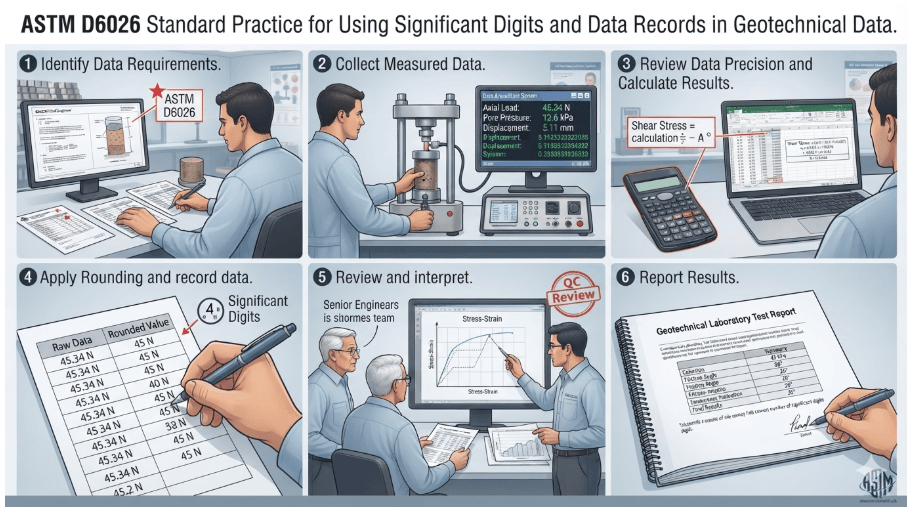
    Identify Data RequirementsAnalysts identify the applicable geotechnical standard and determine whether it already specifies significant digits, decimal places, or rounding requirements.
    Collect Measured DataTechnicians record measured values using enough numerical detail to support appropriate calculations and subsequent evaluation.
    Review Data Precision and Calculate ResultsAnalysts evaluate whether the recorded digits represent meaningful measurement information rather than simply accepting all digits displayed by a calculator, computer, or digital instrument. Engineers and analysts calculate derived values while maintaining sufficient numerical information for subsequent calculations and data evaluation.
    Apply Rounding and Record Data. Users apply the appropriate rounding approach specified by the applicable standard or, when no specific requirement exists, use the guidance provided by ASTM D6026. Technicians and analysts record measured and calculated values with appropriate significant digits or decimal places.
    Review and InterpretAnalysts verify that the final numerical representation neither exaggerates nor degrades the apparent precision of the underlying data.
    Report ResultsEngineers report final values with numerical precision suitable to the applicable standard, project goals, material variation, and intended use.

    ASTM D6026 Testing Process and Data Collection 

    During ASTM D6026 data handling, technicians collect numerical values from applicable geotechnical tests or field measurements and preserve sufficient digits for calculations and evaluation. Analysts then review the relevant standard, perform calculations, round appropriately, and record the final values. Digital systems can generate additional digits, but programmers and users remain responsible for determining which values are meaningful.

    This image shows a geotechnical testing instrument used to determine the properties of soil as per ASTM D6026.
    ASTM D6026 Testing Procedure Using Geotechnical Testing 

    Common Challenges and Troubleshooting 

    Common ASTM D6026 data-management challenges include retaining too many insignificant digits, rounding data too early, applying an incorrect rounding approach, and assuming that all digits displayed by computers represent meaningful precision. Technicians should retain adequate numerical detail throughout calculations; final reporting precision should be used at the correct point. Analysts should also check the applicable geotechnical standard because that document may establish specific reporting requirements that take precedence over general D6026 guidance.

    ASTM D6026 Analysis Results and Interpretation 

    It guides the numerical representation of measured and calculated geotechnical results so that reported precision reflects the nature and intended use of the data.

    Read more

    • Geotechnical properties reported from a laboratory will be reported with significant digits or decimal places that are suitable for the test method and data needs. 
    • Primary numerical outcomes and the original measurements, units, calculations, specimen or field identification, and applicable data-record information are documented by technicians. 
    • Analysts document the calculation method, rounding approach, source data, digital processing, and any project-specific considerations that affect reported precision. 
    • Engineers and analysts compare and interpret the reported values against applicable geotechnical requirements, project specifications, sensitivity analyses, or engineering objectives while considering the limitations of numerical precision.

    Link to ASTM D6026

    FAQ

    What does ASTM D6026 cover?
    ASTM D6026 provides guidance for using significant digits and recording measured and calculated values in geotechnical data.
    No. It is a standard practice that provides guidance for collecting, calculating, recording, rounding, and reporting geotechnical data rather than prescribing a physical laboratory test.
    No. The scope specifically states that significant digits used in analysis methods for engineering design fall outside the practice.

    Updated on September 15, 2026

    Malhar Khole
    About Author
    Malhar Khole is a Material Testing Associate at Matestlab Inc. and holds a postgraduate degree in Material Science and Technology from IIT (BHU), Varanasi.
    Know More
    Testimonials
    Real results
    Engineers trust us with what matters most
    Start Your Testing
    Project Today
    Define your requirements and get access to
    specialized laboratories ready to deliver results
    Partners with us
    Clients
    Vendors
    Process for testing
    • STEP 01

      You share your testing requirements

    • STEP 02

      You share your sample(s)

    • STEP 03

      We deliver your test reports

    Get your testing done

    Let us know your testing requirements and we will be right back with a solution.

      Let us root for each other. Collaborate to grow, expand, and accelerate our businesses.

      Partner with us

        Discover more from Matestlab

        Subscribe now to keep reading and get access to the full archive.

        Continue reading