ASTM D653 Terminology Relating to Soil, Rock, and Contained Fluids

    What is ASTM D653?

    ASTM D653 is a standard terminology that defines terms related to soil, rock, and contained fluids throughout ASTM Committee D18 standards. The terminology provides a set of standard definitions of technical terms used in geotechnical engineering, soil testing, rock mechanics, groundwater, and related applications. ASTM D653 also includes symbols, units, and lists of related terms and groupings of definitions for selected concepts. This way, engineers, technicians, and analysts can communicate with one another using the same terminology when describing materials, properties, measurements, and test results.

    Read more

    Get Certified ASTM D653 Testing for Reliable Soil and Rock Evaluation

    ASTM D653 facilitates the interchange of technical terminology among specifications, test methods, engineering reports, and geotechnical documentation for reliable soil and rock evaluation. The definitions are included to ensure that the engineer understands the correct definitions of terms when evaluating soil, rock, and contained fluids. This will be a way to enhance communication between testing teams, geotechnical engineers, contractors, and project stakeholders through consistent terminology. Matestlab can offer advice on the use of ASTM D653 terminology in a consistent manner with existing soil, rock, and contained-fluid testing programs.

    What is the Scope of the ASTM D653?

    ASTM D653 is a terminology standard for terms that are used in standards under the jurisdiction of ASTM Committee D18, which covers the area of soil and rock. The terminology is relevant to many of the terms in the Terminology section of ASTM D18 standards. The scope of ASTM D653 includes:

    Read more

    • Soil terminology: Defines technical terms used to describe soil materials, characteristics, and behavior.
    • Rock terminology: Establishes definitions used in rock mechanics, characterization, and engineering.
    • Contained fluids: Covers terminology associated with fluids contained within soil and rock formations.
    • ASTM D18 usage: Provides definitions for terms appearing throughout ASTM Committee D18 standards.
    • Symbols: Identifies symbols used with selected technical definitions.
    • Units: Provides dimensional notation for applicable quantities while allowing the engineer to select the appropriate unit system.
    • Related terms: Groups definitions and lists related terminology to help users locate applicable concepts.
    • Frozen soils: Terms relating specifically to frozen soils are addressed by ASTM D7099 rather than ASTM D653.

    What are the Uses of ASTM D653?

    ASTM D653 provides a common language for engineers and analysts to use in communicating about soil, rock, and contained fluids involved in geotechnical activities. The terminology is intended to aid in the characterization, testing, engineering analysis, specification, and reporting of material for all ASTM Committee D18 applications.

    • Offers uniform terminology for soil and rock engineering.
    • Helps to describe soil properties and conditions clearly.
    • Supports engineers in developing geotechnical specifications using standardized terminology.
    • Consistently uses terminology in soil and rock testing methods.
    • Assists analysts in understanding the technical aspects of geotechnical codes.
    • Provides symbols and dimensions for quantities that apply.
    • Enhances the consistency of reporting soil, rock, and contained fluids test results.
    • Facilitates communication among testing teams, engineers, contractors, and project stakeholders.

    Which materials can be tested under ASTM D653?

    ASTM D653 does not prescribe a physical test for a specific material or specimen. Rather, it is terminology used in standards in ASTM Committee D18 for soils, rocks, and contained fluids. Physical testing of these materials must be performed in accordance with the particular ASTM test method used for the geotechnical evaluation for which they are needed.

    Why is ASTM D653 Important?

    ASTM D653 is significant because it provides consistent terminology, allowing engineers and analysts to interpret information about soil, rock, and contained fluids using standardized ASTM terms. The terminology is used in test methods, specifications, engineering calculations, site investigations, material characterization, and technical reports. Symbols, dimensional notation, groupings, and associated terminology for selected concepts are also identified. However, there are several different definitions of these technical terms in textbooks or other uses, and the definitions in ASTM D653 should be used when applying ASTM D18 standards. Inconsistent terminology, incorrect symbols, unclear units, and general versus ASTM definitions can also contribute to inaccurate communication.

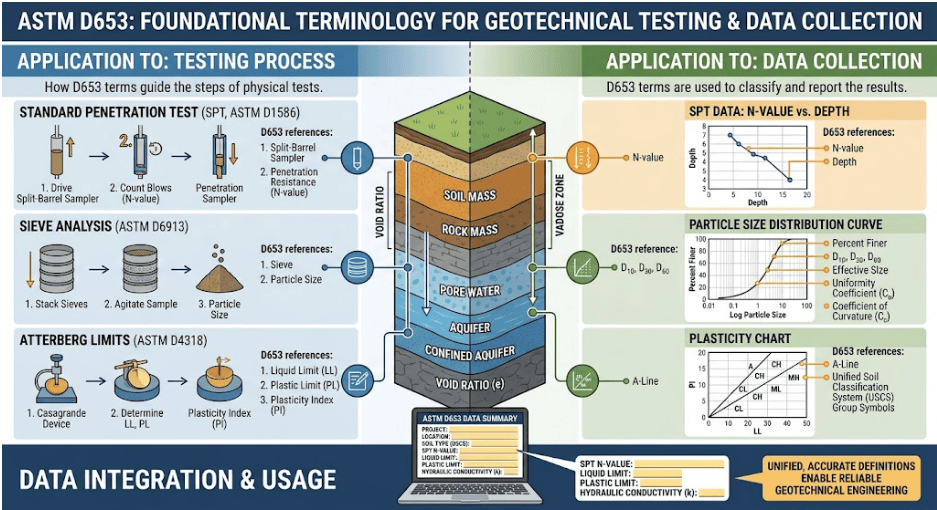
    ASTM D653 Equipment and Sample Preparation Guide

    ASTM D653 does not specify physical test equipment or specimen preparation, as it is a set of terms instead of a laboratory test procedure. Engineers, however, simply read the definitions and apply the terminology as appropriate to the soil, rock, or contained-fluid test method being used.

    Read more

    Standard ClassificationDefines terminology for soil, rock, and contained fluids used throughout ASTM Committee D18 standards to provide consistent technical language and interpretation.
    Soil and Rock TerminologyEstablishes standardized definitions for technical terms relating to soil, rock, engineering properties, and geotechnical conditions.
    Contained Fluids and Engineering ConceptsProvides terminology associated with fluids contained within soil and rock and concepts such as density, specific gravity, stress, head, consolidation, and unit weight.
    Symbols and Measurement UnitsIdentifies symbols associated with defined terms and explains dimensional categories such as dimensionless, force, length, mass, and time for applicable quantities.
    Grouping and Related TermsOrganizes selected definitions into related technical groupings and provides listings of related terms to help users locate and apply terminology consistently.

    Testing Procedures and Requirements for ASTM D653

    ASTM D653 provides standard terminology for soils, rocks, and contained fluids, so there is no physical testing procedure. Therefore, engineers examine the definitions and consistently use them in technical documents and geotechnical testing activities. The procedure outlined in ASTM D653 is as follows-

    Read more

    Terminology IdentificationEngineers know which soil, rock, or contained-fluid terms are necessary for the specification, test, engineering analysis, or technical document in use.
    Definition ReviewAnalysts review the applicable ASTM D653 definitions, symbols, units, and explanatory information associated with each selected term.
    Technical Context EvaluationEngineers verify that the terminology they choose corresponds to the material, property, condition, measurement, or application being described.
    Symbol and Unit ReviewAnalysts examine the symbols and dimensional notation that are applicable and choose the suitable unit system for the engineering application.
    Terminology ApplicationTechnicians and engineers use the chosen terminology uniformly in their specifications, test documents, calculations, analyses, and reports.
    Document ReviewEngineers verify the document for inconsistent, ambiguous, or incorrect terminology before finalizing the engineering record.
    Result ReportingEngineers report soil, rock, or contained-fluid information using terminology that corresponds with ASTM D653 definitions and the relevant physical test method.

    ASTM D653 Testing Process and Data Collection

    ASTM D653 reviews terminology, not physical data collection. Engineers determine the appropriate term for the soil, rock, or contained fluid, examine the definitions, verify the technical context, and use the terminology uniformly in specifications, test procedures, calculations, engineering records, and reports. The applicable test method specifies the specimen, equipment, measurement procedure, and the data recorded in physical measurements. The activities can then be described technically in a consistent manner with the use of ASTM D653.

     Engineers reviewing standardized soil and rock terminology used for geotechnical testing, analysis, and technical reporting.
    ASTM D653 Soil, Rock, and Contained Fluids Terminology for Geotechnical Testing

    Common Challenges and Troubleshooting

    The successful use of ASTM D653 depends on proper selection and uniform use of the terminology used for soil, rock, and contained fluids. Some of the most typical problems are applying a term out of the context of ASTM, ignoring symbols or units that apply, and misinterpreting the ASTM definition with the term as it is used in a textbook. Prior to the documentation of geotechnical materials or properties, the relevant D653 definition should be reviewed by the engineer. Where physical testing is performed, procedures in the test method should also be followed in the preparation of specimens, instrumentation, measurements, and reporting.

    ASTM D653 Analysis Results and Interpretation

    ASTM D653 is not a physical testing standard and therefore does not provide independent physical test results. The standard, rather, allows for consistent reporting and interpretation of information from soil, rock, and contained-fluid testing methods that are applicable. The terminology provides a means by which engineers can describe materials, properties, measurements, and conditions using common ASTM terminology. Therefore, the standard improves communication among analysts when comparing data from various geotechnical testing, engineering, construction, and research activities.

    Read more

    • Engineers describe soil, rock, and contained fluids in a consistent manner using a specific set of terminology.
    • Analysts interpret the geotechnical properties, conditions, measurements, and technical information according to the definitions that apply.
    • Engineers communicate physical quantities consistently using symbols and dimensional notation for applicable terms.
    • Technicians document specimens, test conditions, measurements, and engineering observations consistently using the same terminology.
    • Engineers use standardized terms to improve consistency across specifications, test reports, calculations, and geotechnical documentation.

    Link to ASTM D653

    FAQ

    Why is ASTM D653 important?
    ASTM D653 is significant because it establishes a consistent terminology for soil, rock, and contained fluids to facilitate communication across ASTM Committee D18 applications.
    ASTM D653 provides definitions of terms, symbols, units, and related terminology as used in soil, rock, and contained-fluid standards and geotechnical documentation.
    ASTM D653 is a terminology standard and therefore does not measure a physical property. Physical measurements are taken by the applicable ASTM test method for the soil, rock, or contained-fluid evaluation.

    Updated on September 30, 2026

    Davis Scott
    About Author
    Davis Scott is an Electrical and Electronics Engineer specializing in multidisciplinary validation, quality assurance, and comprehensive electro-mechanical testing.
    Know More
    Testimonials
    Real results
    Engineers trust us with what matters most
    Why Choose Matestlab?
    Matestlab is a unified testing services partner based in the USA. Matestlab offers raw material and product testing services through accredited, expert laboratories primarily based in the USA. Matestlab supports physical, thermal, chemical, electrical, mechanical, environmental, and characterization testing needs through its global network of 2200+ accredited testing laboratories. Matestlab's in-house materials science experts curate and design comprehensive testing programs matched to the sample material and specific testing need, with regulatory requirements and confidentiality in mind.

    If you are looking for a managed and trusted testing partner to achieve your research goals, feel free to schedule a meeting with us or send us a request at connect@matestlabs.com to learn more about our services. For a quick quote, call us at (302)244-7710. We are happy to serve you.
    Start Your Testing
    Project Today
    Define your requirements and get access to
    specialized laboratories ready to deliver results
    Partners with us
    Clients
    Vendors
    Process for testing
    • STEP 01

      You share your testing requirements

    • STEP 02

      You share your sample(s)

    • STEP 03

      We deliver your test reports

    Get your testing done

    Let us know your testing requirements and we will be right back with a solution.

      Let us root for each other. Collaborate to grow, expand, and accelerate our businesses.

      Partner with us