ASTM D4799 Standard Practice for Accelerated Weathering Test Conditions and Procedures for Bituminous Materials (Fluorescent UV, Water Spray, and Condensation Method)

    What is ASTM D4799?

    ASTM D4799 is the standard practice for accelerated weathering conditions and methods for fluorescent ultraviolet (UV) light, water spray, and condensation testing of bituminous materials. The practice then subjects specimens to planned cycles that mimic significant weathering effects such as UV exposure, moisture, and high temperature found outdoors. Engineers use these controlled exposures to compare the weathering characteristics of bituminous materials under repeatable conditions. This practice assesses changes after accelerated exposure and compares materials or formulations. It uses fluorescent UV exposure with water spray and condensation cycles instead of xenon-arc exposure. Engineers use ASTM D4799 (Standard Practice for Accelerated Weathering Test Conditions and Procedures for Bituminous Materials (Fluorescent UV, Water Spray, and Condensation Method) results to determine material developments, quality control, formulation comparison, and weathering-resistance evaluation. The laboratory must choose the appropriate specimen preparation, exposure, and post-exposure evaluation to meet the material and testing purpose.

    Read more

    Get Certified ASTM D4799 Testing for Reliable Bituminous Materials 

    In outdoor service, bituminous materials may deteriorate due to exposure to sunlight, moisture, condensation, and temperature changes. ASTM D4799 provides controlled fluorescent-UV, water-spray, and condensation exposure conditions so laboratories can compare the weathering characteristics of these materials under accelerated laboratory conditions. 
    What is the scope of ASTM D4799? 

    ASTM D4799 provides accelerated weathering conditions and procedures for bituminous materials utilizing fluorescent UV radiation, water spray, and condensation. The practice offers controlled laboratory exposure, not a prediction of outdoor service life.  This standard practice-

    Read more

    • Uses fluorescent UV exposure, including water-spray exposure and condensation cycles.
    • Evaluates weathering behavior of bituminous materials and provides controlled exposure conditions for comparative testing.
    • Supports evaluation of changes after accelerated weathering and helps laboratories compare different materials and formulations.

    What are the uses of ASTM D4799 practice? 

    ASTM D4799 helps manufacturers and laboratories determine the combined effects of UV radiation and moisture on bituminous materials. This standard practice-

    • Compares the weathering resistance of bituminous materials and supports the development of roofing and waterproofing materials.
    • Evaluates formulation changes and supports quality-control investigations.
    • Helps identify surface or physical changes after exposure and provides comparative data for material evaluation.
    • Supports research into accelerated weathering behavior.

    Which Materials Can Be Tested Under ASTM D4799? 

    ASTM D4799 covers bituminous materials that are subjected to accelerated weathering testing. Laboratories should use representative samples and exposure conditions based on the material and use.

    Why is ASTM D4799 Important? 

    ASTM D4799 establishes laboratory-controlled conditions for examining the effects of fluorescent UV radiation, water spray, and condensation on bituminous materials. Outdoor weathering changes environmental conditions, making direct material comparisons difficult. Controlled accelerated exposure gives laboratories a well-defined set of conditions and allows more uniform specimen comparisons.

    ASTM D4799 Equipment and Sample Preparation Guide 

    For accurate testing, the fluorescent UV weathering apparatus must provide controlled UV radiation, water spray, and condensation. Laboratories should prepare representative samples and mount them in the same way inside the exposure chamber.

    Read more

    Sample and Specimen DetailsTechnicians prepare representative bituminous-material specimens suitable for fluorescent-UV, water-spray, and condensation exposure.
    Specimen PreparationTechnicians prepare and mount specimens according to the applicable material and evaluation procedure and maintain consistent preparation for comparative testing.
    Specimen DimensionsAnalysts use dimensions appropriate for the selected exposure apparatus and evaluation procedure.
    Instrumentation Fluorescent UV weathering chamber, UV lamps, specimen holders, water-spray system, condensation system, temperature-control equipment, irradiance-monitoring equipment, and applicable instruments for post-exposure evaluation.

    Testing Procedures and Requirements for ASTM D4799 

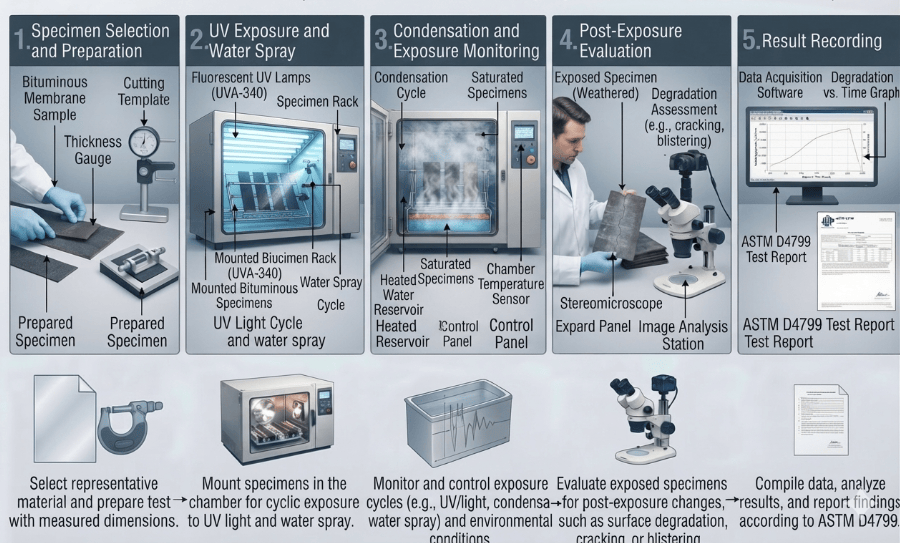
    ASTM D4799 specifies a controlled exposure of bituminous specimens to fluorescent UV radiation, water spray, and condensation. Technicians mount and prepare specimens, select the appropriate exposure cycle, run the weathering chamber, and record the appropriate exposure conditions. Other reference ASTM documents include D36, D1669, D1670, G113, G141, G147, G151, and G154.  The testing procedure of ASTM D4799 is given as:

    Read more

    Specimen Selection and PreparationSkilled personnel select representative bituminous-material specimens for accelerated weathering evaluation. They then prepare and mount specimens consistently in the fluorescent UV weathering apparatus.
    UV Exposure and Water SprayAnalysts expose the specimens to controlled UV radiation using the selected procedure and apply water spray during the specified portion of the exposure cycle.
    Condensation and Exposure MonitoringTechnicians expose specimens to controlled condensation conditions according to the applicable cycle and record relevant temperature, UV, moisture, and exposure-duration conditions.
    Post-Exposure EvaluationAnalysts examine specimens and measure the applicable physical, mechanical, or visual changes.
    Result RecordingEngineers record exposure conditions, specimen information, observations, measurements, and relevant failure or degradation characteristics.

    ASTM D4799 Testing Process and Data Collection

    Technicians first select representative samples and prepare them for accelerated weathering. They place the specimens in the fluorescent UV weathering apparatus and then subject them to the following cycles of UV radiation, water spray, and condensation. Technicians record exposure duration, exposure temperature, UV exposure conditions, and moisture cycle information during the testing phase. Technicians then examine the specimens and conduct the appropriate evaluation. Data may include visual changes, surface deterioration, cracking, discoloration, physical-property changes, or other material-relevant characteristics.

    This image depicts a fluorescent UV weathering chamber used for weathering testing as ASTM D4799.
    ASTM D4799 Testing Using Fluorescent UV Weathering Chamber

    Common Challenges and Troubleshooting 

    Several factors can influence accelerated weathering results. Common challenges include inconsistent specimen preparation, incorrect specimen mounting, uneven UV exposure, incorrect water-spray conditions, inadequate condensation, poor temperature control, incorrect exposure duration, and differences in material formulation. Technicians should check the weathering chamber, ensure consistent exposure conditions, prepare specimens uniformly, and record all test parameters.

    ASTM D4799 Analysis Results and Interpretation

    • Laboratories report ASTM D4799 results based on the exposure cycle, specimen type, exposure duration, and post-exposure evaluation method selected. 
    • The practice uses fluorescent UV, water spraying, and condensation to assess the weathering of bituminous materials.
    • Analysts document exposure time in hours and temperature in ºC.
    • A visual examination reveals cracks, color changes, blistering, surface deterioration, or other observed changes.

    Link to ASTM D4799

    Read more

    FAQ

    What is ASTM D4799?
    ASTM D4799 provides accelerated weathering conditions and procedures for bituminous materials using fluorescent UV radiation, water spray, and condensation.
    The practice relies on fluorescent UV, water sprays, and condensation to expose bituminous specimens in a controlled laboratory environment.
    The testing helps laboratories evaluate changes and compare the accelerated weathering behavior of bituminous materials.
    Suyog Kamble
    About Author
    Suyog Kamble
    Suyog Kamble is an Operations Associate at MaTestLab Inc. and holds a postgraduate degree in Organic Chemistry.
    Testimonials
    Real results
    Engineers trust us with what matters most
    Start Your Testing
    Project Today
    Define your requirements and get access to
    specialized laboratories ready to deliver results
    Partners with us
    Clients
    Vendors
    Process for testing
    • STEP 01

      You share your testing requirements

    • STEP 02

      You share your sample(s)

    • STEP 03

      We deliver your test reports

    Get your testing done

    Let us known your testing requirements and we will be right back with a solution.

      Let us root for each other. Collaborate to grow, expand, and accelerate our businesses.

      Partner with us

        Contact Us

        Discover more from MaTestLab

        Subscribe now to keep reading and get access to the full archive.

        Continue reading