
ASTM D4798/D4798M Standard Practice for Accelerated Weathering Test Conditions and Procedures for Bituminous Materials (Xenon-Arc Method)

    What is ASTM D4798/D4798M? 

    ASTM D4798/D4798M is a standard practice for determining the accelerated weathering properties of bituminous materials exposed to a xenon-arc light source. The practice involves loading materials with controlled cycles of light, moisture, temperature, and other selected environmental conditions to mimic significant outdoor weathering factors. The procedure is used in the laboratory to investigate changes that can occur in bituminous materials after exposure, such as cracking, discoloration, surface deterioration, loss of flexibility, or other changes in physical properties. The standard focuses on defining exposure conditions and procedures in the xenon arc, not on a universal performance value. ASTM D4798/D4798M (Standard Practice for Accelerated Weathering Test Conditions and Procedures for Bituminous Materials (Xenon-Arc Method) can be used by manufacturers, laboratories, and researchers to compare materials, explore formulation changes, assess weathering resistance, and study accelerated environmental exposure. The laboratory should choose appropriate exposure conditions, specimen preparation techniques, and evaluation techniques based on the material and purpose of the test.

    Read more

    Get Certified ASTM D4798 Testing for Weathering Resistance 

    Sunlight, heat, moisture, and repeated weather conditions can alter bituminous roofing and waterproofing materials. ASTM D4798/D4798M provides controlled xenon-arc exposure conditions that laboratories can use to compare the weathering characteristics of materials with a control material of known outdoor durability. There is no single correlation available from accelerated exposure to natural outdoor exposure, so results should be interpreted based on material, formulation, and exposure conditions. 
    What is the scope of ASTM D4798?

    ASTM D4798/D4798M establishes conditions and procedures for xenon-arc exposure of bituminous roofing and waterproofing materials. This standard practice-

    Read more

    • Covers accelerated weathering of bituminous roofing materials and highlights weathering acceleration of bituminous waterproofing materials.
    • Uses xenon-arc exposure equipment under controlled light and moisture exposure conditions.
    • Supports comparison of weathering characteristics with a suitable control material. 
    • Helps laboratories study material degradation after accelerated exposure.

    What are the uses of ASTM D4798/D4798M practice? 

    Manufacturers use ASTM D4798/D4798M testing to assess the response of bituminous materials to controlled accelerated weathering conditions. The practice is for comparative evaluation and material-development work, not to predict an exact outdoor service life. This standard practice-

    • Compares the weathering resistance of bituminous materials and evaluates material formulations against a control material.
    • Supports roofing-material development and waterproofing-material evaluation.
    • Helps identify changes after xenon-arc exposure and supports formulation comparison and quality evaluation.
    • Helps laboratories investigate the effects of light, moisture, and temperature.

    Which Materials Can Be Tested Under ASTM D4798? 

    ASTM D4798 primarily applies to bituminous roofing and waterproofing materials. The practice may be used with other materials; however, ASTM explicitly recognizes that it has not evaluated the significance or use of the practice with materials beyond its primary bituminous application.

    Why is ASTM D4798/D4798M Important? 

    ASTM D4798/D4798M provides a controlled method for comparing the weathering characteristics of bituminous materials. Geographic climate, local weather, pollutants, etc. may affect natural exposure. Furthermore, exposure to accelerated weathering can vary by material and formulation.

    ASTM D4798 Equipment and Sample Preparation Guide 

    To perform accurate accelerated weathering testing, a xenon-arc exposure apparatus with control over the desired environmental conditions is needed. Laboratories prepare representative sample specimens and mount them in the exposure chamber following the applicable procedure.

    Read more

    Sample and Specimen DetailsTechnicians prepare representative specimens of bituminous roofing or waterproofing materials for xenon-arc exposure and subsequent property evaluation.
    Specimen PreparationTechnicians prepare specimens based on material type and evaluation method, mount them securely in the exposure apparatus, and maintain consistent preparation for comparative testing.
    Specimen DimensionsAnalysts select dimensions that fit the exposure apparatus and allow the required post-exposure evaluation.
    InstrumentationXenon-arc weathering chamber, specimen holders, irradiance-control system, temperature-control system, moisture or water-spray system, environmental monitoring equipment, and applicable instruments for post-exposure property evaluation.

    Testing Procedures and Requirements for ASTM D4798

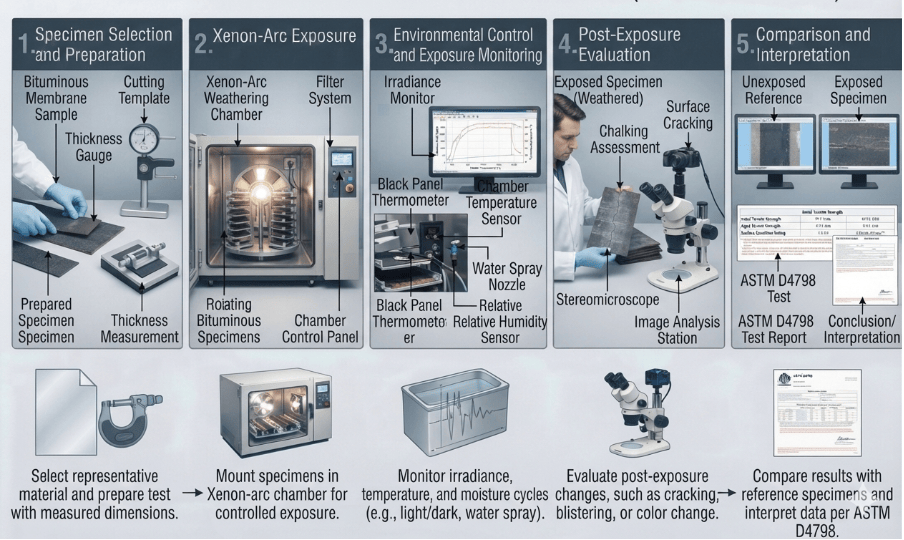
    ASTM D4798 specifies the exposure conditions for bituminous materials using a xenon-arc. Technicians prepare representative specimens, place them in a weathering apparatus, run a selected weathering cycle, and assess them during or after exposure using an appropriate assessment technique. Other reference ASTM documents include D36, D1669, D1670, G113, G141, G147, G151, and G155. The complete ASTM D4798 procedure is given as:

    Read more

    Specimen Selection and Preparation Technicians select representative specimens of the bituminous material and a suitable control material when comparative testing requires one. They then prepare and mount the specimens consistently to reduce variation between samples.
    Xenon-Arc ExposureAnalysts expose the specimens in a xenon-arc weathering apparatus according to the applicable ASTM D4798/D4798M conditions and procedures.
    Environmental Control and Exposure MonitoringTechnicians control the exposure conditions to be applied, such as irradiance, temperature, moisture, or water-spray conditions, and document the exposure time and chamber conditions during the test.
    Post-Exposure EvaluationAnalysts examine exposed specimens and measure the applicable physical, mechanical, or visual changes.
    Comparison and InterpretationAnalysts compare exposed materials with control specimens or unexposed materials and interpret the changes according to the selected evaluation method.

    ASTM D4798/D4798M Testing Process and Data Collection 

    Technicians first choose representative specimens and prepare them for the xenon-arc exposure. The laboratory then mounts the specimens in the exposure chamber and runs the apparatus at controlled conditions. Technicians note and track relevant exposure data and environmental parameters during testing. After the chosen exposure period, analysts analyze specimens for relevant changes. Laboratories can gather information regarding duration of exposure, irradiance, temperature, moisture, appearance changes, cracking, surface deterioration, flexibility changes, or any other material property, depending on the material and evaluation program.

    This image shows a xenon-arc weathering chamber used for weathering test conditions as per ASTM D4798.
    ASTM D4798 Testing Procedure Using Xenon-Arc Weathering Chamber

    Common Challenges and Troubleshooting 

    Several factors can influence accelerated weathering results. Laboratories should maintain consistent specimen preparation and carefully control the exposure conditions. Common challenges include inconsistent specimen preparation, incorrect specimen mounting, non-uniform exposure, poor temperature control, inconsistent moisture, and uneven exposure of specimens. Technicians should confirm the weathering apparatus, expose specimens under consistent conditions, employ appropriate control materials, and record all pertinent test parameters. Laboratories should also avoid it if a specific number of laboratory exposure hours always equals a fixed period of natural outdoor weathering.

    ASTM D4798/D4798M Analysis Results and Interpretation 

    • Laboratories report ASTM D4798/D4798M results based on selected exposure conditions, specimen type, exposure duration, and post-exposure evaluation method.
    • The practice assesses the accelerated weathering properties of bituminous roofing and waterproofing materials under xenon-arc exposure.
    • Analysts measure changes in selected material properties or characteristics after exposure and may compare exposed specimens with unexposed or control material.
    • Engineers report results in temperature (°C), irradiance (W/m²), and time (hours). 

    Link to ASTM D4798/D4798M

    Read more

    FAQ

    What is ASTM D4798/D4798M?
    The ASTM D4798/D4798M outlines test conditions and procedures for accelerated xenon-arc weathering exposure of bituminous roofing and waterproofing materials.
    The practice is used to compare the weathering properties of bituminous materials when exposed to controlled xenon-arc weathering conditions.
    The ASTM acknowledges that no universal relationship applies to all materials between accelerated-test exposure time and natural outdoor weathering because climate, pollutants, material composition, and formulation can affect the relationship.

    Updated on September 7, 2026

    Rohit Dhembare
    About Author
    Rohit Dhembare is an Operations Associate at Matestlab Inc., holds a postgraduate degree in Organic Chemistry and is trained in Materials Science testing techniques.
    Know More
    Testimonials
    Real results
    Engineers trust us with what matters most
    Start Your Testing
    Project Today
    Define your requirements and get access to
    specialized laboratories ready to deliver results
    Partners with us
    Clients
    Vendors
    Process for testing
    • STEP 01

      You share your testing requirements

    • STEP 02

      You share your sample(s)

    • STEP 03

      We deliver your test reports

    Get your testing done

    Let us know your testing requirements and we will be right back with a solution.

      Let us root for each other. Collaborate to grow, expand, and accelerate our businesses.

      Partner with us

        Discover more from Matestlab

        Subscribe now to keep reading and get access to the full archive.

        Continue reading