ASTM D3368 Standard Specification for FEP Sheet and Film

    What is ASTM D3368? 

    ASTM D3368 specifies requirements for unfilled, unpigmented FEP (fluorinated ethylene propylene) resin sheet and film with a thickness below 3.175 mm. The specification applies to FEP materials produced without fillers or plasticizers and allows recycled and reprocessed materials (FRP) as long as they meet the specified physical, mechanical, performance, and toxicological criteria. It categorizes FEP sheets and films into 4 types: Type I general purpose, Type II film that’s cementable, Type III film for more demanding flexural, thermal, and chemical service, and Type IV film for mold release. ASTM D3368 (Standard Specification for FEP Sheet and Film) tests tensile strength, elongation at break, change in dimensions on heating, cementability, dielectric strength, density, and thickness.

    Read more

    Get Certified ASTM D3368 Testing for FEP Sheet and Film 

    Controlled physical, mechanical, dimensional, and electrical properties are required to ensure reliable performance in FEP sheets and films. ASTM D3368 specifies requirements for these properties and allows manufacturers to determine if their FEP products meet the material type and grade. The standard may be used in laboratories to assist with quality control, product certification, material selection, production verification, and supplier evaluation. The specification also allows for the use of recycled or reprocessed FEP provided that the final product meets the performance and toxicological requirements. 
    What is the scope of ASTM D3368? 

    ASTM D3368 covers unfilled, unpigmented FEP resin sheet and film less than 3.175 mm thick. It specifies the requirements for materials, dimensions, mechanical, thermal, electrical, and performance. This standard specification-

    Read more

    • Covers FEP sheet and film below 3.175 mm and unfilled and unpigmented FEP resin.
    • Allows qualifying recycled, reprocessed, and reworked FEP and classifies four FEP material types.
    • Covers general-purpose and cementable films, films for demanding thermal and chemical service, and mold-release films.
    • Specifies tensile strength and elongation requirements and evaluates dimensional change on heating.

    What are the uses of ASTM D3368 testing? 

    ASTM D3368 testing helps manufacturers verify the quality and performance of FEP sheets and films before use or shipment. Laboratories can use the specification to compare material properties with the requirements for the selected type and thickness. Applications include-

    • Evaluates FEP sheet and film quality, verifies tensile strength and elongation, and checks dimensional stability during heating.
    • Evaluates the cementability of applicable Type II film, determines dielectric strength and density.
    • Verifies thickness and thickness tolerance and supports production quality control.
    • Supports material certification and product qualification and helps manufacturers compare FEP products for specific applications.

    Which Materials Can Be Tested Under ASTM D3368? 

    ASTM D3368 applies to FEP-fluorocarbon resin sheet and film that contains no filler or plasticizer. The material may be recycled, reprocessed, or reworked FEP if the finished product meets the physical, mechanical, performance, and toxicological requirements of the specification.

    Why is ASTM D3368 important? 

    ASTM D3368 sets uniform specifications for FEP sheet and film, enabling manufacturers and laboratories to assess material quality based on criteria. The specification relates to material type, material thickness, mechanical performance, dimensional stability, cementability, dielectric strength, and density. This method ensures that manufacturers can produce consistently, and the purchasers can find materials to satisfy the requirements for the chosen FEP type.

    ASTM D3368 Equipment and Sample Preparation Guide 

    Laboratories use equipment based on the property being evaluated. Technologists need to sample from representative sections of the sheet or film and should exclude visible defects such as wrinkles, folds, gels, or other defects.

    Read more

    Sample and Specimen DetailsTechnicians prepare FEP resin sheet and film without filler or plasticizer; the specification covers material less than 3.175 mm thick.
    Specimen PreparationTechnicians cut specimens across the film width while avoiding wrinkles, folds, gels, and visible imperfections. They condition specimens when the selected test requires conditioning.
    Specimen DimensionsFilm up to 0.254 mm uses the applicable thin-sheet tensile specimen procedure. Sheets above 0.254 mm use microtensile bars prepared with the specified die.
    InstrumentationThickness gauge, density/specific-gravity apparatus, tensile testing machine, tensile specimen die, heat-sealing equipment, peel-testing equipment, dielectric-strength tester, and heating equipment.

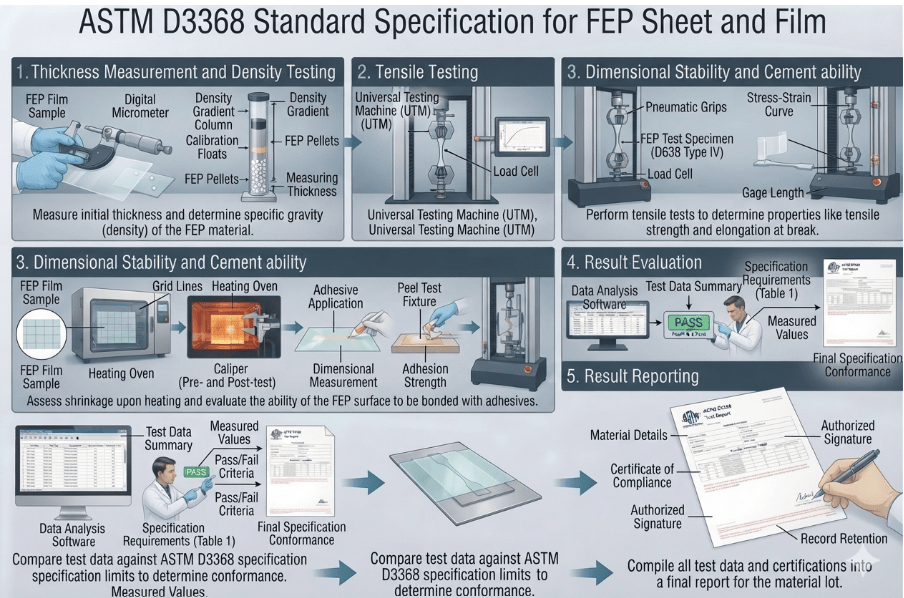
    Testing Procedures and Requirements for ASTM D3368 

    ASTM D3368 assesses the properties of FEP sheet and film individually. Laboratories condition specimens as necessary and conduct the appropriate tests under laboratory conditions. The standard specifies 23 ± 2°C as the standard laboratory temperature unless another condition applies. Other reference ASTM documents include D149, D374, D618, D638, D792, D882, D883, D2116, D3892, D5740, and E691. The procedure of ASTM D3368 is given as:

    Read more

    Thickness Measurement and Density TestingTechnicians measure sheet or film thickness and compare it with the applicable nominal value. value. Thickness and tolerance requirements and specific gravity are determined.
    Tensile TestingThe analyst tests the thin film and the thicker sheet using the specified microtensile specimen configuration.
    Dimensional Stability and CementabilityTechnicians measure dimensional change after heating according to the specified procedure and evaluate peel strength for applicable cementable Type II material.
    Result EvaluationAnalysts compare measured properties with the requirements for the specified FEP type, grade, thickness, and class.


    ASTM D3368 Testing Process and Data Collection 

    Technicians first determine the FEP type, grade, nominal thickness, and applicable requirements. Then, technicians take representative samples and cut out portions that have visible flaws. They measure thickness and prepare specimens for the required mechanical, dimensional, electrical, and physical tests. Analysts condition specimens when required and perform testing at the specified laboratory conditions. They document tensile strength, elongation, dimensional change, cementability, dielectric strength, density, and thickness (where applicable). Finally, laboratories compare the measured values with the requirements for the specified material type and thickness.

    This image shows a universal testing machine used to determine FEP sheet and film as per ASTM D3368.
    ASTM D3368 Testing Using Universal Testing Machine  

    Common Challenges and Troubleshooting 

    Accurate ASTM D3368 results rely on representative sampling, preparation, accurate thickness measurement, and test equipment. Common challenges include selecting the wrong FEP type or grade, measuring thickness inaccurately, cutting specimens from defective areas, using incorrect specimen geometry, inadequate conditioning, improper tensile-test setup, and inconsistent heating conditions. Before testing, technicians should confirm the material code, specimen thickness, equipment condition, and applicable test procedure.

    ASTM D3368 Analysis Results and Interpretation 

    • ASTM D3368 results are reported by type, grade, nominal thickness, applicable property, and test procedure. 
    • The specification includes tensile strength, elongation at break, dimensional change on heating, cementability, dielectric strength, density, and thickness.
    • Engineers report tensile strength (MPa), elongation at break (%), dimensional change on heating (%), cementability/peel strength (N/m), dielectric strength (kV/mm), density (g/cm³), and thickness (mm).

    Link to ASTM D3368

    Read more

    FAQ

    What is ASTM D3368?
    ASTM D3368 is a specification for unfilled, unpigmented FEP resin sheet and film below 3.175 mm in thickness.
    The specification tests for tensile strength, elongation, change on heating, cementability, dielectric strength, density, and thickness.
    It includes Type I general-purpose film, Type II cementable film, Type III film for demanding flexural and thermal/chemical service, and Type IV mold-release film.

    Updated on September 7, 2026

    Suyog Kamble
    About Author
    Suyog Kamble is an Operations Associate at Matestlab Inc. Suyog holds a postgraduate degree in organic chemistry and is trained in material science topics.
    Know More
    Testimonials
    Real results
    Engineers trust us with what matters most
    Start Your Testing
    Project Today
    Define your requirements and get access to
    specialized laboratories ready to deliver results
    Partners with us
    Clients
    Vendors
    Process for testing
    • STEP 01

      You share your testing requirements

    • STEP 02

      You share your sample(s)

    • STEP 03

      We deliver your test reports

    Get your testing done

    Let us know your testing requirements and we will be right back with a solution.

      Let us root for each other. Collaborate to grow, expand, and accelerate our businesses.

      Partner with us

        Discover more from Matestlab

        Subscribe now to keep reading and get access to the full archive.

        Continue reading