
ASTM D2513 Standard Specification for Polyethylene (PE) Gas Pressure Pipe, Tubing, and Fittings

    What is ASTM D2513?

    ASTM D2513 is a standard specification for direct-buried and relined plastic pipes, tubing, and fittings for distributing natural gas in fuel gas mains and services, including requirements and test methods. ASTM D2513 (Standard Specification for Polyethylene (PE) Gas Pressure Pipe, Tubing, and Fittings) specifies the requirements for the transmission and distribution of natural gas and also covers the requirements for qualifying polyethylene systems for use with liquefied petroleum gas. The plastic used to make the pipes and fittings is virgin plastic or reworked plastic having a Plastics Pipe Institute long-term hydrostatic design stress and hydrostatic design basis rating. IPS pipe and CTS pipe are both OD-controlled pipes suitable for heat and electrofusion fittings and other suitable joining techniques.

    Read more

    Get Certified ASTM D2513 for Reliable Natural Gas Pipeline Performance 

    Polyethylene gas pressure pipe, tubing, and fittings are vital to natural gas delivery and essential to public safety, as consistent material quality and joint integrity are directly connected to public safety. When tested to this specification, PE pipe, tubing, or fitting products meet the hydrostatic burst strength, chemical, and impact resistance requirements for direct burial and reliner applications. Manufacturers use accredited laboratory testing to support certification, verify compliance with NSF/ANSI 14, and maintain in-house pipe quality control for utility applications. The Natural Gas and Pipe industry uses certified ASTM D2513 testing to ensure the material meets the qualifications needed for safe, reliable gas distribution systems. 

    What is the Scope of ASTM D2513 Standard?

    ASTM D2513 specifies material dimensions and tolerances, hydrostatic burst strength, chemical resistance, and rapid crack resistance of polyethylene pipe, tubing, and fittings used in direct-buried and reliner fuel gas pipelines. This specification applies to natural gas transmission and distribution, includes qualifications for liquefied petroleum gas systems, and is not intended to cover threaded pipe. The scope of ASTM D2513 includes: 

    • Material type: Reworked polyethylene plastic having a known Plastics Pipe Institute long-term hydrostatic design stress and hydrostatic design basis rating. 
    • Purpose: Establishment of material, dimensional, and performance requirements for PE gas pipe, tubing, and fittings. 
    • Properties measured: Hydrostatic burst strength, tensile strength, chemical resistance, sustained pressure resistance, heat fusion quality, and impact resistance. 
    • Method: Standardized test methods applied to material dimensions and tolerances, along with performance testing under the specification’s annexes. 
    • Result: Pipe, Tubing, and Fittings that meet dimensional and performance specifications for pressure rating and application. 
    • Test Limitations: This specification does not apply to threaded pipe. 
    • Environmental conditions: Performance verification requirements vary based on environmental conditions such as Standard Dimension Ratio (SDR), joining process (heat fusion or electrofusion), and the application (burial or reliner). 
    • Applications: Natural gas mains and gas services, direct burial gas pipelines, gas main reliner installations, and liquefied petroleum gas piping systems.

    What are the Uses of ASTM D2513?

    ASTM D2513 is used to help manufacturers and utilities ensure that PE gas pressure pipe, tubing, and fittings satisfy material and performance requirements to provide natural gas service. Utility engineers and pipe manufacturers use the results to verify product suitability before installation.  This standard- 

    • Tests hydrostatic burst strength of pipe, tubing, and fittings for sustained and short-term pressure.
    • Ensures resistance to chemicals appropriate for natural gas and liquefied petroleum gas use.
    • Evaluates quick crack and impact resistance properties for direct burial use.
    • Supports verification of the quality of heat fusion and electrofusion joints.
    • Helps to qualify PE systems for LPG use.
    • Establishes a common foundation for compliance with NSF/ANSI 14 for gas distribution piping. 

    What Materials Are Covered Under ASTM D2513? 

    ASTM D2513 is for virgin or reworked polyethylene plastic pipe, tubing, and fittings for fuel gas mains and services with the required Plastics Pipe Institute long-term hydrostatic design stress and design basis rating. The specification covers both IPS and CTS pipe as OD-controlled products that manufacturers produce for use with heat and electrofusion fittings. These pipes typically come in SDR configurations such as SDR-11, SDR-10, SDR-11.5, and SDR-7. 

    Why is ASTM D2513 Important? 

    ASTM D2513 establishes a standardized specification for polyethylene gas pressure pipe, tubing, and fittings that are key to the safe transmission and distribution of natural gas. Since they are laid directly in the ground or installed as pipeline reliners, they need to be able to perform over decades of service without failure in the face of decades of hydrostatic pressure, rapid crack propagation, and chemical exposure. Plastic materials must meet the Plastics Pipe Institute’s long-term hydrostatic design stress and hydrostatic design basis ratings to provide confidence that they perform predictably over time under the conditions found in gas distribution systems. Natural gas utilities and pipe manufacturers use this standard to maintain consistent product quality and meet the maximum working pressure requirements specified in U.S. DOT CFR 49, Part 192.121.

    ASTM D2513 Equipment and Sample Preparation Guide

    ASTM D2513 requires hydrostatic pressure testing equipment, impact testing equipment, and chemical resistance testing setups suitable for the material and performance requirements. Technicians select representative production samples of pipe, tube, and/or fittings for compliance verification. 

    Read more

    Sample and Specimen DetailsRepresentative polyethylene pipe, tubing, and fitting samples manufactured from virgin or reworked plastic with an established hydrostatic design basis rating.
    Specimen PreparationTechnicians select samples according to the pipe’s SDR classification, IPS or CTS sizing, and intended joining method, heat fusion or electrofusion.
    Specimen DimensionsTechnicians select pipe or tubing sized by nominal diameter and standard dimension ratio (SDR), spanning roughly ½ in. to 24 in. — e.g., IPS SDR-11 (1 in. OD 1.315 in./wall 0.120 in.) or CTS SDR-11.5 (1 in. OD 0.625 in./wall varies by class). Wall thickness is set by the applicable SDR class per the specification’s dimensional tables. 
    InstrumentationHydrostatic burst and sustained pressure testing apparatus, tensile testing equipment, impact testing apparatus, and chemical resistance testing setup.

    Testing Procedures and Requirements for ASTM  D2513

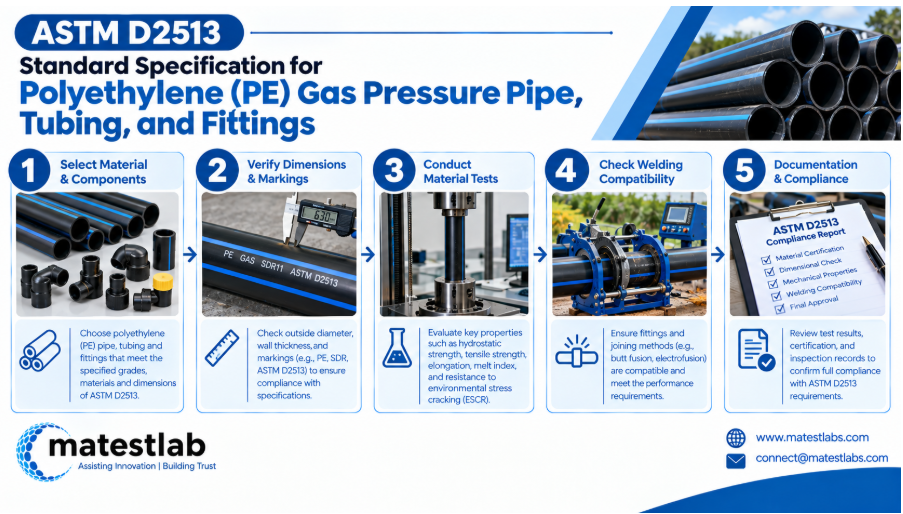
    ASTM D2513 testing is used to verify PE gas pressure pipe, tubing, and fittings to meet the required material dimensions, hydrostatic burst strength, and performance criteria for natural gas service. Laboratories conduct testing on representative samples that are selected depending on the type of material and the relevant annex. 

    Read more

    The other referenced ASTM standards include ASTM D1600, F412, D638, D1238, D1598, D1599, D2122, D2290, D2837, F1473, D543, D618, D1898, D2657, and D2774.

    Dimensional Verification Technicians measure pipe, tubing, or fitting dimensions against the tolerances specified for the applicable SDR classification and sizing system.
    Hydrostatic Burst Testing Technicians pressurize the specimen to determine hydrostatic burst strength under short-term loading.
    Sustained Pressure Testing Technicians subject the specimen to sustained internal pressure over an extended period to verify long-term performance.
    Impact and Rapid Crack Resistance Testing Technicians perform impact testing and rapid crack resistance evaluation appropriate to direct burial service conditions.
    Heat Fusion Verification Technicians verify heat fusion or electrofusion joint quality where the fitting or pipe involves a fused connection.

    ASTM D2513 Testing Process and Data Collection

    The verification process starts with ensuring that the polyethylene material from which the product is made has a known long-term hydrostatic design stress and hydrostatic design basis rating from the Plastics Pipe Institute. For pipe, tubing, and fittings, technicians take measurements of the parts and compare them to the tolerances given in the applicable SDR classification; they then pressurize representative samples to measure the hydrostatic burst strength. The operator applies sustained pressure to the samples for a long time to ensure long-term performance, and conducts impact and rapid crack resistance tests according to direct burial applications. Technicians also verify heat fusion or electrofusion joint quality for fittings and pipe involving fused connections. Laboratories collect this information to support pipe manufacturer certification, NSF/ANSI 14 compliance, and utility quality management programs.

     The image shows a polyethylene gas pipe specimen undergoing hydrostatic burst pressure testing as per ASTM D2513
    ASTM D2513 Hydrostatic Burst Testing of Polyethylene Gas Pipe

    Common Challenges and Troubleshooting

    Common ASTM D2513 verification issues include inconsistent material-rating documentation, heat-fusion procedure issues, and size variations between SDR classifications. These issues threaten the integrity of a gas pipeline and affect acceptance of the pipeline. Poor documentation of the rating of a material’s hydrostatic design basis from the Plastics Pipe Institute can result in the use of a material that is not qualified for the pressure service. A heat fusion or electrofusion technique that isn’t properly executed results in joints that are weaker or have increased potential for leakage, compromising pipeline integrity. Installation and compatibility problems result from differences in sizing systems (IPS vs CTS) or incorrect SDR classification. Proper material rating verification, trained fusion technicians, and careful dimensional confirmation minimize these issues. Experienced technicians use standard procedures and calibrated testing equipment to produce reliable results. 

    ASTM D2513 Results and Interpretation

    The report provides a summary of the material qualification, dimensional compliance, and performance test results of the PE pipe, tubing, or fitting tested. These results are compared with the requirements outlined in the relevant annex and SDR classification. 

    Read more

    • The laboratory provides the material’s long-term hydrostatic design stress and hydrostatic design basis rating as reported by the Plastics Pipe Institute.
    • The Laboratory provides hydrostatic burst strength and sustained pressure test results, which meet the prescribed minimum requirements.
    • The laboratory documents the applicable SDR classification and the IPS or CTS sizing system.
    • Results are in line with direct burial or reline impact and rapid crack resistance.
    • The laboratory documents the quality of the heat-fusion or electrofusion joints when applicable. 
    • Laboratories use consistent sampling and testing methods to yield accurate and uniform results from production lots.
    • Test results provide certification and NSF/ANSI 14 compliance for natural gas distribution applications. 

    Link to ASTM D2513 

    FAQ

    Is threaded pipe covered by ASTM D2513?
    No. This specification does not apply to threaded pipe; it applies to polyethylene pipe, tubing, and fittings used for heat fusion or electrofusion joinable pipe connections.
    The pipe and fittings specified herein are designed for use in the transmission and distribution of natural gas, and the criteria for qualifying PE systems for use in Liquefied Petroleum Gas are also covered.
    The plastic used to make the pipes and fittings shall be virgin plastic or reworked plastic having a Plastics Pipe Institute long-term hydrostatic design stress and hydrostatic design basis rating.
    ASTM D2513 pipe is offered in Iron Pipe Size (IPS) and Copper Tube Size (CTS), and both are OD-controlled pipes for use with heat and electrofusion fittings.

    Updated on October 5, 2026

    Divakar Shukla
    About Author
    Divakar Shukla is an Electrical and Electronics Engineer specializing in the convergence of embedded systems architecture, industrial automation, and applied artificial intelligence.
    Know More
    Testimonials
    Real results
    Engineers trust us with what matters most
    Why Choose Matestlab?
    Matestlab is a unified testing services partner based in the USA. Matestlab offers raw material and product testing services through accredited, expert laboratories primarily based in the USA. Matestlab supports physical, thermal, chemical, electrical, mechanical, environmental, and characterization testing needs through its global network of 2200+ accredited testing laboratories. Matestlab's in-house materials science experts curate and design comprehensive testing programs matched to the sample material and specific testing need, with regulatory requirements and confidentiality in mind.

    If you are looking for a managed and trusted testing partner to achieve your research goals, feel free to schedule a meeting with us or send us a request at connect@matestlabs.com to learn more about our services. For a quick quote, call us at (302)244-7710. We are happy to serve you.
    Start Your Testing
    Project Today
    Define your requirements and get access to
    specialized laboratories ready to deliver results
    Partners with us
    Clients
    Vendors
    Process for testing
    • STEP 01

      You share your testing requirements

    • STEP 02

      You share your sample(s)

    • STEP 03

      We deliver your test reports

    Get your testing done

    Let us know your testing requirements and we will be right back with a solution.

      Let us root for each other. Collaborate to grow, expand, and accelerate our businesses.

      Partner with us