
ASTM D1599 is a standard test method for determining the resistance of plastic pipe, tubing, and fittings to short-term hydraulic pressure. This method is applicable to thermoplastic pipe, reinforced thermosetting resin (RTR) pipe, and reinforced thermoplastic pipe (RTP). Laboratories place a specimen in water and gradually raise the internal pressure until the specimen fails, usually in 60 to 70 seconds. ASTM D1599 (Standard Test Method for Resistance to Short-Time Hydraulic Pressure of Plastic Pipe, Tubing, and Fittings) has two procedures: Procedure A to determine burst pressure based on mode of failure and Procedure B to determine whether a specimen meets a minimum burst requirement. The standard provides the quality control and procurement requirements for pipes in water supply, drainage, and irrigation applications, but does not indicate long-term strength.
ASTM D1599 Resistance of Short-Time Hydraulic Pressure of Plastic Pipe, Tubing, and Fittings
What is ASTM D1599?
What is the Scope of ASTM D1599?
ASTM D1599 is a standard test method for determining resistance to short-time hydraulic pressure for thermoplastic pipe, tubing, and fittings, reinforced thermosetting resin pipe, and reinforced thermoplastic pipe. It measures the amount of pressure that is needed to cause the cylinder to fail, as well as the nature of the failure, under a controlled, steady increase in pressure from the inside.
This standard offers a standard test method to verify that plastic piping products have minimum burst requirements, or to describe failure of the specimen during short-term pressure. ASTM D1599’s primary purpose is to provide a short-term hydraulic failure pressure for the purposes of quality control and procurement in the laboratory. This test is performed for qualification of product, pressure rating validation, and quality assurance in industries.
The scope of ASTM D3354 includes
- Material type: Thermoplastic pipe, tubing and fittings; reinforced thermosetting resin pipe; reinforced thermoplastic pipe.
- Purpose: Any sample of the fluid that satisfies the test requirements.Test Method: Hydraulic burst pressure test.
- Property measured: The hydraulic pressure required to cause failure in a relatively short period of time – 60 to 70 seconds.
- Method: Fill and seal a specimen with water, then apply steadily increasing internal hydrostatic pressure using Procedure A (failure mode determination) or Procedure B (minimum burst compliance).
- Result: Burst pressure is reported, and the mode of failure (when using Procedure A) is observed.
- Limitations: Tests give information on short-term behavior only and cannot be relied upon for long-term strength under sustained pressure.
- Environmental conditions: The test can be conducted at ambient or elevated temperature – as required by material or applicable product standards.
- Applications: Water supply, drainage and irrigation piped systems, quality control pipe and fitting production, for example, pipe and fitting procurement specification compliance.
What are the Uses of ASTM D1599 Testing?
ASTM D1599 testing ensures that plastic pipe, tubing, and fittings withstand the pressure they are rated for under controlled, short-term conditions. Also, the two-procedure structure allows laboratories the flexibility of performing a failure mode characterization or just compliance. This standard is used in plumbing, oil/gas, water treatment, and manufacturing industries to ensure high-pressure performance. This standard –
- Helps maintain the quality of plastic pipe and fitting manufacturing.
- Supports manufacturers in validating burst pressure to procurement specifications.
- Determines if a specimen has a minimum burst pressure (Procedure B).
- Assists in describing the mode of failure if necessary (Procedure A).
- Supplies documented pressure-rating qualification for plumbing, oil and gas, and water treatment.
What Materials Can Be Tested Under ASTM D1599?
ASTM D1599 applies to thermoplastic pipe, tubing, and fittings, as well as reinforced thermosetting resin pipe and reinforced thermoplastic pipe. Thermoplastics like PVC, HDPE, PEX, and CPVC, and thermosetting composites like epoxy and polyester are among the materials typically tested for their ability to withstand sudden bursts of pressure in the lab. Reinforced thermoplastic pipe is especially designed with a three-layer structure: a helical reinforcement layer to support the hoop stress and a thermoplastic cover layer to protect the pipe.
Why is ASTM D1599 Important?
ASTM D1599 provides a method for manufacturers to ensure plastic piping products can resist short-term hydraulic pressure until installation. The test ensures products have burst resistance under controlled conditions to avoid costly field failures in water supply, drainage, irrigation, or industrial fluid systems. There are also related long-term performance tests such as ASTM D2837, which establishes the hydrostatic design basis of thermoplastic pipe materials, based on similar principles. ASTM D1599 testing contributes to product reliability and safety in critical applications by supporting failure-mode characterization, minimum-requirement validation, and industry regulatory compliance.
ASTM D1599 Equipment and Sample Preparation Guide
ASTM D1599 requires hydraulic pressure testing equipment capable of applying controlled internal pressure to pipe, tubing, and fitting specimens. Technicians prepare representative specimens and seal them before pressurization. The equipment includes a pressure vessel, calibrated pressure gauge, pressurization pump, and temperature control equipment where required. The table below enlists the equipment used in this test.
| Sample and Specimen Details | Laboratories test sections of thermoplastic or reinforced pipe, tubing, or assembled fittings selected to represent the production batch or procurement specification. |
| Specimen Preparation | Technicians clean the specimen, fill it with water, and seal both ends before pressurization, ensuring no trapped air interferes with the pressure buildup. |
| Specimen Dimensions | Specimen length and diameter depend on the pipe, tubing, or fitting size specified by the relevant product standard or procurement requirement. |
| Instrumentation | The test uses a pressure vessel or test chamber, a calibrated pressure gauge, a pump capable of precise and rapid pressure increase, and temperature control equipment where required. |
Testing Procedures and Requirements for ASTM D1599
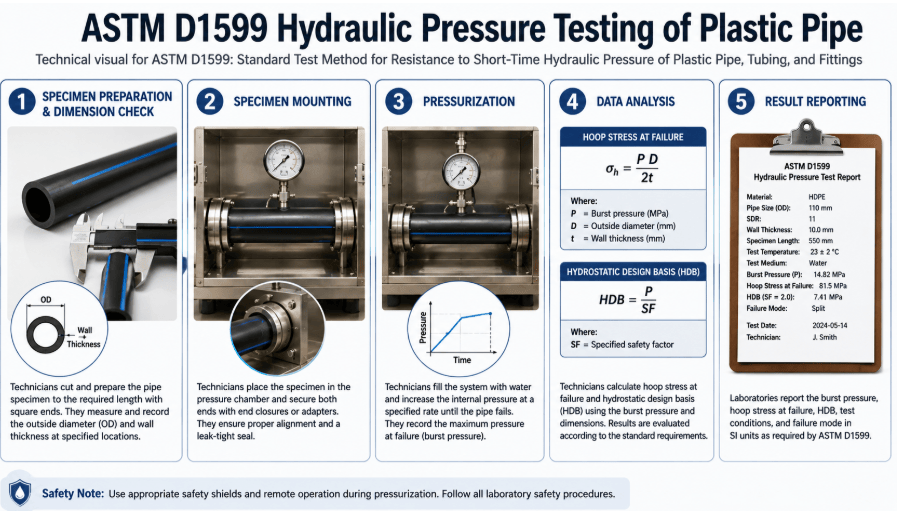
The technician fills the sealed specimen with water and installs it in the hydraulic testing apparatus. A pump is then used to raise the internal hydraulic pressure at a controlled, slow rate, keeping this pressure constant for the desired time until the specimen fails or reaches the desired pressure. Technicians record the burst pressure and failure mode, or they determine that it has survived the prescribed minimum pressure and disassemble it to check it for leakage or indications of failure after it has been held at that pressure.
| Specimen Filling and Sealing | Technicians fill the pipe, tubing, or fitting specimen with water and seal both ends to prepare it for pressurization. |
| Pressure Application | A pump increases internal hydraulic pressure at a steady, controlled, gradual rate. |
| Procedure A (Failure Mode) | Technicians pressurize the specimen to failure and record the burst pressure along with the mode of failure. |
| Procedure B (Minimum Requirement) | Technicians pressurize the specimen to a predetermined minimum pressure to confirm compliance. |
| Post-Pressure Evaluation | Once pressure is released, technicians inspect the specimen for leakage, failure, or damage. |
ASTM D1599 Testing Process and Data Collection
The first step analysts take is to determine which procedure fits the failure mode or meets minimum requirements. Technicians then fill and seal a pipe, tubing, or fitting sample with water and place it in the test chamber. The calibrated gauge then records the rise in pressure as the pressure increases at a controlled and gradual rate through the pump, and the pressure is held for the set amount of time. Finally, technicians vent the pressure, check the specimen for any leaks or damage, and document the burst pressure, failure time, and failure mode, if applicable, in a detailed report.
Common Challenges and Troubleshooting
One common problem with ASTM D1599 testing is the inability to apply a consistent pressure, as varying pressurization rates will result in inaccurate burst-pressure readings. Leakage at fittings or end seals is also a challenge for technicians during testing, as well as being able to accurately identifying where leakage is occurring. Additionally, if there is pressure instability from trapped air within the specimen, this will result in inaccurate pressure readings. The answer is to carefully calibrate the equipment, seal connections tightly, and prepare specimens in the same manner to eliminate variables that can influence results.
ASTM D1599 Analysis Results and Interpretation
The report summarizes the burst pressure, failure time, and failure mode of the tested specimen under short-term hydraulic pressure. The interpretation compares these measured values against specification requirements or performance benchmarks. Quality control professionals use these results to verify material compliance and ensure product performance.
- The laboratory reports the burst pressure that occurs at or just before the specimen bursts.
- Failure typically occurs in 60 to 70 seconds.
- The specimen withstands the predetermined minimum pressure and passes Procedure B.
- Results indicate short-term strength, as compared to long-term results per ASTM D2837.
- The laboratory documents testing conditions and specimen information.
- Consistent specimen preparation, proper calibration, and controlled pressurization help laboratories produce reliable results.
Get Certified ASTM D1599 Testing for Reliable Burst Strength Analysis
A certified ASTM D1599 test certifies that plastic piping products are able to endure the applied pressure over a specified period of time within a controlled and repeatable period of time. This in turn means that manufacturers minimize the risk of field failures and facilitate compliance with procurement specifications.
FAQ
Updated on September 14, 2026


If you are looking for a managed and trusted testing partner to achieve your research goals, feel free to schedule a meeting with us or send us a request at connect@matestlabs.com to learn more about our services. For a quick quote, call us at (302)244-7710. We are happy to serve you.
Project Today
specialized laboratories ready to deliver results