By content81c70d6e36 | Last updated 6th February 2026

Density of PVC Plastics Material: Technical Properties Table

Plastic material density is the amount of mass per unit volume of the material, usually in grams per cubic centimeter (g/cm3) or kilograms per cubic meter (kg/m3). Polyvinyl chloride is widely used in construction, electrical, packaging, and medical sectors due to its balanced mechanical and physical properties. The most important parameter to consider when determining PVC performance, processing behavior, and end-use appropriateness is density. Knowledge of PVC density in comparison to other technical properties assists in enabling the engineers and manufacturers to determine the right grade to use in particular use at the lowest cost and reliability of the product.

Read More

GET STARTED

    Share your requirements *

    Provide your contact information *

    Introduction

    Several formulations of PVC plastics exist, and their differences are vastly different in structure and performance. The density is significant in the strength, rigidity, weight, and duration of PVC products. The differences in additives, plasticizers, and fillers have a direct influence on density and the general material behavior. Density data is used by the engineers to estimate the mechanical response, to optimize a design, and to meet the demands of the application. Sound interpretation of density in combination with technical properties helps to make sound material choices in the industry and commerce. ASTM D792 provides the methods for determining the density of polyvinyl chloride (PVC) materials. 

    Learning the Density of PVC Plastics

    PVC has a density that will be between1.30 and 1.45 g/cm3 when not plasticized, and between 1.30 and 1.24 g/cm3 when plasticized. Rigid PVC (also referred to as uPVC) has a higher density because of its non-use of plasticizers and highly packed molecular structure. Slightly lower density of flexible PVC occurs due to the fact that plasticizers enhance the mobility of the chains and slow down the intermolecular forces. Additives like stabilizers, pigments, and fillers also affect values of density, and hence the control of formulation becomes crucial during the manufacturing process.

    Influencing Factors of PVC Density

    The density of PVC is dependent on the formulation composition and processing. The density is lowered, and flexibility is enhanced by plasticizer contents. Free-flowing fillers such as calcium carbonate add rigidity and density. It is also influenced by the degree of polymerization and the quality of compounds used in the material, which influences the mass distribution. Extrusion or molding temperature and pressure affect the final density by changing the molecular packing and void creation. The manufacturers take these factors into careful consideration in order to achieve product performance goals.

    Technical Properties Table of PVC Plastics

    PropertyValue RangeInfluence of Density
    Density1.30 to 1.45 g/cm³Determines weight and rigidity
    Tensile Strength40 to 60 MPaHigher density improves strength
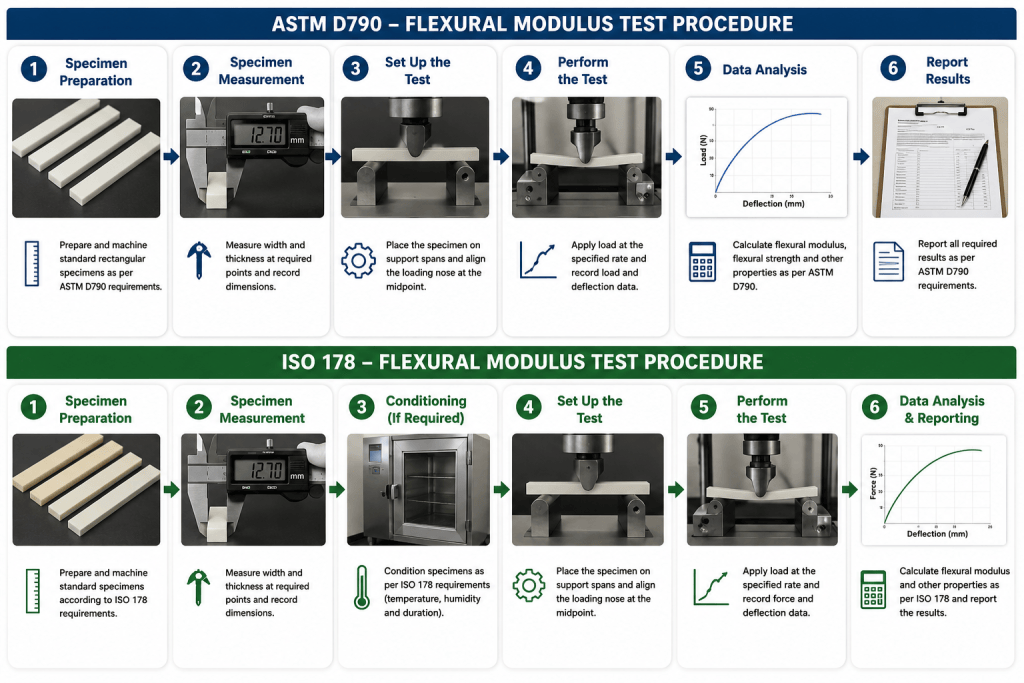
    Flexural Modulus2.5 to 4.0 GPaIncreases with rigid formulations
    Impact ResistanceModerate to highLower density improves toughness
    Thermal Conductivity0.14 to 0.19 W/m ·KSlight variation with density
    Water AbsorptionLess than 0.5 percentMinimal effect from density

    Industrial Significance of Density Data

    Density data is used to aid in the choice of material to use in pipes and profiles, cables, and sheets. Light PVC saves on transportation as it does not compromise the structural integrity. Increased density grades are appropriate in load bearing and pressure. Regular density guarantees the same quality of the products and uninterrupted performance under the service conditions. One parameter of quality control used by manufacturers to ensure consistency in the batches is density.


    FAQ's

    Where can I get the density of pvc plastics material tested?

    You can share your density of pvc plastics material testing requirements with MaTestLab. MaTestLab has a vast network of material testing laboratories, spread across the USA and Canada. We support your all material testing needs ranging from specific density of pvc plastics material test to various testing techniques.

    How much do I need to pay for the density of pvc plastics material test?

    Please contact us for a detailed quote for your density of pvc plastics material testing needs. Cost incurred to carry out different density of pvc plastics material testing methodology depends on the type of raw material; number of samples, coupons, or specimens; test conditions, turn around time etc. Costs of some ASTM testing methods start from $100 and the final value depends upon the factors listed above. Please contact us for the best and latest prices.

    How many samples are required for density of pvc plastics material?

    The required number of samples or specimens should comply with the procedure given in the density of pvc plastics material standard. However, the MaTestLab operations team can assist you for your special requirements once you share your testing details with us.

    How much discount can I get on the density of pvc plastics material test?

    MaTestLab has a vast testing laboratory network, hence we bring you the best testing facilities in a cost-effective way. We offer considerable discounts (15-20%) to our returning customers based on test volume and frequency.

    How many days will it take to complete the density of pvc plastics material test?

    The turnaround time for density of pvc plastics material test methodology depends upon the test procedure mentioned in the standard test document. However, we at MaTestLab understand your research requirements and hence try to get your test completed within the least possible time.

    Where can I get the density of pvc plastics material tested?

    You can share your density of pvc plastics material testing requirements with MaTestLab. MaTestLab has a vast network of material testing laboratories, spread across the USA and Canada. We support your all material testing needs ranging from specific density of pvc plastics material test to various testing techniques.

    POPULAR TESTS
    ONE-STOP FOR ALL
    MATERIAL TESTING NEEDS
    MaTestLab Inc. offers accessible, quick, and affordable material testing, product testing, and failure analysis services. We support your on-demand testing and expert consultation needs with the help of our extensive network of material testing laboratories situated in the US and other parts of the world.
    MATERIAL TESTING
    We offer destructive and non-destructive tests over a range of mechanical, electrical, chemical, thermal, optical, corrosion, radiation, and biological testing methodologies defined by ASTM, ISO and other organizations.
    PRODUCT TESTING
    We help you evaluate and ensure your product quality and performance with standard and custom-made testing solutions. All the tests are done at well-equipped testing laboratories using standard testing methods for best output and satisfaction.
    FAILURE ANALYSIS
    Failure analysis ensures high levels of quality in every manufacturing process. We help you with getting the best failure or root cause analysis to determine the cause of the failure. The results help you identify means to prevent failure recurrences.
    Process for testing
    • STEP 01

      You share your testing requirements

    • STEP 02

      You share your sample(s)

    • STEP 03

      We deliver your test reports

    Get your testing done

    Let us known your testing requirements and we will be right back with a solution.

      Let us root for each other. Collaborate to grow, expand, and accelerate our businesses.

      Partner with us

        close

        Please share your requirement with us

          ×

          Contact Us