ASTM D1636 Standard Specification for Allyl Molding Compounds

    What is ASTM D1636?

    ASTM D1636 is a standard specification for compression-molded, thermosetting allyl compounds. In the specification, there are three main types classified based on the type of filler used in the compound: Type I for high-strength, glass-fiber-reinforced materials, Type II for general-purpose mineral-filled materials, and Type III for general-purpose synthetic-fiber-filled materials. Types I and II also include Classes A, B, C, and D based on resin composition and flame-retardant characteristics. The specification uses diallyl ortho-phthalate and diallyl meta-phthalate resins as the major resin components. Manufacturers can use these classifications to select and identify suitable molding compounds for specific applications.

    Read more

    Get Certified ASTM D1636 Testing for Reliable Allyl Molding Compounds

    For reliable molded products, allyl molding compounds require consistent composition and controlled performance. ASTM D1636 (Standard Specification for Allyl Molding Compounds) helps manufacturers evaluate the properties that identify different grades of these thermosetting materials. Lab testing can help qualify materials, monitor material quality, and assist in product development.

    What is the scope of ASTM D1636?

    ASTM D1636 covers the properties of compression molding thermosetting allyl molding compounds. These compounds are classified by filler type and resin composition, and properties such as impact resistance, dissipation factor, insulation resistance, flexural strength, permittivity, flame resistance, and oxygen index are evaluated. These requirements are used in laboratories to determine material grades and support quality control in allyl molding compounds.

    Read more

    ASTM D1636 defines thermosetting allyl compounds that engineers process through compression molding. The specification defines a classification system primarily based on filler type, resin composition, flame-retardant properties, and grade. This standard-

    • Covers thermosetting allyl compounds compression-molded. Identifies three primary material types. 
    • Includes glass-fiber-reinforced Type I compounds. 
    • Contains mineral-filled Type II compounds. 
    • Includes synthetic-fiber-filled Type III compounds. 
    • Classifies Types I and II into Classes A, B, C, and D. 
    • Establishes requirements for specified mechanical, electrical, flame, and oxygen-index properties. 
    • Uses SI units as the standard measurement system.

    What are the uses of ASTM D1636 testing?

    Innovators use ASTM D1636 to determine allyl molding compounds and identify their required characteristics. This specification helps manufacturers in material selection, production control, product development, and quality assurance. 

    • Identifies allyl molding compounds according to filler and resin type. 
    • Evaluates impact resistance and flexural strength. 
    • Evaluates permittivity and dissipation factors. 
    • Checks insulation resistance, flame resistance, and oxygen index. 
    • Supports material qualification and quality control.

    Which Types of Allyl Molding Compounds Does ASTM D1636 Cover? 

    The specification identifies three main types based on the general filler used in manufacturing. Type I uses glass fiber for high-strength applications, Type II uses mineral fillers for general-purpose applications, and Type III uses synthetic fiber fillers for general-purpose applications. 

    Types I and II can use four resin-based classes: 

    • Class A: Diallyl ortho-phthalate resin, non-flame-retardant. 
    • Class B: Diallyl ortho-phthalate resin, flame-retardant. 
    • Class C: Diallyl meta-phthalate resin, non-flame-retardant. 
    • Class D: Diallyl meta-phthalate resin, flame-retardant. 

    Type I divides these classes into four grades, while Type II divides each class into two grades. Type III uses Class A compounds in three grades.

    What Properties Does ASTM D1636 Evaluate?

    The specification determines allyl molding compounds through several mechanical, electrical, and combustion-related properties. Manufacturers can compare these properties with the requirements for the applicable material grade.

    • Impact resistance 
    • Flexural strength 
    • Permittivity
    • Dissipation factor 
    • Insulation resistance 
    • Flame resistance 
    • Oxygen index.

    What Materials Can Be Tested Under ASTM D1636?

    ASTM D1636 applies to thermosetting allyl molding compounds that manufacturers use in compression molding. The specification specifies compounds with allyl resins and filler systems that comply with the specified type, class, and grade classification.

    Why is ASTM D1636 Important?

    ASTM D1636 provides a classification and performance system for use with allyl molding compounds. These requirements are then used by engineers to compare grades of materials, monitor production quality and to choose the appropriate compounds according to the mechanical, electrical and flame properties required.

    ASTM D1636 Equipment and Sample Preparation Guide

    Technicians condition and prepare molded parts for testing of needed properties. For mechanical properties, electrical properties, fire resistance and oxygen index, the laboratory should be equipped with suitable equipment.

    Read more

    Sample and Specimen DetailsTechnicians first take representative allyl molding compound material from the production batch.
    Specimen PreparationTechnicians compression-mold the thermosetting compound into specimens and condition the specimens in accordance with the applicable referenced test method.
    Specimen DimensionsThe laboratory uses applicable dimensions based on the property under evaluation and the referenced ASTM test method.
    Instrumentation Compression molding, impact testing, flexural testing, electrical-property measuring, flame-resistance, and oxygen-index testing.

    ASTM D1636 Testing Procedures and Requirements

    ASTM D1636 requires engineers to compression mold, condition, and test allyl molding compounds in accordance with applicable specification requirements. The laboratory evaluates the properties that identify each material type, class, and grade.

    Read more

    Other reference ASTM standards include D150, D229, D256, D257, D618, D790, D2863, and D3892. 

    Material ClassificationThe laboratory identifies the compound based on filler type, resin composition, flame-retardant characteristics, class, and grade.
    Compression MoldingThen they compression-mold the thermosetting allyl compound to prepare test specimens.
    ConditioningThey condition the molded specimens in accordance with the applicable referenced ASTM procedure.
    Mechanical TestingThe laboratory determines impact resistance and flexural strength using the applicable ASTM test methods.
    Electrical TestingTechnicians evaluate permittivity, dissipation factor, and insulation resistance based on applicable procedures.
    Flame and Oxygen TestingLaboratories assess flame resistance and oxygen index using the specified reference methods.

    ASTM D1636 Testing Process and Data Collection

    Technicians first take a representative allyl molding compound and identify its type, class, and grade. Then, analysts compression-mold the compound and condition the specimens following the referenced procedures. The laboratory then conducts the necessary mechanical, electrical, flame, and oxygen-index tests. Laboratories document specimen identification, material classification, conditioning data, test conditions, measurement data, and specification requirements.

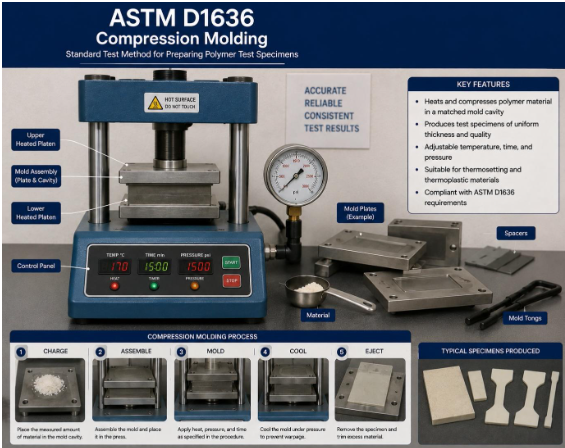
    This image depicts a heated hydraulic compression molding press used to prepare polymer test specimens under controlled heat, pressure, and time according to ASTM D1636.
    ASTM D1636 Heated Hydraulic Compression Molding Press 

    Common Challenges and Troubleshooting

    Variations in compound composition, molding conditions, specimen conditioning, and test equipment can affect test results. Additionally, poor molding conditions can make specimens unrepresentative of the material grade. Technicians should maintain consistent material compositions, ensure equipment is calibrated, and follow applicable conditioning procedures before testing. They should also choose the appropriate reference ASTM method for each required property.

    ASTM D1636 Analysis Results and Interpretation

    • ASTM D1636 uses SI units as the standard measurement system. 
    • Laboratories report each property using the unit specified according to the applicable referenced ASTM test method.
    • Laboratories report impact resistance in J/m, flexural strength in MPa, dissipation factor in %, insulation resistance in Ω, and oxygen index in %. 
    • Then, engineers compare these results with the requirements for the applicable type, class, and grade to determine material conformity.

    Link to ASTM D1636

    Read more

    Updated on August 20, 2026

    Rohit Dhembare
    About Author
    Rohit Dhembare is an Operations Associate at Matestlab Inc., holds a postgraduate degree in Organic Chemistry and is trained in Materials Science testing techniques.
    Know More
    Testimonials
    Real results
    Engineers trust us with what matters most
    Why Choose Matestlab?
    Matestlab is a unified testing services partner based in the USA. Matestlab offers raw material and product testing services through accredited, expert laboratories primarily based in the USA. Matestlab supports physical, thermal, chemical, electrical, mechanical, environmental, and characterization testing needs through its global network of 2200+ accredited testing laboratories. Matestlab's in-house materials science experts curate and design comprehensive testing programs matched to the sample material and specific testing need, with regulatory requirements and confidentiality in mind.

    If you are looking for a managed and trusted testing partner to achieve your research goals, feel free to schedule a meeting with us or send us a request at connect@matestlabs.com to learn more about our services. For a quick quote, call us at (302)244-7710. We are happy to serve you.
    Start Your Testing
    Project Today
    Define your requirements and get access to
    specialized laboratories ready to deliver results
    Partners with us
    Clients
    Vendors
    Process for testing
    • STEP 01

      You share your testing requirements

    • STEP 02

      You share your sample(s)

    • STEP 03

      We deliver your test reports

    Get your testing done

    Let us know your testing requirements and we will be right back with a solution.

      Let us root for each other. Collaborate to grow, expand, and accelerate our businesses.

      Partner with us