ASTM D1593 Standard Specification for Nonrigid Vinyl Chloride Plastic Film and Sheeting
What is ASTM D1593?
ASTM D1593 is a standard practice for nonrigid, unsupported vinyl chloride plastic film and sheeting. The resin portion must contain at least 90 % vinyl chloride, while the remaining portion can contain copolymerized monomers or other resins mechanically blended with poly(vinyl chloride) or its copolymers. The specification covers transparent, translucent, and opaque materials. It also applies to plain, printed, embossed, and otherwise surface-treated film and sheeting. ASTM D1593 specifies three major manufacturing types: calendared, extruded, and cast.
Get Certified ASTM D1593 Testing for Vinyl Chloride Film and Sheeting
Manufacturers need consistent film properties to maintain product quality and performance. ASTM D1593 provides requirements that laboratories can use to evaluate important mechanical, physical, thermal, and appearance-related properties. ASTM D1593 helps engineers to compare production batches, identify material variations, and verify compliance with specified requirements.
What is the scope of ASTM D1593?
ASTM D1593 establishes requirements for non-rigid, unsupported vinyl chloride plastic film and sheeting that contains at least 90% vinyl chloride in the resin portion. The specification covers film from 0.075 to 0.25 mm (3 to 10 mils) thick and sheeting thicker than 0.25 mm. Laboratories use this specification to evaluate tensile strength, elongation at rupture, tear resistance, volatile loss, water extraction, low-temperature impact, burning rate, shrinkage, and color fastness to rubbing.
ASTM D1593 applies to nonrigid, unsupported vinyl chloride plastic film and sheeting containing 90% or more vinyl chloride in the resin. The specification also specifies thickness ranges for film and sheeting.
Covers nonrigid, unsupported vinyl chloride plastic film.
Covers vinyl chloride plastic sheeting.
Requires at least 90 % vinyl chloride in the resin portion.
The film covers from 0.075 to 0.25 mm (3 to 10 mils).
Sheeting covers greater than 0.25 mm in thickness.
Covers transparent, translucent, and opaque materials.
Covers plain, printed, embossed, and surface-treated materials.
Includes calendared, extruded, and cast materials.
What are the uses of ASTM D1593 testing?
ASTM D1593 is used to determine the mechanical and physical properties of vinyl chloride film and sheeting for a manufacturer. The specification establishes quality control and material evaluation across different manufacturing types.
Evaluates tensile strength, elongation, tear resistance, and volatile loss.
Evaluates water extraction behavior and low-temperature impact resistance.
Evaluates burning rate, shrinkage, color fastness to rubbing, and production quality control.
Helps manufacturers compare different vinyl chloride materials.
What Types of Vinyl Chloride Film and Sheeting Does ASTM D1593 Cover?
ASTM D1593 identifies three general-purpose types of vinyl chloride film and sheeting:
Calendered film and sheeting
Extruded film and sheeting
Cast film and sheeting
Manufacturers can produce the covered material as transparent, translucent, or opaque film and sheeting. They can also use plain, printed, embossed, or other surface treatments.
What Materials Can Be Tested Under ASTM D1593?
ASTM D1593 applies to nonrigid, unsupported vinyl chloride plastic film and sheeting with 90% or more vinyl chloride in resin content. The specification applies to film 0.075 to 0.25 mm thick and sheeting thicker than 0.25 mm.
Why is ASTM D1593 Important?
ASTM D1593 provides a uniform method of testing nonrigid vinyl chloride film and sheeting products. The requirements cover several properties that influence material performance during manufacturing and use. Engineers use these results to determine differences in mechanical strength, tear resistance, dimensional stability, chemical properties, low-temperature properties, combustion characteristics, and color retention. Therefore, the specifications assess material selection, production control, and product quality.
ASTM D1593 Equipment and Sample Preparation Guide
ASTM D1593 highlights several property requirements, and laboratories select equipment based on specific evaluation tests. This specification sets out film and sheeting thickness requirements and requires testing for several mechanical and physical properties.
Sample and Specimen Details
Technicians first select representative nonrigid, unsupported vinyl chloride plastic film or sheeting for testing.
Specimen Preparation
The laboratory should prepare specimens based on required tests and maintain required conditions prior to testing.
Specimen Dimensions
Technicians should prepare film thickness between 0.075-0.25 mm (3-10 mils), and sheeting must measure greater than 0.25 mm in thickness.
Instrumentation
Tensile testing equipment, tear-testing equipment, volatile-loss and water-extraction equipment, low-temperature impact equipment, burning-rate equipment, shrinkage measurement equipment, and color-fastness testing equipment, as selected by requirement.
ASTM D1593 Testing Procedures and Requirements
ASTM D1593 evaluates several properties that help manufacturers characterize vinyl chloride film and sheeting. Laboratories should choose the appropriate test procedure based on the property being measured.
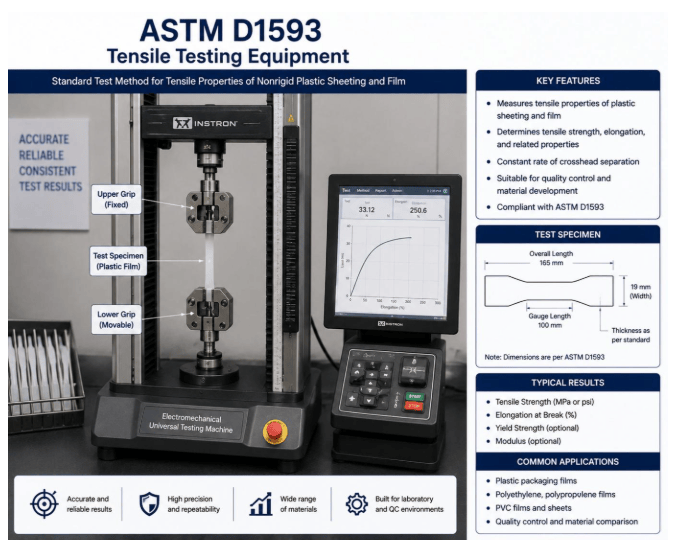
Laboratories evaluate the tensile behavior of the vinyl chloride film or sheeting.
Tear Resistance and Volatile Loss
Technicians determine the material’s resistance to tearing and evaluate material loss under the applicable test conditions.
Water Extraction and Low-Temperature Impact
Technicians determine the material’s behavior after water contact and evaluate its impact behavior at low temperature.
Burning Rate and Shrinkage
Technicians evaluate the material’s burning behavior using the applicable procedure and measure dimensional changes after the specified exposure.
Color Fastness to Rubbing
Laboratories assess color transfer or resistance to rubbing.
ASTM D1593 Testing Process and Data Collection
The analyst first identifies the vinyl chloride film or sheeting type and confirms the film or sheeting’s composition and thickness range. Then, technicians take representative samples for specific property tests. The analyst then carries out mechanical, physical, thermal, and appearance tests as applicable. Next, they measure tensile strength, elongation, tear resistance, volatile loss, water extraction, low-temperature impact, burning rate, shrinkage, and color fastness to rubbing. Lastly, the laboratory compares the measured properties to the relevant ASTM D1593 specifications and documents specimen information, test conditions, measured values, and observations for quality-control purposes.
ASTM D1593 Universal Testing Machine (UTM)
Common Challenges and Troubleshooting
Several factors can influence the results of vinyl chloride film and sheeting tests. Differences in specimen preparation, thickness, conditioning, test equipment, and testing conditions can affect individual property measurements. Technicians should confirm specimen dimensions, select the right test procedure, operate calibrated equipment, and follow the applicable requirements for each property. Laboratories should also record the material type and relevant specimen characteristics to ensure consistent comparisons.
ASTM D1593 Analysis Results and Interpretation
Laboratories report ASTM D1593 results in SI units.
The specification assesses several properties of nonrigid vinyl chloride plastic film and sheeting, including tensile strength, elongation at rupture, tear resistance, volatile loss, water extraction, low-temperature impact, burning rate, shrinkage, and color fastness to rubbing.
Laboratories report film thickness (mm), tensile strength (MPa), elongation at rupture (%), volatile loss (%), shrinkage (%), and color fastness based on the rub fastness procedure used.
Malhar Khole is a Material Testing Associate at Matestlab Inc. and holds a postgraduate degree in Material Science and Technology from IIT (BHU), Varanasi. Know More
Testimonials
Real results
Engineers trust us with what matters most
“We had a great experience working with this company for our ASTM E84 testing. They were the first company to respond to our inquiry within just a few minutes of submitting it. From start to finish, the communication was excellent, and the entire process was swift, straightforward, and hassle-free.”
Ivars FancyWalls
United States
“Very good communication, testing associates were very patient with delays on our end. Reasonable turnaround time for results and nicely detailed report. Analysts were also quick to answer any follow-up questions. Happy with results.”
Skye Henderson
United States
“Matestlab connected us with an accredited lab within days, cutting weeks off our product validation timeline.”
Rebecca Kozodoy-Pins
United States
Start Your Testing Project Today
Define your requirements and get access to specialized laboratories ready to deliver results