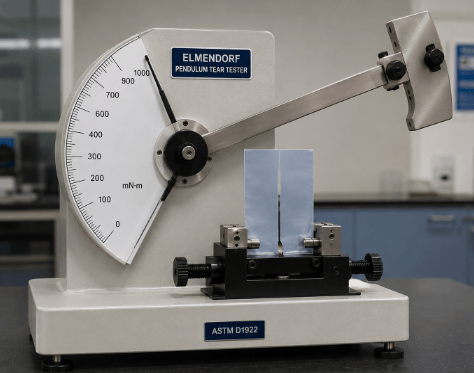
ASTM D1922 is the standard for measuring the propagation tear resistance of plastic films and thin sheeting by the pendulum method. The ASTM D1922 test method-
- Measures the tear resistance of plastic films.
- Calculates the tear propagation energy by the pendulum method.
- It can be applied to all processed plastic films and thin sheeting.
- Assists with the development and quality control of products.
- Provides a standard tear-resistance measurement for laboratory comparison.
- These are used for testing packaging, industrial films, and flexible materials.
What are the Uses of ASTM D1922 Testing?
This standard helps manufacturers determine the tear resistance expected from flexible materials and whether they are suitable for applications subject to accidental tearing. The results support product development, material selection, quality assurance, and specification compliance.
- It is used to assess the tearing strength of plastic films, food packaging, shopping bags and flexible pouches to ensure they can withstand movement in the warehouse, during transport and when used by consumers. Tear resistance provides better package integrity and reduces loss of product.
- Agricultural film manufacturers test greenhouse covers, mulch films, and silage wraps for suitability to withstand stresses during installation, as well as environmental exposure.
- The standard is used to test the durability of medical packaging during transport and, when necessary, to test the opening characteristics of medical packaging.
- Industrial film manufacturers evaluate protective film, shrink wrap, and flexible laminates to increase the product’s durability and mechanical properties in service.
- This standard is used in research laboratories to test and compare new polymer formulations, multilayer film structures, and manufacturing processes for superior tear resistance.
What Materials Can Be Tested Under ASTM D1922?
This test standard covers all types of flexible plastics, such as polyethylene (PE), polypropylene (PP), polyester (PET), polyvinyl chloride (PVC), nylon films, multilayer laminates, barrier films, coated papers, flexible composite materials, nonwoven sheets, agricultural films, medical packaging materials, shrink films, stretch films, and other thin polymeric materials where tear resistance is a critical property.
Why is ASTM D1922 Important for Tear Resistance Evaluation?
This standard methodically measures the tear propagation resistance of materials objectively, enabling manufacturers to compare materials tested reliably using the same procedure. High-quality, reliable tear resistance data can increase package durability, reduce package failures, help select appropriate materials, improve manufacturing quality control, reduce waste, and ensure packages perform throughout the entire handling, transportation, and use life cycle.