ASTM D1004 Tear Resistance (Graves Tear) of Plastic Film and Sheeting

    What is ASTM D1004?

    ASTM D1004 is a standard test method for determining the tear resistance of flexible plastic film and sheeting by measuring the force required to initiate tearing.  The geometry of the specimen provides stress concentrations in a small area, thus enabling tearing to start at a controlled location. ASTM D1004 uses a constant grip-separation rate of 51 mm/min (2 in./min and records the maximum stress, usually found near the onset of tearing, as the tear resistance in newtons (N) or pounds-force (lbf).  The method gives comparative data for the ranking of specimens of plastic materials of similar composition and thickness. 

    Read more

    Get Certified ASTM D1004 Tear Resistance Testing for Plastic Film and Sheeting

    Tear resistance matters when a plastic film must withstand handling, packaging, installation, transportation, and tear damage without easily tearing. The ASTM D1004 test allows manufacturers to compare films, keep track of how they are being made, qualify their material, and select films with the necessary tear initiation resistance.

    What is the scope of ASTM D1004?

    ASTM D1004 specifies the test method for measuring the tear resistance of flexible plastic film and sheeting at a low loading rate. It measures only a certain amount of stress necessary to start a tear, not overall tensile strength or resistance to failure.

    Read more

    • Evaluates flexible plastic films and sheeting by measuring the force required to initiate tearing from the specified stress-concentrating specimen geometry.
    • Measures tear resistance at a controlled grip-separation rate of 51 mm/min (2 in./min) so laboratories can compare materials under standardized loading conditions.
    • Provides comparative tear-resistance data for ranking plastic specimens of similar composition and thickness.
    • Evaluates materials that can undergo the specified tear test without brittle failure or excessive extension, since ASTM identifies these behaviors as limitations of the method.
    • Supports comparison of plastic materials, formulations, and production batches when laboratories maintain appropriate specimen thickness and test conditions.
    • Provides data for material qualification, quality control, product development, and engineering evaluation of plastic films and sheeting used in applications where resistance to tear initiation matters.

    What are the Applications of ASTM D1004 Testing?

    ASTM D1004 testing helps manufacturers determine whether flexible plastic films and sheets can resist the initiation of tears under controlled loading. The results are particularly useful for comparing similar materials and evaluating films used in products where accidental tearing can affect product integrity.

    • Evaluates packaging films and sheeting to compare their ability to resist tear initiation during handling and use.
    • Evaluates plastic films for geomembranes and geosynthetic applications in which the ability to resist tearing is a factor in ensuring integrity during installation and service.
    • Facilitates quality control for film manufacturers, comparing the tear force of formulations, production runs, and manufacturing conditions.
    • Supports product qualification and specification compliance when a material specification requires ASTM D1004 testing or modifies the procedure for a particular product.
    • Provides comparative mechanical data for packaging, industrial films, agricultural films, protective sheets, and other flexible plastic products where resistance to tear initiation is important.

    What is Tear Resistance in Plastic Film and Sheeting?

    Tear resistance refers to the amount of force needed to tear a plastic film or sheet during a specified test procedure. ASTM D1004 uses a specially designed specimen geometry that produces a stress concentration in a small area and enables the laboratory to measure the maximum stress near the onset of tearing. The result provides comparative information about tear initiation and should not be interpreted as a direct measure of tear performance in actual service. 

    Why is ASTM D1004 Testing Important?

    Plastic films may be damaged, notched, cut, and punctured during the manufacturing, packaging, transportation, installation, and service processes. ASTM D1004 offers a repeatable test to measure the force needed to start a tear in similar films. Manufacturers use this information to select the right materials, identify formulation variations, ensure production quality, and reduce failures caused by insufficient tear resistance.

    What Materials Can Be Tested According to ASTM D1004?

    ASTM D1004 tests flexible plastic films and sheeting that can withstand the specified Graves tear procedure without brittle failure or excessive extension. Examples of flexible plastic films and sheeting that may be evaluated include polyethylene, polypropylene, PVC, and other plastic materials, provided that the material is suitable for the method and does not exhibit brittle failure or a maximum extension greater than 101.6 mm (4 in.) during testing.

    How Does ASTM D1004 Measure Tear Resistance of Plastic Film?

    ASTM D1004 measures the tear resistance of plastic film by applying a controlled force to a standardized Graves tear specimen at a constant grip-separation rate of 51 mm (2 in.)/min. The method measures the force required to initiate tearing and records the maximum stress, usually found near the onset of tearing, in newtons (N) or pounds-force (lbf). The results provide comparative information for specimens of similar composition and thickness and should not be interpreted as a direct measure of tear performance in service.

    Common Challenges and Troubleshooting

    Specimen geometry, specimen thickness, cut-edge condition, specimen slippage, specimen orientation, and material orientation can affect tear-force measurements. Laboratories can reduce variability by using the specified specimen geometry, preparing specimens carefully, measuring thickness accurately, aligning specimens correctly, and maintaining the specified grip-separation rate. ASTM D1004 is most reliable for materials that do not exhibit brittle failure or elongate more than 200% during testing.

    ASTM D1004 Testing Process and Data Collection

    Technicians prepare representative film samples in the specified Graves tear geometry and determine their thickness before testing. They mount each specimen in the grips of the universal testing machine and separate the grips at a constant rate of 51 mm (2 in.)/min. The testing system measures the applied force and grip separation as the specimen begins to tear. The laboratory then records the maximum tear force, specimen thickness, grip-separation rate, specimen identification, and relevant test observations for analysis and reporting.

    ASTM D1004 Equipment and Sample Preparation Guide

    Technicians should maintain the specified specimen geometry, measure specimen thickness accurately, and use a properly calibrated testing system to obtain reliable Graves tear measurements. The technician cuts the plastic film or sheeting into the desired specimen shape by die-cutting, measures the thickness of the specimen, checks the notch and edges, and then mounts the specimen in proper grips for testing at the specified separation rate. 

    Read more

    Sample DetailsASTM D1004 applies to flexible plastic film and sheeting that do not exhibit brittle failure during testing and do not have a maximum extension greater than 101.6 mm (4 in.). ASTM defines film as sheeting having a nominal thickness of not greater than 0.25 mm (0.010 in.).
    Sample PreparationTechnicians cut the sample into the specified Graves tear geometry, measure the specimen thickness, inspect the cut edges and notch, and condition the material as required before testing. 
    Sample ConfigurationThe die-cut Graves tear specimen produces a stress concentration in a small area so that the test can measure the force required to initiate tearing.
    InstrumentationUniversal Testing Machine (UTM), calibrated load cell, appropriate film or sheet grips, precision specimen die, thickness micrometer or gauge, specimen measurement tools, displacement/grip-separation measurement system, and computer software that will capture the measurement data. 

    Testing Procedures and Requirements

    ASTM D1004 uses a controlled grip-separation rate to test a die-cut plastic film specimen with a stress-concentrating geometry. The test continues as the specimen tears, and the maximum stress, usually found near the onset of tearing, is recorded as the tear resistance in newtons (N) or pounds-force (lbf).  The standard calls for a loading rate of 51 mm/min (2 in./min) and requires the maximum tear force to be reported in N or lbf. It is designed for flexible plastic films and sheeting that do not exhibit brittle failure during testing and do not have a maximum extension greater than 101.6 mm (4 in.). 

    Read more

    Specimen Preparation and Thickness MeasurementTechnicians die-cut representative plastic film or sheeting specimens with the specified Graves tear geometry and measure their thickness to verify consistency before testing.
    Specimen Installation and AlignmentTechnicians secure each specimen in the testing grips and align it correctly to prevent unintended loading during the test.
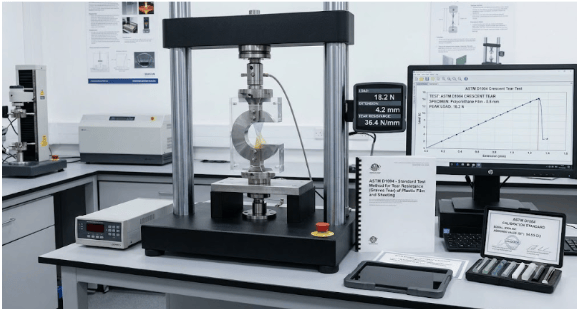
    Controlled Tear Loading and Force MeasurementTechnicians separate the grips at a constant rate of 51 mm (2 in.)/min and record the force until the specimen initiates tearing, identifying the maximum stress near the onset of tearing.
    Result Analysis and ReportingTechnicians determine the tear resistance and report the relevant specimen dimensions, test conditions, and observations to support material comparison and quality assessment.
    The image shows a universal testing machine measuring the tear resistance of a die-cut plastic film specimen using the ASTM D1004 Graves tear method.
    ASTM D1004 Universal Testing Machine (UTM)

    Analysis Results and Interpretation

    • The laboratory report lists the tear resistance in N or lbf, specimen thickness, rate of separation of the grip, if applicable, and observations that may have been made during the testing.
    • The test measures the force required to initiate tearing in flexible plastic film or sheeting using the Graves tear geometry at a constant grip-separation rate of 51 mm (2 in.)/min.
    • Engineers assess the tear-resistance results and compare plastic formulations, compositions, manufacturing methods, and production batches, particularly when the specimens have similar composition and thickness. 
    • The results help engineers with material qualification, quality assurance, product development, packaging design, and selecting flexible plastic films where resistance to tear initiation is important.

    Link to ASTM D1004

    Read more

    Updated on August 17, 2026

    Dr Ruchika Yogesh
    About Author
    Dr. Ruchika Yogesh is a serial entrepreneur, material science and AI/ML enthusiast, medicinal chemistry subject matter expert (SME), scientific/medical copyeditor, and a researcher.
    Know More
    Testimonials
    Real results
    Engineers trust us with what matters most
    Why Choose Matestlab?
    Matestlab is a unified testing services partner based in the USA. Matestlab offers raw material and product testing services through accredited, expert laboratories primarily based in the USA. Matestlab supports physical, thermal, chemical, electrical, mechanical, environmental, and characterization testing needs through its global network of 2200+ accredited testing laboratories. Matestlab's in-house materials science experts curate and design comprehensive testing programs matched to the sample material and specific testing need, with regulatory requirements and confidentiality in mind.

    If you are looking for a managed and trusted testing partner to achieve your research goals, feel free to schedule a meeting with us or send us a request at connect@matestlabs.com to learn more about our services. For a quick quote, call us at (302)244-7710. We are happy to serve you.
    Start Your Testing
    Project Today
    Define your requirements and get access to
    specialized laboratories ready to deliver results
    Partners with us
    Clients
    Vendors
    Process for testing
    • STEP 01

      You share your testing requirements

    • STEP 02

      You share your sample(s)

    • STEP 03

      We deliver your test reports

    Get your testing done

    Let us know your testing requirements and we will be right back with a solution.

      Let us root for each other. Collaborate to grow, expand, and accelerate our businesses.

      Partner with us