
ASTM D116 Standard Test Methods for Vitrified Ceramic Materials for Electrical Applications

    What is ASTM D116?

    ASTM D116 is a set of standard test methods for determining the properties of vitrified ceramic materials used for electrical insulation. This standard applies to unglazed specimens and may include glazed specimens if the laboratory specifies the surface condition in the test report. It provides individual procedures for physical, mechanical, thermal, and electrical properties of ceramic materials. This standard offers methods for specific gravity, porosity, compressive strength, flexural strength, elastic properties, hardness, thermal conductivity, thermal expansion, thermal shock resistance, dielectric strength, electrical resistivity, and relative permittivity and dissipation factors. 

    Read more

    Get Certified ASTM D116 Testing for Reliable Electrical Ceramic Materials

    Ceramic materials need to be physically, mechanically, thermally, and electrically consistent in order to be used for electrical insulation. These properties can be characterized in a laboratory with standardized test procedures according to ASTM D116 (Standard Test Methods for Vitrified Ceramic Materials for Electrical Applications). These results are used to determine the quality, control, and choice of the ceramic compositions for certain insulating uses by engineers.
    What is the scope of the ASTM D116 test standard?

    ASTM D116 evaluates physical properties of vitrified ceramic products used for electrical insulation. The standard primarily targets unglazed specimens but also allows testing of glazed specimens. Laboratories select individual procedures according to the property that they need to characterize. The ASTM D116 standard-

    Read more

    • Tests vitrified ceramic materials for electrical insulation purposes. 
    • Evaluates physical, mechanical, thermal, and electrical properties. 
    • Covers unglazed ceramic specimens and can accommodate glazed specimens. 
    • Determines specific gravity and porosity. 
    • Evaluates compressive and flexural strength. 
    • Measures elastic properties and hardness. 
    • Determines thermal conductivity, thermal expansion, and thermal shock resistance. 
    • Measures dielectric strength and electrical resistivity. 
    • Evaluates relative permittivity and dissipation factors.

    What are the uses of ASTM D116 testing?

    ASTM D116 testing helps laboratories to characterize vitrified ceramics for electrical insulation applications. Engineers use these measured properties to check ceramic quality control, compare composition, and evaluate material suitability for insulating applications. This standard-

    • Determines the specific gravity of ceramic materials. 
    • Evaluates ceramic porosity and structural integrity. 
    • Measures compressive and flexural strength. 
    • Determines elastic and hardness properties. 
    • Evaluates thermal conductivity and thermal expansion. 
    • Measures thermal shock resistance. 
    • Determines dielectric strength and electrical resistivity. 
    • Measures relative permittivity and dissipation factor. 
    • Supports ceramic material quality control and development.

    Which materials can be tested under ASTM D116? 

    ASTM D116 specifies the properties of vitrified ceramic electrical insulators. Laboratories can test unglazed or glazed specimens as long as the analyst clearly identifies the surface condition.

    Why is ASTM D116 Important?

    ASTM D116 offers a standardized procedure for determining the physical, mechanical, thermal, and electrical characteristics of vitrified ceramic materials. Manufacturers use these measured properties to check ceramic quality control, compare composition, and evaluate material suitability for insulating applications. 

    ASTM D116 Equipment and Sample Preparation Guide

    ASTM D116 uses different equipment for different material properties. Laboratories select the appropriate apparatus according to the property under evaluation. The standard also provides alternative methods for specific gravity and porosity based on specimen size, required accuracy, and material properties.

    Read more

    Sample and Specimen DetailsLaboratories test samples of vitrified ceramic materials for electrical insulation purposes. This method focuses on unglazed samples but can be applied to glazed specimens when the test identifies the surface condition.
    Specimen PreparationTechnicians prepare specimens according to the specific procedure selected for the property being evaluated. For the dye-penetration porosity procedure, technicians use freshly broken ceramic fragments with clean and apparently unshattered exposed surfaces.
    Specimen DimensionsFor the dye-penetration porosity procedure, ASTM D116 recommends freshly broken ceramic fragments approximately 5 mm in the smallest dimension and up to 20 mm in the largest dimension.
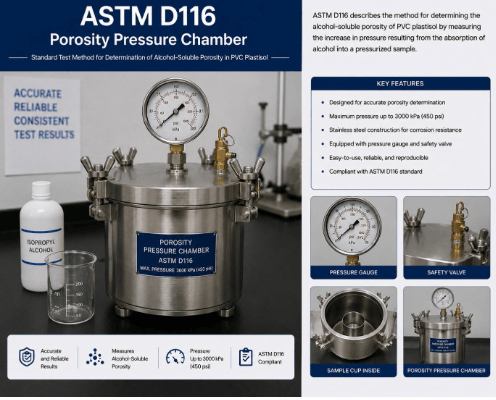
    Instrumentation Specific gravity apparatus, porosity pressure chamber, flexural testing equipment, compressive testing equipment, hardness tester, thermal conductivity apparatus, thermal expansion apparatus, dielectric strength equipment, electrical resistivity equipment, permittivity/dissipation factor measuring equipment.

    Testing Procedures and Requirements for ASTM D116

    ASTM D116 offers different test procedures according to the property that needs to be evaluated. Technicians select the appropriate procedure, prepare the ceramic specimen, perform the measurement, and record the resulting property data.

    Read more

    Other referenced ASTM documents include C20, C177, C329, C373, C418, C539, C623, C730, C773, D150, D257, D618, D638, D1823, and D2520.

    Specific Gravity and Porosity Technicians determine the correct specific-gravity method based on the specimen’s conditions, required accuracy, and specimen size and determine the ceramics’ porosity using suitable water absorption or dye penetration tests.
    Mechanical PropertiesThen analysts assess compressive strength, flexural strength, elastic properties, and hardness according to referenced ASTM methods.
    Thermal PropertiesTechnicians measure thermal conductivity, thermal expansion, and thermal shock resistance using appropriate procedures specified in ASTM D116.
    Electrical PropertiesAnalysts test dielectric strength, electrical resistivity, relative permittivity, and dissipation factors according to appropriate electrical test procedures.
    Result ReportingLaboratories record the measured property, applicable test conditions, specimen information, and relevant observations in the test report.

    ASTM D116 Testing Process and Data Collection

    Analysts take the representative specimens and identify the required properties for evaluation. Then, they prepare and run the specimens according to the ASTM D116 procedure. Next, technicians perform the required physical, mechanical, thermal, or electrical tests and record the test conditions and observations. Laboratories can collect data for thermal properties, dielectric properties, electrical resistivity, relative permittivity, specific gravity, porosity, strength, hardness, and dissipation factor.

    This image shows a porosity pressure chamber used to evaluate the porosity of a vitrified ceramic specimen according to ASTM D116.
    ASTM D116 Porosity Pressure Chamber

    Common Challenges and Troubleshooting

    Accurate results require proper sample preparation, suitable test procedures, and reliable equipment. Test results may vary because of different specimen conditions, surface treatment, equipment setup, and measurement techniques. Technicians should identify the specimen condition before testing, check the apparatus, check conditions, and select appropriate procedures for the required property. For porosity testing, technicians should prepare clean sample surfaces and follow the specific dye-penetration procedure to ensure consistent results.

    ASTM D116 Analysis Results and Interpretation

    • ASTM D116 produces property-specific results rather than a single overall test value.
    • Laboratories often represent results for specific gravity as a dimensionless value, compressive strength in F/A, flexural strength in F/A, thermal conductivity in W/(m·K), thermal expansion as a coefficient of linear thermal expansion, electrical resistivity in Ω·m, and dissipation factor as a dimensionless value. 
    • Consistent specimen preparation, suitable equipment, and controlled test conditions help laboratories produce reliable results.

    Link to ASTM D116

    Read more

    Updated on August 18, 2026

    Rohit Dhembare
    About Author
    Rohit Dhembare is an Operations Associate at Matestlab Inc., holds a postgraduate degree in Organic Chemistry and is trained in Materials Science testing techniques.
    Know More
    Testimonials
    Real results
    Engineers trust us with what matters most
    Start Your Testing
    Project Today
    Define your requirements and get access to
    specialized laboratories ready to deliver results
    Partners with us
    Clients
    Vendors
    Process for testing
    • STEP 01

      You share your testing requirements

    • STEP 02

      You share your sample(s)

    • STEP 03

      We deliver your test reports

    Get your testing done

    Let us know your testing requirements and we will be right back with a solution.

      Let us root for each other. Collaborate to grow, expand, and accelerate our businesses.

      Partner with us

        Discover more from Matestlab

        Subscribe now to keep reading and get access to the full archive.

        Continue reading