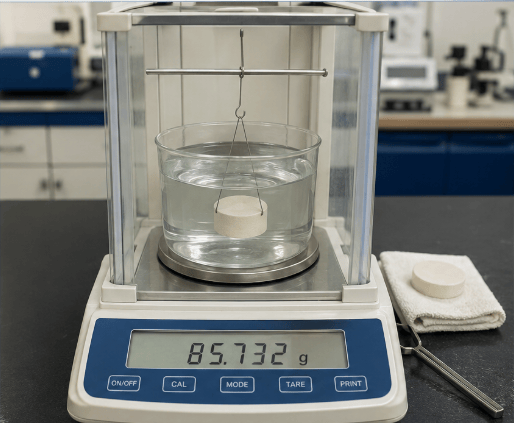
ASTM C329 is a standard method for calculating the specific gravity of fired ceramic whitewares by the immersion method, in standard laboratory conditions. Determines the specific gravity of fired whiteware products relative to water and provides valuable information about density, porosity, and firing quality. The standard:
- Determines the specific gravity of fired ceramic whiteware materials.
- Calculates specific gravity of a substance by using the method of immersion and weighing.
- Tests the density and physical properties of fired ceramics.
- Helps with quality control and product evaluation.
- Gives correct and reproducible lab measurements.
- ASTM C329 is mainly used for fired ceramic whiteware products such as porcelain, ceramic tile, sanitaryware, and other ceramic products.
What are the Uses of ASTM C329 Test Standard?
This test standard is widely used in the ceramic industry and by testing laboratories to obtain the specific gravity of fired ceramic whiteware materials and to measure physical properties of ceramic whiteware. The results are used to assess firing quality, monitor production consistency, and verify that ceramic products meet required performance and quality standards. Common applications include:
- Determining specific Gravity of Fired Ceramic Whiteware Materials.
- Measurement of the density and porosity of ceramic products.
- Assisting in quality control in Ceramic Production.
- Evaluating important physical properties of fired ceramic products.
- Helping manufacturers verify production consistency and firing quality.
- Assisting manufacturers to create ceramic products that have uniform density and reliable quality.
What is Specific Gravity Testing in ASTM C329?
The specific gravity test is used to measure the relative density of a fired ceramic product compared to the density of water. The test is used to determine the specific gravity of the specimen by measuring its weight in air and apparent weight in water. The value obtained gives information about the density, porosity, and degree of densification of material after firing.
Why is Specific Gravity Testing Important for Fired Ceramic Whiteware Materials?
Specific gravity is one of the important physical parameters that indicates the quality and performance of fired ceramic materials. Differences in specific gravity could be due to porosity, material properties, or firing effectiveness. Specific gravity measurements are used by the manufacturer to assess product consistency, identify processing issues, adjust the firing process, and ensure the finished ceramic product meets design and quality requirements.
How Does ASTM C329 Measure Specific Gravity?
The test starts with cleaning and drying the fired ceramic sample, and then weighing the sample in air with an analytical balance. Its immersed weight is then recorded, and the specimen is suspended in water. The measurements are made according to a standard ASTM procedure to determine the specific gravity of the material. If a product has specifications or quality requirements, the calculated value is compared to those requirements.
Common Challenges and Troubleshooting
Some variables that may influence the accuracy of ASTM C329 are surface contamination, residual water, air bubbles that may be included in the sample during immersion, and inaccurate preparation or weighing of the sample. Repeatability and reliability are improved by careful cleaning and drying of specimens, using calibrated weighing equipment, avoiding air bubbles while immersing specimens, maintaining an even environment in the laboratory, and adhering to a fixed testing procedure.
ASTM C329 Testing Technique, Process, and Data Collection Guide
A fired ceramic specimen is cleaned, dried, and weighed in air on a precision analytical balance. The specimen is immersed in water, and an apparent weight in water is measured. These weight measurements allow the specific gravity to be determined. Specific gravity is calculated and reported and compared against product specifications to determine material density, porosity, and production consistency. The test report includes specimen identification, dry weight, immersed weight, dry-to-immersed weight (calculated specific gravity), testing conditions, laboratory observations, and any quality assessment data relevant to the test.