ASTM A572 Standard Specification for High-Strength Low-Alloy Columbium-Vanadium Structural Steel

    What is ASTM A572?

    ASTM A572 is a standard specification that covers high-strength low-alloy columbium-vanadium structural steel plates, shapes, bars, and sheet piling in five strength grades for structural applications. ASTM A572 (Standard Specification for High-Strength Low-Alloy Columbium-Vanadium Structural Steel) is available in Grades 42, 50, 55, 60, and 65, each with specified minimum yield strength requirements for different structural applications.  ASTM A572 provides a high strength-to-weight ratio, good weldability, and improved atmospheric corrosion resistance, making it suitable for bridges, buildings, transmission towers, construction equipment, and other load-bearing structural applications. The addition of columbium (niobium) and vanadium improves the strength of the steel while maintaining good toughness and weldability.

    Read more

    Get Certified ASTM A572 Testing for Reliable Structural Steel Performance

    Structural steel used in critical infrastructure projects has a combination of very specific mechanical and chemical properties. ASTM A572 testing is standard testing to verify compliance with the requirements of the material specification for strength, ductility, weldability, and dimensional accuracy. A certified test can be used by engineers, fabricators, and contractors to ensure that structures are safe, products are of high quality, and they conform to industry standards.

    What is the Scope of ASTM A572 Test Standard?

    ASTM A572 establishes the chemical and physical properties and mechanical characteristics of the high-strength, low-alloy structural steel commonly used in the construction and engineering industry. The specification sets quality requirements for the structural performance, which are standardized and can be relied upon under static and dynamic loads. The scope of the ASTM A572 test standard:

    Read more

    • Includes high-strength low-alloy (HSLA) columbium-vanadium structural steel. 
    • Applies to structural steel plates, bars, shapes, and sheet piling. 
    • Includes Grades 42, 50, 55, 60, and 65. 
    • Defines the chemical and mechanical properties required. 
    • Supports welded, bolted, and riveted structural assembly. 
    • Establishes quality specifications for buildings, bridges, industrial buildings, and projects involving infrastructure. 
    • Covers structural steel in five grades (42, 50, 55, 60, and 65), with the applicable grade depending on the product form, thickness, and specified minimum yield strength requirements.

    What is the Use of ASTM A572 Testing?

    ASTM A572 testing helps to guarantee that the mechanical, chemical, and dimensional properties of structural steel products are suitable for safe structural use. Test results can be used to certify product quality, aid in the structural design of products, and support quality assurance during fabrication and construction. ASTM A572 Testing

    • Ensures that the product meets the mechanical and chemical requirements of ASTM A572. Verdicts confirm yield strength, tensile strength, ductility, and weldability. 
    • Helps to control the quality of steel production. 
    • Helps structural engineers determine suitable steel grades. 
    • Certifies bridges, buildings, cranes, transmission towers, and industrial facilities.
    • Supports manufacturers in meeting customer requirements and regulations. 

    What is High-Strength Low-Alloy (HSLA) Steel?

    High-strength low-alloy (HSLA) steels are structural steels containing small additions of alloying elements such as columbium (niobium) and vanadium to improve strength, toughness, and weldability.

    Why Are Multiple ASTM A572 Grades Available?

    ASTM A572 contains five grades to suit various types of structural loading. While maintaining excellent weldability, higher grades offer greater minimum yield strength, which helps engineers to optimize structural weight, load-carrying capacity, and construction efficiency.

    Which Industries Commonly Use ASTM A572 Steel?

    ASTM A572 structural steel is utilized in the construction of commercial buildings, highway bridges, transmission towers, industrial plants, mining equipment, construction machinery, offshore structures, rail system structures, storage tanks, heavy transportation equipment, and many other applications that demand high strength and durability.

    Common Challenges and Troubleshooting

    Inaccuracies in the test occur when the sample is not prepared correctly, the test equipment is miscalibrated, the measurement of the dimensions of the test is inaccurate, or the chemical analysis procedures are inaccurate. Accurate and repeatable results are achieved through careful sample preparation, instrument calibration, and competent laboratory staff.

    ASTM A572 Testing Process and Data Collection

    Testing begins by selecting representative samples from the production lot. Chemical composition analysis, tensile testing, bend testing (when required), dimensional inspection, and visual examination are performed according to ASTM requirements. All measured values are documented and compared with the applicable grade requirements before issuing the final certification report.

    ASTM A572 Equipment and Sample Preparation Guide

    To obtain accurate mechanical and chemical property data, proper sample preparation and calibrated testing equipment are vital. To assure reliable and repeatable test results of structural steel products, representative specimens are prepared according to the applicable ASTM standards.

    Read more

    Specimen DetailsRepresentative HSLA structural steel products such as plates, structural shapes, bars, and sheet piling are produced from ASTM A572 Grades 42, 50, 55, 60, or 65. These are usually used in bridges, buildings, transmission towers, cranes, heavy machinery, and industrial buildings.
    Specimen PreparationTest specimens are machined from representative production material without introducing excessive heat or mechanical deformation. Samples are cleaned and prepared according to ASTM A370 for mechanical testing and ASTM A751 for chemical analysis.
    Specimen DimensionsTensile and bend specimens are prepared according to ASTM A370 dimensions. Dimensional inspections are performed on full-size structural products.
    InstrumentationUniversal Testing Machine (UTM), Optical Emission Spectrometer (OES), tensile extensometer, bend testing fixture, Charpy impact tester (if specified), calibrated dimensional measuring equipment, calipers, micrometers, and a hardness tester (if specified).

    Testing Procedures and Requirements for High-Strength Low-Alloy Structural Steel

    ASTM A572 is a specification that establishes the chemical composition, mechanical properties, and manufacturing requirements for high-strength low-alloy columbium-vanadium structural steel products. Laboratory tests guarantee that the steel delivers the necessary strength, toughness, ductility, and fabrication properties for challenging structural applications. 

    Read more

    These specifications include standards ASTM A6/A6M, ASTM A370, ASTM A751, ASTM A941, and ASTM E29.

    Chemical Composition AnalysisGuarantees compliance with specific limits for carbon, manganese, phosphorus, sulfur, columbium (niobium), vanadium, and other alloying elements.
    Tensile TestingIt measures the yield strength, tensile strength, and elongation. 
    Bend Testing (When Required)Tests the ductility and cracking resistance in the forming process.
    Dimensional InspectionChecks the thickness, width, length, straightness, and dimensional tolerances.
    Visual ExaminationVisual examination identifies visible surface imperfections such as seams, laps, and cracks, while internal laminations generally require nondestructive testing methods for detection.
    Documentation and CertificationConfirms conformance with the specification requirements of ASTM A572. 
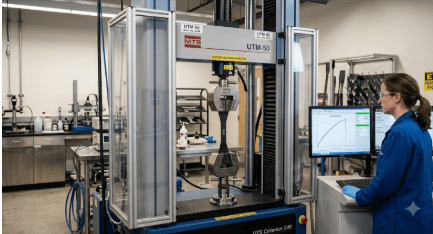
    The image shows a universal testing machine (UTM) performing tensile testing on ASTM A572 high-strength low-alloy structural steel specimens to measure yield strength, tensile strength, and elongation.
    ASTM A572 Universal Testing Machine (UTM) 

    Analysis Results and Interpretation

    • The mechanical properties for grades are usually indicated as yield strength (MPa or ksi), 
    • Ultimate tensile strength (MPa or ksi), and elongation. 
    • Chemical composition is reported as weight percent (wt.%), and dimensional measurements are reported in millimeters (mm) or inches (in.).
    • If the material meets all specified requirements for the selected ASTM A572 grade, it is considered acceptable for structural applications.
    • Test results are compared with the specified grade requirements for yield strength, tensile strength, elongation, and chemical composition before the material is accepted or rejected.

    Link to ASTM A572

    Read more

    FAQ

    Where can I get the astm a572 tested?
    You can share your astm a572 testing requirements with MaTestLab. MaTestLab has a vast network of material testing laboratories, spread across the USA and Canada. We support your all material testing needs ranging from specific astm a572 test to various testing techniques.
    Please contact us for a detailed quote for your astm a572 testing needs. Cost incurred to carry out different astm a572 testing methodology depends on the type of raw material; number of samples, coupons, or specimens; test conditions, turn around time etc. Costs of some ASTM testing methods start from $100 and the final value depends upon the factors listed above. Please contact us for the best and latest prices.
    The required number of samples or specimens should comply with the procedure given in the astm a572 standard. However, the MaTestLab operations team can assist you for your special requirements once you share your testing details with us.
    MaTestLab has a vast testing laboratory network, hence we bring you the best testing facilities in a cost-effective way. We offer considerable discounts (15-20%) to our returning customers based on test volume and frequency.
    The turnaround time for astm a572 test methodology depends upon the test procedure mentioned in the standard test document. However, we at MaTestLab understand your research requirements and hence try to get your test completed within the least possible time.
    Rohit Dhembare
    About Author
    Rohit Dhembare
    Rohit Dhembare is an Operations Associate at MaTestLab Inc. and holds a postgraduate degree in Organic Chemistry.
    Testimonials
    Real results
    Engineers trust us with what matters most
    Start Your Testing
    Project Today
    Define your requirements and get access to
    specialized laboratories ready to deliver results
    Partners with us
    Clients
    Vendors
    Process for testing
    • STEP 01

      You share your testing requirements

    • STEP 02

      You share your sample(s)

    • STEP 03

      We deliver your test reports

    Get your testing done

    Let us known your testing requirements and we will be right back with a solution.

      Let us root for each other. Collaborate to grow, expand, and accelerate our businesses.

      Partner with us

        Contact Us

        Discover more from MaTestLab

        Subscribe now to keep reading and get access to the full archive.

        Continue reading