ASTM A463 Standard Specification for Steel Sheet, Aluminum-Coated, by the Hot-Dip Process

    What is ASTM A463? 

    ASTM A463 is the standard specification covering steel sheet coated with aluminum on both sides via the continuous hot-dip process. It includes two main coating types: one based on a silicon-aluminum alloy for high-temperature and heat-oxidation resistance in automotive exhaust systems, and another with a commercially pure coating for atmospheric corrosion resistance. It sets high standards for chemical, mechanical, and coating-weight characteristics across a range of steel substrates for use in harsh thermal and corrosive environments in challenging industrial, architectural, and appliance applications. 

    Read more

    Get Certified ASTM A463 Compliance for High-Performance Coated Steel

    In automotive exhaust components, heat exchangers, industrial ovens, and HVAC systems, which are exposed to extreme temperature cycles, combustion gases, and corrosive atmospheres, are all in need of strong surface protection. If the coating does not adhere to the substrate and the aluminum layer is too thin, it can cause rapid oxidation, substrate scaling, and catastrophic component failure. ASTM A463 specifies quality requirements to ensure that hot-dip aluminum-coated steel sheets provide the high corrosion and heat-resistance characteristics required by manufacturers and testing laboratories. 

    What is the Scope of ASTM A463?

    ASTM A463 provides requirements for aluminum-coated steel sheet, in coils or cut lengths, with two types of aluminum coating by the hot-dip process. The standard specifies the chemical composition, mechanical properties, and test conditions of these products. 

    Read more

    The scope of ASTM A463 includes:

    • Material types: The material type is coated aluminum steel sheet coil and cut length, which is Type 1 or Type 2 coated.
    • Purpose: The specification applies to aluminum-coated steel sheet designed to be used in general engineering and heat-resisting applications.
    • Properties evaluated: Heat analysis of the base metal, coating weight, bend test properties, and mechanical property requirements.
    • Testing method: Technicians perform heat analysis, coating weight tests, and bend tests to meet the requirements specified.
    • Result: Confirmation of chemical composition, coating weight, and mechanical properties in accordance with specification.
    • Test Limitations: Product furnished under this specification shall meet the requirements of the latest specification ASTM A924 unless otherwise herein provided.
    • Use conditions: Product is offered in various steel types and coatings for different applications.
    • Applications: Heat-resisting applications, corrosion-resistant applications, automotive exhaust systems, mufflers, heat shields, and high-temperature applications.

     What are the Uses of the ASTM A463 Specification?

    Aluminum-coated steel sheet is widely used in general engineering and heat-resisting applications, and ASTM A463 testing ensures the material meets chemical and mechanical requirements. Engineers then interpret the results to determine the acceptability of the product in specific applications. This standard-

    • Checks the base metal heat analysis to ensure it meets the requirements.
    • Normalizes the testing process and ensures the same results from product to product, laboratory to laboratory, and production batch to production batch.
    • Supports the selection of products that perform to certain specifications for heat-resisting applications.
    • Allows weighing and bend testing of coating weight.
    • Backs up material specifications with quantifiable data suitable for technical documentation.
    • Assists in the selection of the proper type and weight of coating for various applications.
    • Assists in setting up facilities and personnel for testing aluminum-coated steel.

    What Materials Can Be Tested Under ASTM A463?

    Steel sheet substrates covered under ASTM A463 are commercial steel (CS), drawing steel (DS), deep-drawing steel (DDS), extra deep-drawing steel (EDDS), and structural (physical quality) steels coated with Type 1 or Type 2 hot-dip coatings of aluminum.  

    Why is ASTM A463 Important? 

    Aluminum-coated steel combines the best of both materials: the strength of carbon steel with the corrosion and heat resistance of aluminum. Without a strict specification such as ASTM A463, variations in alloy-bath composition, coating thickness, or interface bonding can cause premature flaking, blistering, or oxidation during forming and in service. ASTM A463 ensures durability in extreme temperature and corrosive environments.

    ASTM A463 Equipment and Sample Preparation Guide

    ASTM A463 specifies testing equipment and procedures for verifying the chemical and mechanical properties of aluminum-coated steel sheet. Technicians prepare test specimens and perform the required tests. The specification defines requirements for heat analysis, coating weight testing, and bend testing. 

    Read more

    Sample and Specimen DetailsTechnicians test aluminum-coated steel sheet in coils and cut lengths with Type 1 or Type 2 coating.
    Specimen PreparationTechnicians prepare test specimens according to the test methods specified in the standard and Specification ASTM A924.
    Specimen DimensionsSpecimen dimensions depend on the test method and the product form (coil or cut length).
    InstrumentationTechnicians use chemical analysis equipment, coating weight test apparatus, and bend testing equipment.

     Testing Procedures and Requirements for ASTM A463

    The standard specifies controlled testing procedures for verifying the chemical and mechanical properties of aluminum-coated steel sheet. Technicians perform heat analysis, coating weight tests, and bend tests to verify compliance with the specified requirements. Other reference documents include ASTM A428, A480, A902,A924, E517, and E646. The ASTM A463 test method comprises the following test procedure: 

    Read more

    Specimen Preparation Technicians prepare test specimens from the aluminum-coated steel sheet according to the standard.
    Heat Analysis Technicians perform heat analysis of the base metal to verify conformity with specified chemical requirements.
    Coating Weight Testing Technicians perform coating weight tests to verify conformity with coating designation requirements.
    Bend Testing Technicians perform bend tests to verify coating adhesion and formability requirements.
    Result Reporting Laboratories report heat analysis, coating weight, and bend test results for compliance verification.

    ASTM A463 Testing Process and Data Collection

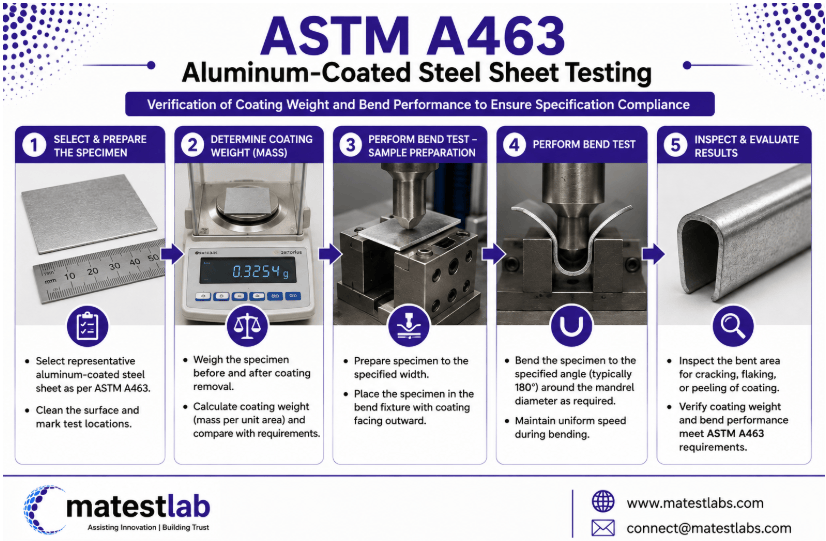
    Technicians prepare specimens from the aluminum-coated steel sheet and then test them. The technician does a heat analysis of the base metal to verify chemical composition. The technician conducts a coating weight test to verify conformance with the coating designation. The technician tests coating adhesion and formability with bend tests. The lab then records the results of the test in the lab and compares them with the requirements. Technicians document the heat analysis, coating weight, bend test results, specimen identification, and test conditions. 

     The image shows ASTM A463 aluminum-coated steel sheet undergoing coating weight and bend testing to verify specification compliance.
    ASTM A463 Aluminum-Coated Steel Sheet Testing 

    Common Challenges and Troubleshooting

    Test accuracy depends on how the specimen is prepared. Poor specimen preparation may lead to incorrect results, since the properties being measured depend upon the specimen preparation. Product furnished in compliance with this specification shall meet the requirements of the latest revision of the specification ASTM A924 unless specified in this specification. Various coating designations require different coating weights, and an incorrect coating weight can lead to incorrect acceptance decisions. Laboratories address these issues by ensuring test equipment is calibrated, specimens are set up properly, and the correct requirements are applied based on the coating type and designation. 

    ASTM A463 Analysis Results and Interpretation

    The report is a summary of the heat analysis, coating weight, and bend test results of aluminum-coated steel sheet. ASTM A463 is a specification that covers chemical and mechanical properties for aluminum-coated steel sheet, not a rating of the general performance of the material.

    Read more

    • The laboratory conducts the heat analysis and reports it to the base metal; the base metal should meet the requirements specified. Element concentrations are reported as weight percent (wt.%) for carbon, manganese, phosphorus, sulfur, and other specified elements in the heat analysis.
    • The technician shows the weight of the coating to meet the coating designation requirements. The coating weight is usually expressed in ounces per square foot (oz/ft²) or in grams per square meter (g/m²), depending on the coating designation.
    • The inspector documents the results of the bend test and confirms coating adhesion and formability. The bend test measures the minimum bend radius at which the coated sheet will not fail its coating.
    • The engineer must consider the type and designation of coating when interpreting the result since the requirements change with the type of coating. The 5 to 11% silicon alloy is used primarily for heat-resisting applications, and the commercially pure aluminum alloy is used primarily for corrosion-resisting applications.
    • Engineers analyze the results against the acceptance criteria set by the cognizant engineering organization. Product manufactured in accordance with this specification shall comply with the relevant requirements of the most recent edition of Specification ASTM A924 unless otherwise stated in this specification.

    FAQs

    What are the compositions of steel substrates used for improved high-temperature performance?

    It is possible to develop strength and oxidation resistance at high temperature in a Ti-added Si-Mn steel with controlled chemistry of up to 0.020% C, 0.1-2.2% Si, up to 2.5% Mn, and 0.1-0.5% Ti, by coiling the steel at a sufficiently low temperature so that the Si and Mn do not become oxidized. It can replace high-priced AISI 409 and 410 stainless steels used in auto exhaust systems.

    What is the latest ASTM work item for terms in A463 and related specifications?

    The ASTM Work Item (WI) for revising A463/A463M and other steel sheet specifications to use the new term “Niobium” to replace the old term “Columbium” also has a footnote noting that the term Columbium is an alternate name for the element Niobium. This is consistent with the IUPAC decision to take Niobium as the official name of the element 41.

    How does the thickness of the alloy layer differ between Type 1 and Type 2 coatings, and what is the consequence on the formability?

    The thickness of the alloy layer (Type 1 = aluminium-silicon, Type 2 = commercially pure aluminium) formed is significantly different, with Type 1 producing a much thinner (approx 7 µm) alloy layer than Type 2 (approx. 15 µm). Type 2 has a thicker alloy layer, making it less formable, and this is why it is preferred for applications that require bending or forming

    Link to ASTM A463

    Updated on September 25, 2026

    Suyog Kamble
    About Author
    Suyog Kamble is an Operations Associate at Matestlab Inc. Suyog holds a postgraduate degree in organic chemistry and is trained in material science topics.
    Know More
    Testimonials
    Real results
    Engineers trust us with what matters most
    Start Your Testing
    Project Today
    Define your requirements and get access to
    specialized laboratories ready to deliver results
    Partners with us
    Clients
    Vendors
    Process for testing
    • STEP 01

      You share your testing requirements

    • STEP 02

      You share your sample(s)

    • STEP 03

      We deliver your test reports

    Get your testing done

    Let us know your testing requirements and we will be right back with a solution.

      Let us root for each other. Collaborate to grow, expand, and accelerate our businesses.

      Partner with us

        Discover more from Matestlab

        Subscribe now to keep reading and get access to the full archive.

        Continue reading