

Introduction
Battery systems are increasingly needed to support electric mobility and must be high-performing, reliable, and safe. Lithium-ion batteries currently dominate EV energy storage, offering high energy density, long cycle life, and fast charging. The repeated charge-discharge cycles, exposure to extreme temperatures, vibration, mechanical shock, and potential abuse conditions, however, pose challenging operating conditions for EV batteries. A comprehensive testing effort is necessary during product development, validation, certification, and production to assure optimal performance and compliance with international standards. Automotive battery testing enables battery manufacturers to evaluate battery efficiency, capacity retention, thermal performance, safety features, and environmental resistance.
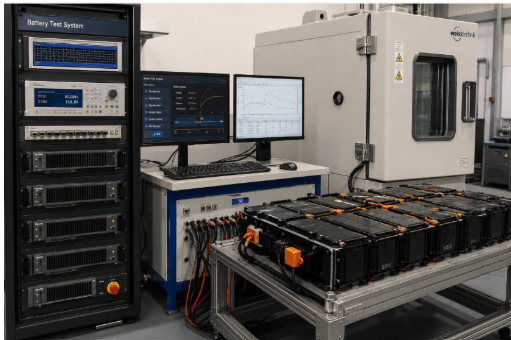
Principle of EV Battery Testing
EV battery testing assesses the electrical, mechanical, thermal, and environmental performance of batteries, battery modules, and battery packs under simulated operating conditions. Batteries are subjected to controlled charge/discharge cycling, mechanical loading, thermal cycling, vibration, and safety testing to measure capacity, energy efficiency, cycle life, thermal stability, and failure mechanisms. The purpose of these tests is to assess the batteries against a set of requirements and performance targets for automotive applications.
Instrumentation
| Instrument | Primary Application |
| Battery Cycler System | Charge/discharge cycling and performance evaluation |
| Environmental Chamber | Temperature, humidity, and thermal cycling testing. |
| Thermal Imaging Camera | Thermal distribution & hotspot detection |
| Battery Analyzer | Measures the capacity, voltage, current, and resistance. |
| Impedance Analyzer | Internal resistance and electrochemical analysis |
| Vibration Test System | Vibration durability assessment |
| Shock Test Machine | Mechanical shock testing |
| Universal Testing Machine (UTM) | Mechanical integrity and crush testing |
| Calorimeter | Thermal runaway and heat generation studies |
| Data Acquisition System | Real-time monitoring and data recording |
Types of EV Battery Testing
| Testing Type | Purpose | Typical Evaluations | Common Standards |
| Electrical Performance Testing | Tests battery performance under normal operating conditions. | Capacity, energy density, charge/discharge efficiency, and internal resistance | IEC 62660 |
| Cycle Life Testing | Evaluates the long-term durability under repeated charging and discharging. | Capacity retention, capacity fade, cycle durability, and resistance growth. | IEC 62660-1 |
| Thermal Testing | Evaluates thermal characteristics and thermal effects. | Thermal cycling, heat generation, thermal stability | SAE J2464, IEC 60068 |
| Environmental Testing | Evaluates battery behavior with environmental stresses. | Temperature, humidity, corrosion, and altitude simulation | IEC 60068, ISO 16750 |
| Ingress Protection (IP) Testing | Verifies protection against dust and water ingress. | Verifies resistance to dust ingress and water exposure in accordance with the specified IP rating. | IEC 60529 |
| Transportation Testing | Provides safety when transporting batteries | Vibration, altitude, thermal, and impact testing | UN 38.3 |
Materials Commonly Tested
- Lithium-ion battery cells
- Battery modules
- Battery packs
- Battery management systems (BMS)
- Cathode and anode materials
- Battery separators
- Solid-state battery materials
- Battery enclosure and structural materials
- Thermal management components
Applications and Industry Use
- Ensuring battery packs in electric vehicles meet quality standards.
- Performance testing of EV batteries.
- Qualification of battery cells and modules.
- OEM product development programs for the automotive industry.
- Battery validation, qualification, and certification testing.
- Next-generation battery research and development.
- Validation of battery management systems (BMS).
- Performance assessment of battery packs for plug-in hybrid electric vehicles (PHEVs).
- Quality control during battery production.
Common Challenges and Troubleshooting
There are several issues with EV battery testing. EV batteries store considerable energy and can pose electrical, thermal, or fire hazards if not handled carefully during testing. Electrochemical systems are complex and sensitive to temperature changes. Improper balancing, conditioning, and monitoring of the cells, as well as improper thermal management, may affect test results. Reliable and repeatable data is critical and requires precise instrumentation, consistent test protocols, and thorough safety measures.


