Last updated 2nd March 2026

ASTM A36 Standard Specification for Carbon Structural Steel

ASTM A36 covers the most popular classification of carbon structural steel in terms of mechanical and chemical requirements for steel shapes, plates, and bars used in construction and general structural purposes. Well known for its weldability, machinability, and multifunctionality, this carbon steel under the method is a construction-type material for bridges, buildings, and other load-bearing structures. The specification ensures that the steel meets minimum yield strength and tensile strength values and specified limits on composition, making it suitable for both fabricated and bolted/welded uses. By stipulating such properties, this method provides uniformity of quality and dependability for engineers and manufacturers undertaking infrastructure and industrial works.

Read More

GET STARTED

    Share your requirements *

    Provide your contact information *

    ASTM A36 Introduction

    The procedure performs as a specification that talks about the mechanical properties and chemical composition requirements of carbon structural steel and is applicable for constructional and industrial purposes. This method of steel is meant to manufacture structural components, such as beams, channels, and angles. It has applications in mass construction due to its commendable strength and easy-to-weld, machine, and fabricate properties. This specification will limit the yield strength and tensile strength, along with providing specific limits on carbon content, manganese, phosphorus, and sulfur, as well as other alloying elements.

    Get Certified ASTM A36 for Reliable Structural Performance

    ASTM A36 certification attests to the fact that structural steel products possess the necessary chemical and mechanical property limits. Certified materials are reliable in terms of their strength, ductility, and weldability, which guarantees safe and durable operations in load-bearing structural work.

    Service NameRemarks
    ASTM A36 Testing
    Contact US

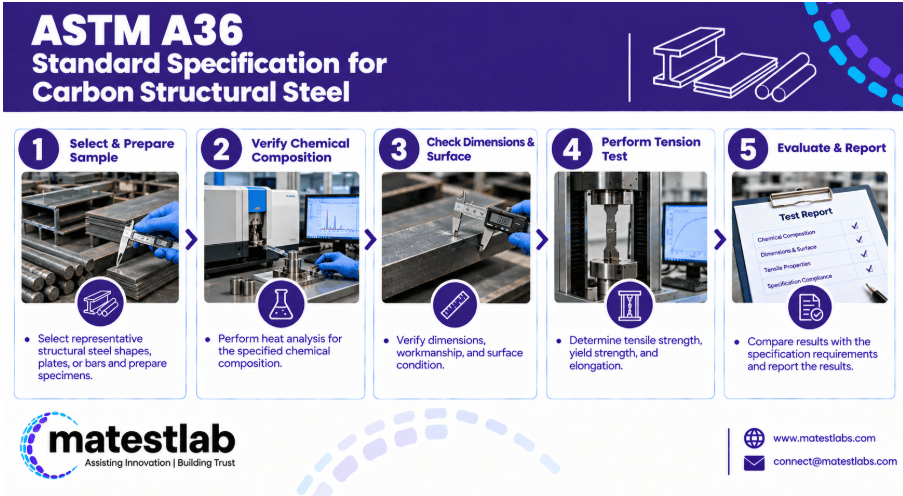
    ASTM A36 Testing Procedure and Requirements

    Chemical Composition AnalysisChecks carbon, manganese, phosphorus, sulphur, and silicon to specifications.
    Tensile TestTensile strength, elongation, and yield strength.
    Bend Test (When Required)Evaluate ductility and the ability to withstand deformation without cracking

    Scope of ASTM A36

    • Coats carbon structural steel plates, shapes, and bars.
    • Categorized as structural and construction.
    • Applicable to structures and fabricated elements that are bridges, buildings, and others.
    • Specifies minimum tensile strength and yield requirement.
    • Stipulates the level of chemical composition.
    • Develops inspection and acceptance standards.

    ASTM A36 Equipment and Sample Preparation

    Specimen PreparationTest specimens are cut from rolled products and machined according to applicable ASTM tensile testing standards to represent the material properties.
    Specimen SizeStandard tensile specimens are prepared depending on plate thickness or size.
    Specimen DimensionsDimensions follow standardized tensile specimen geometry, and product dimensions are verified according to ASTM A36 tolerances and design drawings.

    Applications of ASTM A36

    • Structural columns and beams.
    • Bridge elements and plates.
    • Base plates and gusset plates.
    • Frames and industrial platforms.
    • General fabricated and construction components.
    • Brackets and structural supports.

    ASTM A36 Common Challenges and Troubleshooting

    The most common ones are variability in mechanical properties because of rolling practices, surface defects, and incorrect welding practices, which can lead to less strength or cracking. Rolling temperature control, checking of the surface quality, and following the recommended welding procedures contribute to structural integrity and the same performance.

    ASTM A36 Technique, Process, and Data Collection

    The carbon steel is obtained by controlled refining and melting processes and then hot rolled into a plate, shape, or bar. Tensile and chemical analyses are done on samples taken from representative portions. Testing outcomes of mechanical tests, chemical composition testing, and inspection outcomes are noted down and compared to ASTM A36 specifications limits to determine compliance and structural appropriateness.

    ASTM A36 Analysis Results and Interpretation

    Acceptable results verify that the yield strength, tensile strength, elongation, and chemical composition comply with the desired values. Conformance shows that there is sufficient ductility and weldability for structural usage. Nonconformance can necessitate rejection of material, reclassification, or further testing. When ASTM A36 requirements are adhered to, there is a sure way of having reliable performance in both load-bearing and fabricated structural systems.

    ASTM A36 Problem & Solution

    Problem:
    Construction structural steel can be of insufficient strength, weldability, or erratic mechanical characteristics that result in decreased structural integrity and fabrication challenges.

    Solution:
    ASTM A36 offers chemical composition and mechanical property requirements that are standardized and inspection standards to make sure that the strength, ductility, and weldability remain the same in the safe application of structures.

    Factors to Consider for ASTM A36

    Speed
    The rolling and fabrication processes should be efficient enough to ensure a balance between quality control and no delays in production due to the production of mechanical properties that are always consistent.

    Expert
    Well-trained metallurgists and structural engineers are required to govern the choice of materials to be used, welding practices, and inspection.

    Cost
    ASTM A36 has proven to be a cost-effective and structural steel with sufficient strength and good weldability that eases the fabrication and construction cost and ensures the safety of the structure.

    FAQ's

    Where can I get the astm a36 tested?

    You can share your astm a36 testing requirements with MaTestLab. MaTestLab has a vast network of material testing laboratories, spread across the USA and Canada. We support your all material testing needs ranging from specific astm a36 test to various testing techniques.

    How much do I need to pay for the astm a36 test?

    Please contact us for a detailed quote for your astm a36 testing needs. Cost incurred to carry out different astm a36 testing methodology depends on the type of raw material; number of samples, coupons, or specimens; test conditions, turn around time etc. Costs of some ASTM testing methods start from $100 and the final value depends upon the factors listed above. Please contact us for the best and latest prices.

    How many samples are required for astm a36?

    The required number of samples or specimens should comply with the procedure given in the astm a36 standard. However, the MaTestLab operations team can assist you for your special requirements once you share your testing details with us.

    How much discount can I get on the astm a36 test?

    MaTestLab has a vast testing laboratory network, hence we bring you the best testing facilities in a cost-effective way. We offer considerable discounts (15-20%) to our returning customers based on test volume and frequency.

    How many days will it take to complete the astm a36 test?

    The turnaround time for astm a36 test methodology depends upon the test procedure mentioned in the standard test document. However, we at MaTestLab understand your research requirements and hence try to get your test completed within the least possible time.

    Where can I get the astm a36 tested?

    You can share your astm a36 testing requirements with MaTestLab. MaTestLab has a vast network of material testing laboratories, spread across the USA and Canada. We support your all material testing needs ranging from specific astm a36 test to various testing techniques.

    POPULAR TESTS
    ONE-STOP FOR ALL
    MATERIAL TESTING NEEDS
    MaTestLab Inc. offers accessible, quick, and affordable material testing, product testing, and failure analysis services. We support your on-demand testing and expert consultation needs with the help of our extensive network of material testing laboratories situated in the US and other parts of the world.
    MATERIAL TESTING
    We offer destructive and non-destructive tests over a range of mechanical, electrical, chemical, thermal, optical, corrosion, radiation, and biological testing methodologies defined by ASTM, ISO and other organizations.
    PRODUCT TESTING
    We help you evaluate and ensure your product quality and performance with standard and custom-made testing solutions. All the tests are done at well-equipped testing laboratories using standard testing methods for best output and satisfaction.
    FAILURE ANALYSIS
    Failure analysis ensures high levels of quality in every manufacturing process. We help you with getting the best failure or root cause analysis to determine the cause of the failure. The results help you identify means to prevent failure recurrences.
    Process for testing
    • STEP 01

      You share your testing requirements

    • STEP 02

      You share your sample(s)

    • STEP 03

      We deliver your test reports

    Get your testing done

    Let us known your testing requirements and we will be right back with a solution.

      Let us root for each other. Collaborate to grow, expand, and accelerate our businesses.

      Partner with us

        close

        Please share your requirement with us

          ×

          Contact Us

          Discover more from MaTestLab

          Subscribe now to keep reading and get access to the full archive.

          Continue reading