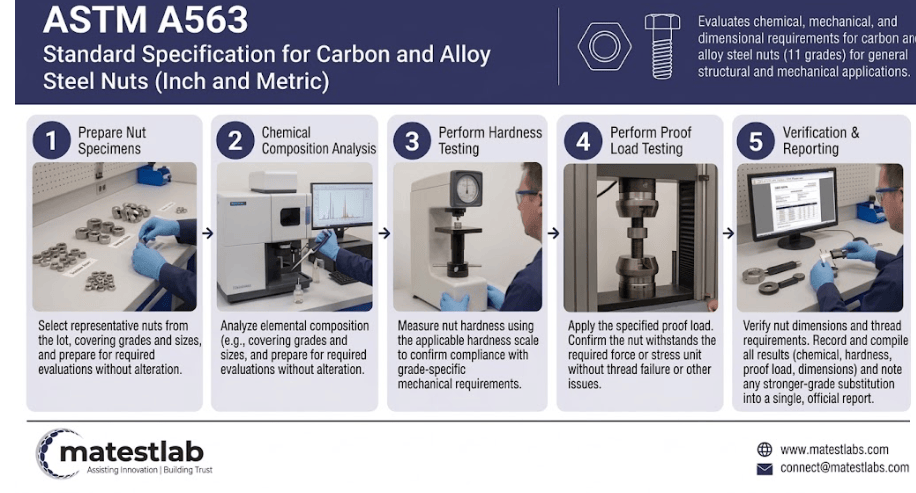
ASTM A563 specifies the chemical, mechanical, and dimensional requirements of carbon and alloy steel nuts of general structural and mechanical use for bolts, studs, and other externally threaded parts. The specification covers eleven grades and establishes requirements according to the nut’s grade, size, style, and applicable service requirements.
The scope of ASTM A563 includes-
- Material type: Carbon and alloy steel nuts of general structural and mechanical use covered under the eleven specified grades.
- Purpose: Establishment of chemical, mechanical, and dimensional requirements for nuts of general structural and mechanical use for bolts, studs, and other externally threaded parts.
- Properties evaluated: Chemical composition, hardness, proof load, dimensions, and other requirements applicable to the nut grade.
- Testing method: A chemist verifies chemical composition against the grade requirement, and a technician performs hardness testing and proof load testing on representative nuts to confirm mechanical compliance.
- Results: The chemical composition of the nut is reported for each element as applicable, while the hardness value is stated in the applicable hardness test scale. Additionally, the proof load is reported using the appropriate force or stress units.
- Test limitations: A stronger nut grade may satisfy the requirements of a specified weaker grade when the supplier provides notice to the purchaser, unless the inquiry or purchase order prohibits the substitution. The values expressed in SI and inch-pound units are considered independent of one another.
- Use conditions: The requirements apply to nuts of each grade, nominal size, style, thread series, finish, and overtapped or coated as applicable. Weathering-resistant grades are suitable for exposure to the atmosphere in which the specified corrosion resistance applies.
- Applications: Structural steel bolting, general mechanical fastening, and other applications that require nuts of carbon or alloy steel with defined chemical, mechanical, and dimensional properties.
What are the Uses of ASTM A563 Testing?
ASTM A563 provides fastener manufacturers and structural engineers with a standard grade verification framework that a general specification for nuts cannot provide for nuts used in structural and mechanical applications. The specification-
- Establishes the chemical composition, hardness, and proof load requirements that a nut of a particular grade must satisfy.
- Supports structural bolting applications that require nuts with mechanical properties equivalent to those of the associated bolts.
- Addresses the atmospheric corrosion and weathering requirements applicable to the weathering-resistant grades of nuts when exposed to the atmosphere.
- Provides a substitution framework allowing a stronger grade to satisfy a weaker grade’s requirement, subject to purchase order terms.
- Supports quality control of nut manufacturing and heat treatment processes.
- Supports verification of proof load requirements of nuts used in structural bolting applications.
- Provides a procurement basis for buyers and manufacturers of structural and mechanical nuts.
Which materials can be tested under ASTM A563?
ASTM A563 applies to carbon and alloy steel nuts of the specified grades and styles suitable for general structural and mechanical use on bolts, studs, and other externally threaded parts. The specification includes hex and heavy hex configurations and covers both inch and metric requirements. Before selecting a nut, an engineer should confirm the required grade, size, configuration, thread requirements, and applicable service conditions.
Why is ASTM A563 Important?
A structural or mechanical connection is only as strong as its weakest component, including the nut. Therefore, a nut that does not comply with the minimum requirements of its specified grade can compromise the integrity of the associated connection, particularly if it is a part of a structural steel assembly. ASTM A563 establishes the chemical and mechanical requirements nuts must meet before incorporation into a connection, while the substitution provision gives manufacturers flexibility to substitute a higher-grade nut for a lower-grade one. For weathering-resistant grades, the specification also matters in exposed structural applications, where a nut’s corrosion behavior needs to match the weathering steel it’s paired with. Consistent compliance with ASTM A563 reduces the risk of fastener-related failures in structural steel and mechanical assemblies.