
ASTM A27 Standard Specification for Steel Castings, Carbon, for General Application

    What is ASTM A27? 

    ASTM A27 is a standard specification for carbon steel castings for general-purpose applications, with a maximum tensile strength of 70 ksi (485 MPa). This specification includes several grades and two classes of steel castings, and the purchaser indicates the required grade and class. The specification covers chemical composition, heat treatment, and mechanical properties. ASTM A27 (Standard Specification for Steel Castings, Carbon, for General Application) is used to determine chemical composition, tensile strength, yield point, elongation, reduction of area, and to qualify materials, support quality control, and develop general-use castings. Castings are tested after heat treatment to assess conformity with the specified requirements. Engineers compare the results with the mechanical property requirements of the applicable grade. 

    Read more

    Get Certified ASTM A27 Testing for Reliable Carbon Steel Casting Quality 

    Certification confirms that carbon steel castings meet the corresponding ASTM A27 requirements, such as chemical composition and mechanical properties. ASTM A27 certified testing determines the casting’s conformity before manufacturers accept it for general industrial applications. Testing and certification ensure conformance to ASTM A27 requirements and reduce the risk of material failures when releasing products to the market. 
    What is the Scope of ASTM A27? 

    ASTM A27 is a standard specification for the determination of the chemical composition and mechanical properties of carbon steel castings using heat analysis, product analysis, and tensile testing. This specification covers the carbon steel castings used for general applications in which the minimum tensile strength is required to be up to 70 ksi (485 MPa).

    Read more

    The scope of ASTM A27 covers: 

    • Material type: Carbon steel castings for general use. 
    • Purpose: Establishes requirements for castings that require up to 70 ksi (485 MPa) minimum tensile strength.
    • Properties measured: Chemical composition and (for applicable grades) tensile strength, yield strength, elongation, and reduction of area. 
    • Method: Chemical analysis and mechanical testing to the requirements for the designated grade and class. 
    • Result: Laboratory reports of chemical and applicable mechanical test results are reported for comparison to the specified requirements. 
    • Test Limitations: The requirements for a test vary from class to class and grade to grade, so the testing requirements for the indicated grade and class shall be applied in the laboratory. 
    • Use conditions: The specification is for general applications and contains grades which may be joined by fusion welding to other wrought steel or steel castings. 
    • Applications: The specification is used for carbon steel castings for general engineering and industrial applications. 

    What are the Uses of ASTM A27 Specification?

    ASTM A27 is used for quality control and material verification for carbon steel castings for general applications. Manufacturers, purchasers, and laboratories use the specification to evaluate chemical composition and applicable mechanical properties. This standard-

    • Assists manufacturers in confirming the desired grade of carbon steel casting.
    • Assists with chemical composition testing for production and acceptance.
    • Helps laboratories evaluate tensile strength and other required mechanical properties.
    • Helps to verify heat-treated grades against specified requirements.
    • Supports buyers in evaluating and comparing castings to material standards.
    • Supplies certified test data for quality control and material acceptance.

    What Materials Can Be Tested Under ASTM A27? 

    ASTM A27 is applicable to carbon steel castings that have a maximum specified tensile strength of 70 ksi (485 MPa) or less and are intended for general applications. Requirements vary according to grade; some grades require chemical analysis only, others require heat treatment or mechanical testing or both. The specification includes seven grades: Grade N-1, Grade N-2, Grade U-60-30, Grade 60-30, Grade 65-35, Grade 70-36, and Grade 70-40.

    Why is ASTM A27 Important? 

    ASTM A27 is significant because it offers a standard specification for the making and quality assurance of carbon steel castings for general applications. The specification ensures that castings produced under the standard undergo comprehensive testing to confirm reliability under different operating conditions. ASTM A27 specifies both chemical composition and mechanical properties, as well as heat treatment requirements, which help ensure uniformity, particularly in applications that call upon the product for strength and weldability. The specification also contains supplementary requirements for use, where further testing or restrictions are needed as a result of the purchaser’s requirements. 

    ASTM A27 Equipment and Sample Preparation Guide

    ASTM A27 requires a universal testing machine equipped with the proper fixtures, chemical analysis equipment, and heat treatment facilities. Technicians calibrate the testing equipment using reference standards before running the samples. 

    Read more

    Sample and Specimen DetailsTechnicians test representative samples of carbon steel castings or separately cast test bars (coupons) poured and heat treated with the castings, prepared for controlled mechanical and chemical testing  
    Specimen PreparationTechnicians machine tensile specimens from separately cast test bars or cast-on extensions. 
    Test Bar Requirements ASTM A27 requires that tests made on coupons have the same composition as the casting. Technicians pour and heat treat test bars at the same time as the castings. 
    InstrumentationLaboratories use chemical-analysis equipment, tensile-testing equipment, specimen-preparation tools, and other instruments required for the applicable evaluations. 

    Testing Procedures and Requirements for ASTM A27  

    The technicians calibrate the testing equipment with reference standards, prepare the specimen, and introduce it into the testing apparatus. The instrument maintains the desired test conditions, measures the desired properties, and computes the results. This specification includes standards such as ASTM A370, A732, A781, and A957.

    Read more

    Chemical Composition Analysis Technicians perform heat and product analyses to determine the composition of carbon, manganese, silicon, sulfur, and phosphorus. 
    Heat Treatment For applicable grades, technicians heat treat castings by full annealing, normalizing, normalizing and tempering, or quenching and tempering. 
    Tension Testing For applicable grades, technicians perform tension testing to determine tensile strength, yield point, elongation, and reduction of area. 
    Property Verification Technicians compare test results to specified requirements for the applicable grade. 
    Result Reporting Laboratories report mechanical property values and chemical composition conformity in SI or inch-pound units.

    ASTM A27 Testing Process and Data Collection

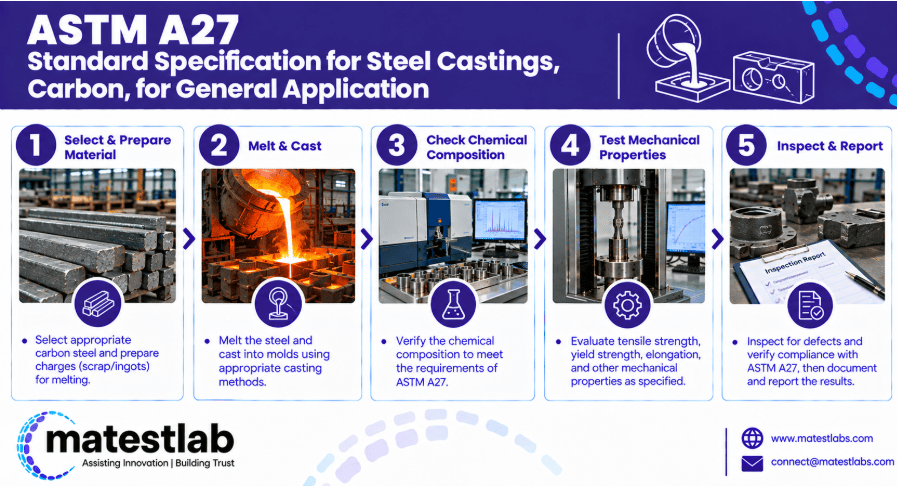
    Testing begins with taking representative samples of carbon steel castings or separately cast test bars and determining the appropriate grade and class. The technician then conducts heat and product analysis to determine the chemical composition of carbon, manganese, silicon, sulfur, and phosphorus. They heat treat castings for applicable grades to full annealing, normalizing, normalizing and tempering, or quenching and tempering after the cooling process. Tensile testing is done to measure tensile strength, yield point, elongation, and reduction of area for Grades U-60-30, 60-30, 65-35, 70-36, and 70-40. They compare test results with the mechanical requirements specified for the appropriate grade. Lastly, the analyst documents all testing conditions and records any differences from the standard testing process. 

     The image depicts a carbon steel casting specimen prepared for ASTM A27 chemical and mechanical evaluation.
    ASTM A27 Carbon Steel Casting Mechanical Testing

    Common Challenges and Troubleshooting

    The common challenges involve the selection of the proper grade and class, preparation of a representative mechanical specimen, and use of the correct testing requirements. The problem becomes exacerbated with variations in casting quality, and the standard requires that heat treatment be performed after castings have fully cooled.   Laboratories minimize the risk of error by keeping records of specimen identification, confirming the required grade before testing, inspecting equipment condition, and reviewing chemical and mechanical requirements before reporting.

    ASTM A27 Analysis Results and Interpretation

    The laboratory report summarizes the chemical composition and applicable mechanical properties of the carbon steel casting. ASTM A27 specifies the basic material properties of chemical composition and mechanical properties, rather than a material-performance rating.

    Read more

    • The laboratory provides tensile strength, yield point, elongation, and reduction of area figures for the appropriate grade.
    • The technician determines the casting test grade and class.
    • The analyst measures the properties at the specified test conditions and correlates them with the casting and heat treatment conditions being tested.
    • When interpreting test results, the engineer considers the heat treatment condition, casting quality, and dimensional tolerances.
    • Engineers rely on these measured properties to help them meet the material specification and ensure it is suitable for use in general applications. 

    Link to ASTM A27

    FAQ

    What are the differences between grades and classes in ASTM A27?
    The grades depend on chemical composition and mechanical properties. Chemical analysis: Grade N-1; heat treatment: Grade N-2; mechanical test: Grade U-60-30; both heat treatment and mechanical testing: Grade 60-30 to 70-40. Classes are based on the requirement for post-weld heat treatment; Class 1 requires such treatment, Class 2 does not.
    All steel castings, with the exception of Grades N-1 and U-60-30, require heat treatment by full annealing, normalizing, or normalizing and tempering, or quenching and tempering. Heat treatments follow upon cooling of castings.
    ASTM A27 prescribes specimens that meet the following chemical composition: Carbon, manganese, silicon, sulfur, and phosphorus, and performed when required for these elements by heat and product analyses.

    Updated on September 25, 2026

    Pawan Kumar Mali
    About Author
    Pawan Kumar Mali is a Material Testing Associate at Matestlab Inc. and holds an Integrated Dual Degree (B. Tech + M. Tech) in Metallurgical Engineering from IIT (BHU), Varanasi. His academic background and research experience are centered on Physical Metallurgy, Materials Research, and Data Analytics, strengthened through academic research and industry experience.
    Know More
    Testimonials
    Real results
    Engineers trust us with what matters most
    Why Choose Matestlab?
    Matestlab is a unified testing services partner based in the USA. Matestlab offers raw material and product testing services through accredited, expert laboratories primarily based in the USA. Matestlab supports physical, thermal, chemical, electrical, mechanical, environmental, and characterization testing needs through its global network of 2200+ accredited testing laboratories. Matestlab's in-house materials science experts curate and design comprehensive testing programs matched to the sample material and specific testing need, with regulatory requirements and confidentiality in mind.

    If you are looking for a managed and trusted testing partner to achieve your research goals, feel free to schedule a meeting with us or send us a request at connect@matestlabs.com to learn more about our services. For a quick quote, call us at (302)244-7710. We are happy to serve you.
    Start Your Testing
    Project Today
    Define your requirements and get access to
    specialized laboratories ready to deliver results
    Partners with us
    Clients
    Vendors
    Process for testing
    • STEP 01

      You share your testing requirements

    • STEP 02

      You share your sample(s)

    • STEP 03

      We deliver your test reports

    Get your testing done

    Let us know your testing requirements and we will be right back with a solution.

      Let us root for each other. Collaborate to grow, expand, and accelerate our businesses.

      Partner with us