ASTM A307 Standard Specification for Carbon Steel Bolts, Studs, and Threaded Rod 60,000 PSI Tensile Strength

    What is ASTM A307?

    ASTM A307 is a standard specification for the manufacturing and quality requirements for carbon steel bolts, studs, and threaded rods for general-purpose fastening applications. The specification sets out three grades of fasteners for different service conditions and outlines requirements for chemical composition, mechanical properties, manufacturing methods, dimensions, workmanship, and inspection. Manufacturers conduct inspections and testing to verify compliance with the specified mechanical properties, dimensions, thread quality, and workmanship prior to product acceptance. 

    Read more

    ASTM A307 covers three fastener grades with different intended applications. Grade A applies to general-purpose bolts, studs, and threaded rods. Grade B applies to headed bolts and studs intended for flanged joints in cast iron. Grade C applies to nonheaded anchor bolts intended for structural anchorage.

    Get Certified ASTM A307 Material Verification for Reliable Fastener Performance

    The performance of assemblies using carbon steel bolts, studs, and threaded rods depends in part on the quality of the fasteners and their compliance with ASTM A307 requirements. ASTM A307 specifies manufacturing material and inspection requirements for carbon steel bolts, studs, and threaded rods. Mechanical properties, dimensional tolerances, thread quality, and material characteristics are evaluated to verify compliance with ASTM A307 requirements. 

    What is the Scope of ASTM A307 Test Standard?

    ASTM A307 specifies minimum material and mechanical properties for carbon steel fasteners for general-purpose applications. The specification defines the strength, dimensional tolerances, and workmanship of bolts, studs, threaded rods, and anchor bolts to guarantee the reliability of their function in structural and industrial assemblies.

    Read more

    • Applies to carbon steel bolts, studs, and threaded rods having a minimum tensile strength of 60000 psi.
    • Yield strength is ~36,000 psi (~248 MPa).
    • Sets chemical composition specifications for carbon steel fasteners. 
    • Sets down the mechanical property requirements such as tensile strength and proof load. 
    • Establishes manufacturing, workmanship, dimensional tolerance, and quality requirements for threads. 
    • Provides requirements for general-purpose carbon steel fasteners used in construction and industrial applications.

    What is the use of ASTM A307 testing?

    ASTM A307 fasteners are widely employed in structural, industrial, and commercial uses that demand moderate-strength carbon steel fastening parts. They provide good mechanical reliability with low production costs and are appropriate for various engineering assemblies. 

    • Produce general-purpose carbon steel bolts and threaded rods. 
    • Install structural steel in building work. 
    • Set up industrial and machinery equipment. 
    • Set up utility poles, brackets, and supports. 
    • Produce farm and vehicle machinery. 
    • Make attachable components for buildings, both residential and commercial. 
    • Carry out quality checks in the making of fasteners. 
    • Check for compliance prior to product shipment and installation.

    What Materials Can Be Tested Under ASTM A307?

    ASTM A307 covers general-purpose carbon steel bolts, studs, threaded rods, and anchor bolts in Grades A, B, and C. Usually used in structural steel connections, building construction, machinery, piping systems, and general industrial equipment where moderate mechanical strength is required.

    Why is ASTM A307 Important for General-Purpose Fasteners?

    ASTM A307 is significant for the manufacturing, mechanical properties, dimensions, and quality of carbon steel fasteners. Compliance with ASTM A307 helps verify that fasteners meet the specified mechanical and dimensional requirements for their intended applications. 

    Common Challenges and Troubleshooting 

    Common reasons for noncompliance include insufficient tensile strength, thread damage, dimensional deviations, surface discontinuities, and improper manufacturing processes. Identifying these issues early helps reduce production delays and product rejection. Poor specimen preparation and poorly calibrated testing equipment can also affect test results. Technicians should conduct regular equipment calibration, carefully inspect the quality of the thread, prepare representative samples, and make all inspections following the referenced ASTM testing methods in order to ensure accurate evaluation. 

    ASTM A307 Testing Process and Data Collection

    The verification process starts with taking representative bolts, studs, or threaded rods from a production lot. Technicians measure dimensions, analyze chemical makeup, perform tensile tests, perform proof load tests and thread inspection based on the relevant ASTM procedures. The data gathered usually consists of the dimensions of fasteners, tensile strengths, proof load values, chemical composition, thread inspection results, visual inspection and final acceptance. These records document whether the fasteners comply with the requirements of ASTM A307.

    ASTM A307 Equipment Used and Sample Preparation Guide

    Sample and Specimen DetailsRepresentative carbon steel fasteners, bolts, studs, threaded rods, or anchor bolts are taken from the production lot. 
    Specimen DimensionsFinished fasteners and specimens are chosen according to the appropriate ASTM fastener testing standard. 
    Specimen PreparationThe fasteners are cleaned, visually examined, and prepared according to the ASTM Mechanical Testing specifications referenced. 
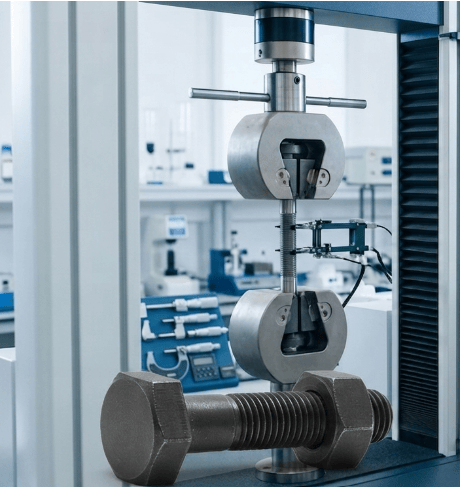
    Universal Testing Machine (UTM) This apparatus applies tensile force to a fastener specimen to determine tensile strength and other applicable mechanical properties in accordance with the referenced ASTM test methods.
    Inspection Equipment Thread Ring Gauge, Thread Plug Gauge, Vernier Caliper, Micrometer. 

    Testing Procedures and Requirements

    ASTM A307 is a material specification that establishes inspection and testing requirements for verifying compliance of carbon steel fasteners. Representative fasteners are chosen after production to verify that the material, dimensional, and mechanical properties meet the specification requirements prior to acceptance.

    Read more

    Other referenced ASTM standards include A563, A706/A706M, A751, B695, F606, F788/F788M, F1470. F1554, F1789, and F2329.

    Material IdentificationFastener grade and dimensions are verified according to specification.
    Mechanical Property Evaluation  Tensile testing, proof load testing if applicable, hardness testing, and visual examination to assess mechanical properties. 
    Chemical AnalysisCarbon steel composition is analyzed to confirm compliance.
    Thread InspectionThread inspection is performed using calibrated thread gauges to verify that the fasteners conform to the applicable thread dimensions and workmanship requirements referenced by the specification.
    Final Compliance Verification Reviews the inspection and test results to determine compliance with the acceptance requirements of ASTM A307.
     The image shows tensile testing of a metal bolt according to ASTM A307.
    ASTM A307 Tensile Test on a Metal Bolt

    ASTM A307 Analysis Results and Interpretation

    • ASTM A307 compliance is determined by comparing the measured mechanical properties, chemical composition, dimensional measurements, and thread quality with the specification requirements. 
    • Typical results include psi/MPa for tensile strength, HRB or HRC (where applicable), mm/inches for dimensions, and pass/fail for thread and visual inspection. 
    • Products that meet all ASTM A307 acceptance requirements are considered compliant with the specification, while nonconforming products are rejected or otherwise handled in accordance with applicable quality procedures.

    What are the Factors to Consider for ASTM A307 Testing?

    The following can be considered while choosing a lab for this testing.

    Read more

    • Speed: Providing efficiency in testing and inspection, which allows the manufacturer to ensure the quality of their product without slowing down production or delivery to their customers. 
    • Expertise: Highly trained technicians provide accurate dimensional inspection, mechanical testing and analysis of fastener performance results. 
    • Cost: Early quality verification reduces material failures and warranty claims and increases the long-term reliability of fastening systems.

    Link ASTM A307

    FAQ

    Where can I get the astm a307 tested?
    You can share your astm a307 testing requirements with MaTestLab. MaTestLab has a vast network of material testing laboratories, spread across the USA and Canada. We support your all material testing needs ranging from specific astm a307 test to various testing techniques.
    Please contact us for a detailed quote for your astm a307 testing needs. Cost incurred to carry out different astm a307 testing methodology depends on the type of raw material; number of samples, coupons, or specimens; test conditions, turn around time etc. Costs of some ASTM testing methods start from $100 and the final value depends upon the factors listed above. Please contact us for the best and latest prices.
    The required number of samples or specimens should comply with the procedure given in the astm a307 standard. However, the MaTestLab operations team can assist you for your special requirements once you share your testing details with us.
    MaTestLab has a vast testing laboratory network, hence we bring you the best testing facilities in a cost-effective way. We offer considerable discounts (15-20%) to our returning customers based on test volume and frequency.
    The turnaround time for astm a307 test methodology depends upon the test procedure mentioned in the standard test document. However, we at MaTestLab understand your research requirements and hence try to get your test completed within the least possible time.
    Dr Ruchika Yogesh
    About Author
    Dr Ruchika Yogesh
    Dr. Ruchika Yogesh is an entrepreneur, science and AI/ML enthusiast, medicinal chemistry subject matter expert (SME), scientific/medical copyeditor, and an independent researcher.
    Testimonials
    Real results
    Engineers trust us with what matters most
    Start Your Testing
    Project Today
    Define your requirements and get access to
    specialized laboratories ready to deliver results
    Partners with us
    Clients
    Vendors
    Process for testing
    • STEP 01

      You share your testing requirements

    • STEP 02

      You share your sample(s)

    • STEP 03

      We deliver your test reports

    Get your testing done

    Let us known your testing requirements and we will be right back with a solution.

      Let us root for each other. Collaborate to grow, expand, and accelerate our businesses.

      Partner with us

        Contact Us

        Discover more from MaTestLab

        Subscribe now to keep reading and get access to the full archive.

        Continue reading