

Introduction to Solid Shaft and Hollow Shaft Design
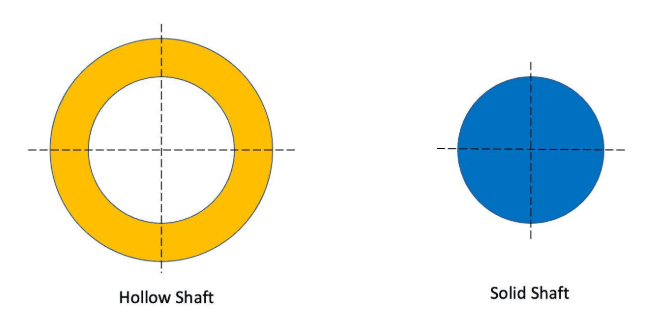
A solid shaft is a filled, cylindrical part that provides power from a driving source (such as an electric motor) to another machine, and a hollow shaft has a hollow center, saving weight without a significant strength reduction. Engineers select hollow or solid shafts based on application requirements such as torque capacity, rotational speed, and weight. As industries move toward lightweight, energy-efficient systems, hollow shafts are gaining popularity over conventional solid shafts.
Why the Choice Between Solid Shaft and Hollow Shaft Matters
A solid shaft is simple and strong and is applied in heavy-duty applications. On the other hand, hollow shafts offer a stronger strength-to-weight ratio, which is crucial in automobile and aerospace systems. The wrong choice of a solid shaft and a hollow shaft can cause certain problems like over-deformation, fatigue breakdown, or ineffective energy utilization.
Design Principles
The shear stress relationships determine the torsional strength of a solid shaft design and a hollow shaft design:
τ=TrJ
Shear stress is related to the torque and the polar moment of inertia. In the case of a solid shaft, the material is spread over the entire cross-section. In the case of a hollow shaft, the concentration of the material is further out from the center, which enhances efficiency. This is the reason why a hollow shaft can, in many cases, be better than a solid shaft of equal weight.
Structural Performance of Solid Shaft
A solid shaft is very rigid and can be easily broken. It is strong under heavy loads and is commonly used in any machine where weight is not a major concern. This consumes more material, however, and much of it does not contribute significantly to torsional resistance in the solid shaft.
Structural Performance of Hollow Shaft
A hollow shaft uses the maximum amount of material. It can perform at less weight by eliminating the low-stress core. A hollow shaft has the advantage over a solid shaft:
- Higher strength-to-weight ratio
- Reduced rotational inertia
- Enhanced performance of dynamic systems.
Testing Methods for Solid Shaft and Hollow Shaft
Test standards confirm the comparison of the performance of a solid shaft and a hollow shaft:
- Torsion Testing – Resistance to twisting.
- Fatigue Testing – Tests the durability over time.
- Bending Tests – Measures the deflection behavior.
- Non-Destructive Testing (NDT) – Internal defects.
These test standards ensure that solid and hollow shaft designs are safe and perform well.
Significance
A hollow shaft has definite benefits over a solid shaft, both in efficiency and performance. It minimizes material consumption while retaining strength and is therefore highly applicable in modern-day engineering systems.
Applications
- A solid shaft is fitted to heavy construction machines and industrial equipment that require high strength and durability.
- A hollow shaft is commonly found in automotive drive shafts, aerospace parts, and turbines, where low weight and high performance are crucial.


