Introduction to FTIR Spectroscopy
Infrared spectroscopy, or FTIR, is among the most common analytical tools used for the identification of chemicals and for the characterization of different materials. The principle of the method involves infrared radiation absorption by the many bonds that are present in the substance. Every chemical bond has a frequency at which it absorbs the infrared radiation, and every material, therefore, has a spectrum with a fingerprint pattern. FTIR spectroscopy is widely used in laboratories and can be used to identify unknowns, verify raw materials, quality-control a final product, or analyze contamination problems. Various industries use FTIR testing, including plastics, pharmaceuticals, chemicals, food processing, and forensics. FTIR spectrum with characteristic absorption peaks of a material.
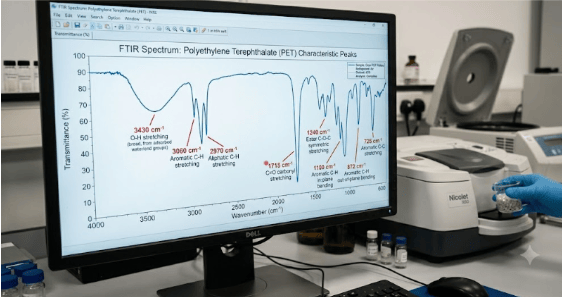
Scope of FTIR Spectroscopy
- FTIR spectroscopy has a wide range of applications.
- Describes chemical compounds and materials.
- Identifies functional groups in molecules.
- Checks the composition of raw materials.
- Analyzes contaminants and unknown materials.
- Assists with quality control and product development.
- Assists with failure analysis and research projects.
- Describes polymers, chemicals, coatings, and pharmaceutical compounds.
Principle of FTIR Spectroscopy
FTIR spectroscopy is the transmission or reflection of the infrared radiation through or onto the sample. Molecules in the material vibrate, absorbing IR wavelengths. The device records the intensity of infrared radiation passing through or absorbed by the sample at various wavenumbers. The resulting FTIR spectrum plots absorption strength on the Y-axis and wavenumber in cm-1 on the X-axis. Each absorption is a particular molecular vibration. The position, intensity, and shape of absorption peaks allow researchers to identify functional groups present and to characterize the material.
Anatomy of an FTIR Spectrum
| X-Axis (Wavenumber) | Displays infrared frequency, usually from 4000 to 400 cm-1. |
| Y-Axis (Transmittance or Absorbance) | Shows the amount of infrared light absorbed by the sample. |
| Absorption Peaks | Indicate specific molecular vibrations and chemical bonds. |
| Fingerprint Region | Region below approximately 1500 cm-1 that contains unique compound-specific patterns. |
| Functional Group Region | The region from approximately 4000 to 1500 cm-1 contains many characteristic absorptions associated with functional groups. |
How to Read an FTIR Spectrum
Step 1: Examine the Functional Group Region
Begin by examining the region from 1500 to 4000 cm-1. Peaks in this region often indicate the presence of specific functional groups such as hydroxyl, carbonyl, amine, or alkane groups.
Step 2: Identify Key Absorption Peaks
Use the positions of peaks to compare with the known absorption ranges of common chemical bonds. Each peak’s wavelength gives data about the molecular makeup of the sample.
Step 3: Analyze the Fingerprint Region
Examine the bottom part of the spectrum from 1500 cm-1. The peak positions in this region vary by compound and are used to distinguish samples.
Step 4: Compare with Reference Spectra
Compare the spectrum with standard spectral libraries or known samples for identification.
Step 5: Interpret the Overall Pattern
Do not use a single absorption band when considering all peaks together. If there are multiple peaks, they are more likely to be definitive for identifying a material.
Common FTIR Peak Assignments
| Wavenumber Range (cm⁻¹) | Typical Bond or Functional Group |
| 3700-3200 | O-H stretching (alcohols, water) |
| 3500-3300 | N-H stretching (amines, amides) |
| 3300-3000 | C-H stretching (alkynes) |
| 3000-2850 | C-H stretching (alkanes) |
| 2260-2100 | C≡N and C≡C bonds |
| 1750-1650 | C=O stretching (carbonyl compounds) |
| 1680-1600 | C=C stretching (alkenes) |
| 1600-1450 | Aromatic ring vibrations |
| 1300-1000 | C-O stretching |
| 900-650 | Aromatic and out-of-plane bending vibrations |
Significance of FTIR Spectroscopy
FTIR spectroscopy is a rapid and reliable technique for material identification and chemical characterization. FTIR is employed by manufacturers to confirm incoming raw materials, to monitor manufacturing processes, and to help ensure product consistency. It is employed in the study of chemical reactions, the characterization of new materials, and the study of degradation mechanisms. FTIR analysis is highly beneficial due to the minimal sample preparation required and often results in analysis within minutes, so it is frequently adopted as a first-line analytical technique for material identification and quality assurance.
Applications of FTIR Spectroscopy
- Recognizes unknown polymers and plastic products.
- Checks raw material content before production.
- Identifies contaminants and foreign material.
- Considers the failure of products and the degradation of materials.
- Ensures consistency of chemical composition.
- Supports pharmaceutical quality control programs.
- Analyzes coatings, adhesives, and composite materials.
- Assists forensic and environmental investigations.
- Tracks polymer oxidation, aging, and chemical changes.
- Helps develop new materials.