

Introduction to ASTM C177 and ASTM C518
Thermal insulation materials are significant in the fields of energy efficiency, temperature control, and product performance. For manufacturers to ensure insulation products comply with design and regulatory requirements, thermal conductivity and thermal resistance must be measured accurately. ASTM C177 (Standard Test Method for Steady-State Heat Flux Measurements and Thermal Transmission Properties by Means of the Guarded-Hot-Plate Apparatus) and ASTM C518 (Standard Test Method for Steady-State Thermal Transmission Properties by Means of the Heat Flow Meter Apparatus) are some of the most widely used standards for thermal property evaluation. ASTM C177 uses a guarded hot plate apparatus to directly measure heat transfer through a specimen under precisely controlled steady-state conditions. ASTM C518 specifies a heat flow meter apparatus to measure heat flux through the specimen to determine thermal conductivity using calibrated heat-flow measurements. Both methods measure thermal performance, and ASTM C177 is sometimes used as a reference method for ASTM C518, which is typically utilized for routine production testing, since it can be completed in a shorter time frame.
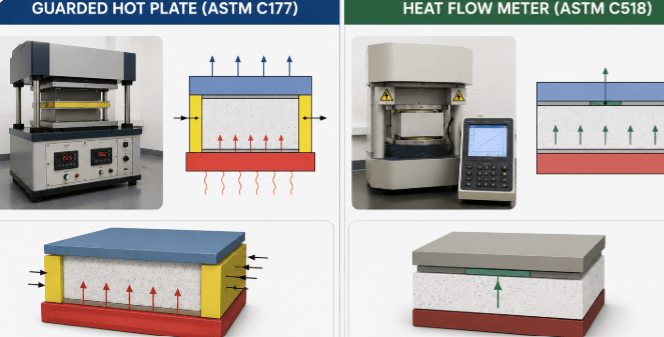
Scope of ASTM C177 and ASTM C518
ASTM C177
- Determines the thermal conductivity and thermal resistance.
- Uses a guarded hot plate apparatus.
- Provides steady-state heat transfer measurements.
- Acts as a reference method of thermal testing.
- Supports research, certification, and product development.
ASTM C518
- Determines thermal conductivity and thermal resistance.
- Uses a heat flow meter apparatus.
- Performs fast thermal property measurements.
- Assists in quality control and production testing.
- Assesses insulating and thermal barrier materials.
Principles of ASTM C177 and ASTM C518
ASTM C177 places a specimen between heated and cooled plates within a guarded hot plate apparatus. The system creates a temperature difference in the material at a steady state. The apparatus directly measures the heat flow through the specimen and calculates the thermal conductivity and thermal resistance of the specimen. The method carefully controls heat losses and boundary conditions, thus providing very accurate thermal property measurements.
ASTM C518 requires a specimen to be placed between two temperature-controlled plates in a heat flow meter apparatus. Heat flow sensors determine the amount of heat flowing across the material. The instrument uses measured heat flux and calibration factors to calculate thermal conductivity and thermal resistance. It is a faster method than ASTM C177 and is commonly used for routine testing and quality control applications.
Test Procedure Overview
| Step | ASTM C177 | ASTM C518 |
| Sample Preparation | Prepares flat specimens with specified dimensions. | Prepares flat specimens suitable for heat flow meter testing. |
| Test Equipment | Guarded hot plate apparatus. | Heat flow meter apparatus. |
| Measurement Process | Directly measures steady-state heat transfer. | Measures heat flux through calibrated sensors. |
| Test Duration | Longer due to steady-state requirements. | Shorter testing time. |
| Result Expression | Thermal conductivity and thermal resistance. | Thermal conductivity and thermal resistance. |
Key Differences Between ASTM C177 and ASTM C518
| Feature | ASTM C177 | ASTM C518 |
| Primary Method | Guarded hot plate | Heat flow meter |
| Measurement Type | Direct measurement | Calibrated heat flux measurement |
| Accuracy | Reference-level accuracy | Highly accurate but dependent on calibration |
| Test Speed | Slower | Faster |
| Equipment Complexity | More complex | Simpler and easier to operate |
| Typical Use | Research, certification, reference testing | Production testing and quality control |
| Steady-State Requirement | Yes | Yes |
| Industry Preference | Reference and validation testing | Routine laboratory testing |
Significance of ASTM C177 and ASTM C518
ASTM C177 is a very precise method for measuring thermal conductivity and is frequently used to assess insulation products. The approach often assists researchers or certification organizations when the highest level of accuracy is desired. ASTM C518 provides a practical alternative to the routine test, shortening testing time while maintaining excellent accuracy for routine applications. The standard aids manufacturers in keeping track of product uniformity, verifying thermal performance, and implementing quality control programs. These standards, combined, help ensure that insulation products perform as expected in service in building, industrial, and specialty applications.
Applications of ASTM C177
- Evaluates thermal insulation materials.
- Supports research and development programs.
- Provides reference thermal conductivity measurements.
- Assists with product certification and validation.
- Evaluates advanced insulation systems.
- Supports regulatory compliance testing.
Applications of ASTM C518
- Performs routine quality control testing of insulation products.
- Evaluates foam insulation materials.
- Tests building insulation and thermal barriers.
- Supports manufacturing process control.
- Verifies thermal performance specifications.
- Assists product development and qualification programs.


