

Introduction to Activated Carbon Testing
Activated carbon testing refers to the assessment of physical properties and adsorption ability of carbonaceous materials to assure their performance in filter systems. The iodine number is a key value for assessing micropore capacity; particle size distribution is another key indicator, and total surface area is determined by gas adsorption. Chemical analyses also confirm purity by moisture, ash, and pH measurements. The standardized tests ensure safety, durability, and excellent structural efficiency in water and air purification systems.
What is Activated Carbon Testing?
Environmental, pharmaceutical, and industrial processes commonly use activated carbon, a porous adsorbent material. Surface characteristics such as surface area, porosity, and chemical purity determine its performance. Internationally accepted standards, such as those published by the ASTM, assess these properties. These offer reliable techniques to determine adsorption capacity, physical characteristics, and purity. For instance, industry professionals commonly use the iodine number (ASTM D4607) to estimate micropore volume and the degree of activation.
Validated methods enable reliable testing and quality control during manufacturing and use. They also enable industries to evaluate and compare different carbon products and comply with regulations. These standards combine adsorption testing, proximate analysis, and physical testing to determine the performance of activated carbon in a variety of applications.
What is the Scope of Activated Carbon Testing?
Activated carbon testing consists of several standard laboratory procedures used to test the adsorption performance, physical properties, and chemical quality of the powdered and granular activated carbon. These tests are used to verify product consistency, compare various types of carbon, support quality control, and verify that the activated carbon is suitable for both application and regulation.
- Evaluate the adsorption capacity of activated carbon
- Determine physical properties such as moisture, ash, and density
- Assess pore structure and surface characteristics
- Apply testing to both virgin and reactivated carbon materials
- Include liquid-phase and gas-phase adsorption testing
- Ensure quality control across manufacturing and application sectors
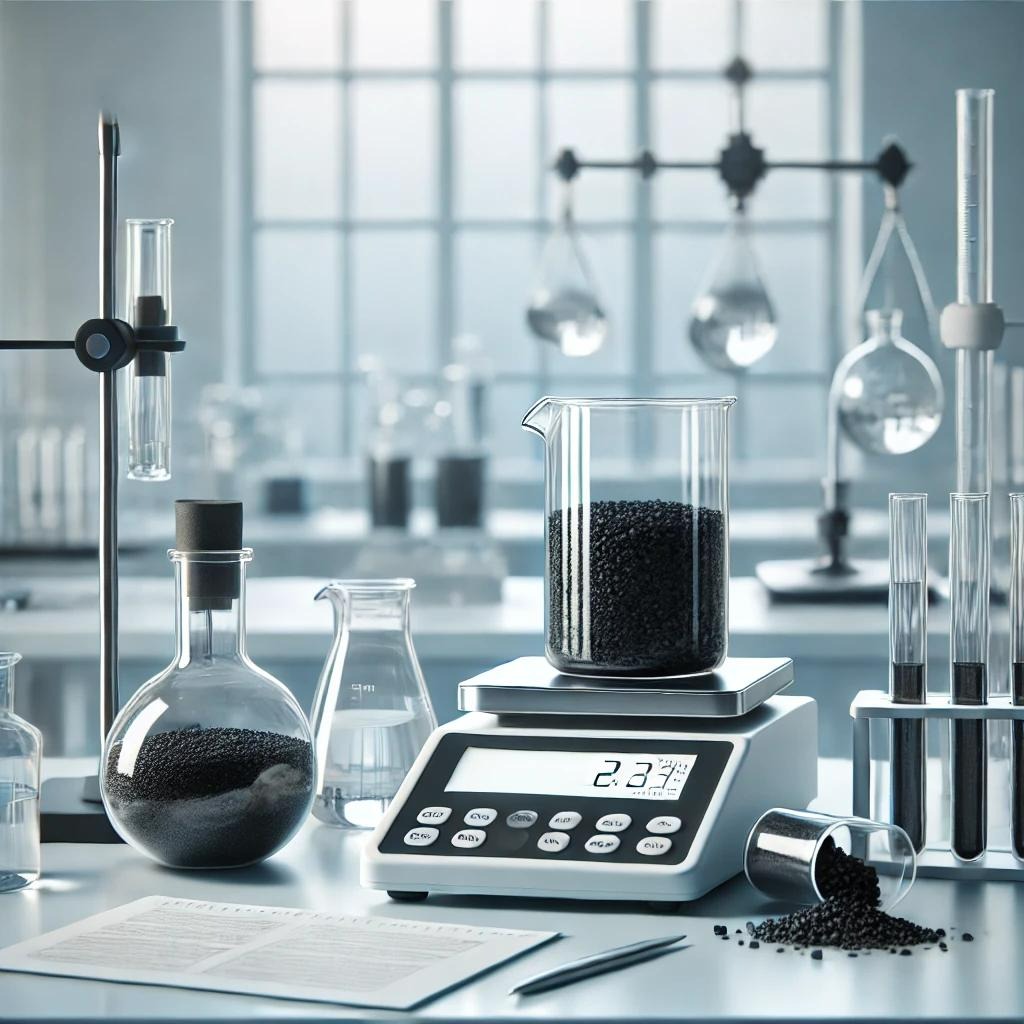
Principle of Iodine Number Determination per ASTM D4607
The iodine number is the amount of iodine (grams) that is adsorbed by one gram of activated carbon, as measured by ASTM D4607, and is a significant indicator of the degree of activation and the micropore adsorption capacity of activated carbon. Testing activated carbon requires assessing its adsorption and physical characteristics under standardized conditions. This process determines how effectively the carbon’s adsorption capacity removes contaminants in liquid or gas phases, based on its pore structure and surface area. While the iodine number measures micropore adsorption capacity, moisture and ash content indicate purity and suitability for use. Gas and water phase adsorption tests evaluate performance, revealing dynamic adsorption capacity and effectiveness. These well-established procedures provide consistent results and allow for comparisons among various carbon types in industrial applications.
How is Activated Carbon Testing Performed?
Activated carbon testing typically involves exposing a known mass of carbon to a standard adsorbate solution or gas, followed by measurement of adsorption capacity through titration, gravimetric, or instrumental methods. Analysts dry, condition, and accurately weigh specimens before performing adsorption, density, moisture, ash, and particle size tests on calibrated laboratory instruments. The results are compared with product specifications to verify quality and application suitability.
| Specimen Details | The analyst takes a sample of activated carbon (powdered or granular), dries and weighs it, typically between 0.1 and 1 g, and then pre-treats to remove moisture or impurities |
| Equipment Used | Analysts use an analytical balance (accuracy ±0.001 g), a drying oven (100–150 °C), and a muffle furnace (for ash content); they also require adsorption columns (gas/liquid phase testing), sieves (particle size analysis), a spectrophotometer, volumetric flasks and burettes, filtration apparatus, a mechanical shaker or stirrer, and a titration setup (for iodine number) |
Why Testing Standards are Crucial for Quality and Compliance?
Testing standards for activated carbon ensure product quality and performance across various applications. Because the starting materials and preparation methods create variability in activated carbon properties, these standards help confirm its adsorption capacity, mechanical integrity, and purity. They also protect essential applications like water treatment, pharmaceuticals, and the food industry by controlling contaminants and adhering to regulatory guidelines. Moreover, they help manufacturers maintain product consistency and empower users to choose the right carbon grade for their specific needs. Overall, these standards improve efficiency, reduce risks, and ensure the safety of the environment and consumers.
Significance
Testing standards for activated carbon ensure product quality and performance across various applications. Because the starting materials and preparation methods create variability in activated carbon properties, these standards help confirm its adsorption capacity, mechanical integrity, and purity. They also protect essential applications like water treatment, pharmaceuticals, and the food industry by controlling contaminants and adhering to regulatory guidelines. Moreover, they help manufacturers maintain product consistency and empower users to choose the right carbon grade for their specific needs. Overall, these standards improve efficiency, reduce risks, and ensure the safety of the environment and consumers.
Key Activated Carbon Properties Evaluated by Testing Standards
Activated carbon testing refers to the physical and chemical characteristics that directly affect its adsorption efficiency, service life, and product quality. Laboratories test physical properties as well as adsorption performance to determine whether the material meets application requirements and standardized specifications.
- Iodine number (micropore adsorption capacity)
- Surface area
- Pore volume and pore size distribution
- Moisture content
- Ash content
- Bulk density
- Particle size distribution
- Apparent density
- Hardness and abrasion resistance
- pH and water-soluble impurities
- Adsorption capacity
- Surface cleanliness and purity
Major Applications of Activated Carbon Testing Across Industries
Activated carbon testing is relevant to industries where adsorption performance directly influences product quality, environmental protection, and process efficiency. Before activated carbon is used in critical applications in industry and the environment, its adsorption capacity, purity, and durability are verified through standardized testing.
- Confirm use of activated carbon for drinking water and wastewater treatment.
- Assess adsorbents for air purification and VOC removal applications.
- Test activated carbon for the pharmaceutical industry.
- Assess food and beverage processing applications.
- Test activated carbon for gold extraction.
- Test chemical processing and catalyst support materials.
- Assist with quality control in the production of activated carbon.
- Assist product development and research activities.


