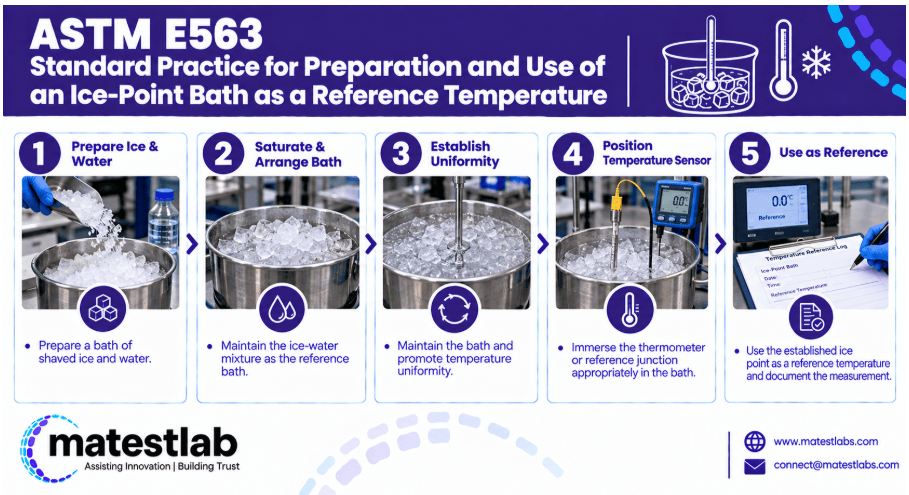
ASTM E563 covers a method of preparing, maintaining, and using a temperature reference bath of shaved ice and water, saturated with air at a pressure of 101 325 Pa (1 atm). This practice encompasses an industrial method of relating values referenced to the ice point to the water triple point on ITS-90, although it does not detail bath-stirring methods or thermostatically controlled ice-point approximation techniques. The scope of ASTM E563 encompasses:
- Material type: Shaved ice and water mixture, saturated with air at standard atmospheric pressure.
- Purpose: Establishment of a fixed-point reference temperature for thermometer calibration.
- Properties evaluated: Reference temperature at the ice point, nominally 0 °C.
- Testing Method: Preparation and maintenance of an ice-water bath, with thermometer immersion for calibration or reference use.
- Result: A stable ice-point reference temperature suitable for resistance, thermoelectric, or liquid-in-glass thermometry.
- Test Limitations: This practice does not detail mechanical stirring methods for bath uniformity or thermostatically controlled ice-point approximation methods.
- Environmental conditions: Atmospheric pressure, bath composition, and thermal isolation of the reference junction affect the accuracy of the ice-point reference.
- Applications: Resistance thermometer calibration, thermocouple reference-junction stabilization, liquid-in-glass thermometer recalibration, and industrial thermometry quality control.
What are the Uses of ASTM E563 Testing?
ASTM E563 testing helps laboratories in establishing a dependable ice-point reference temperature for calibrating multiple types of thermometers. Calibration technicians and instrument manufacturers then use this reference to verify thermometer accuracy against a known fixed point. This standard-
- Provides a readily available, natural fixed-point reference temperature for thermometry.
- Supports resistance thermometer calibration at the 0 °C ice point.
- Serves as the ordinary reference temperature for thermoelectric thermometry using thermocouples.
- Supports periodic recalibration of liquid-in-glass thermometers to detect glass strain relaxation.
- Relates ice-point reference values to the water triple point on ITS-90 for industrial applications.
- Supports calibration programs referenced by other ASTM standards that specify the ice point.
What Materials Can Be Tested Under ASTM E563?
ASTM E563 applies to the preparation of an ice-point reference bath using shaved ice and water saturated with air at standard atmospheric pressure. This practice applies to the calibration of resistance thermometers, thermocouples used in thermoelectric thermometry, and liquid-in-glass thermometers. Before beginning bath preparation, an analyst verifies the intended thermometer type and the reference standard’s requirements, since resistance, thermoelectric, and liquid-in-glass thermometry each apply the ice-point reference somewhat differently.
Why is ASTM E563 Important?
ASTM E563 provides a standardized method for preparing a fixed-point reference temperature that supports accurate thermometry throughout industrial and laboratory applications. The ice point is a common industrial reference point because it is relatively simple to realize and provides an established, readily available natural fixed-point reference temperature. Before 1960, the ice point served as a defining fixed point on practical temperature scales, and it remains the ordinary reference temperature in thermoelectric thermometry today. Periodic recalibration of a liquid-in-glass thermometer at the ice point also reveals the effect of gradual relaxation of residual mechanical strains in the glass, which can otherwise affect measurement accuracy over time.