ASTM D7514 Standard Test Method for Evaluating Ink Stain Blocking of Architectural Paint Systems by Visual Assessment

    What is ASTM D7514?

    ASTM D7514 is a standard test method in the coatings industry for measuring a specially formulated paint system’s ability to resist bleeding. It sets out a common procedure to test whether severe discoloration from surface marker lines or writing tools can penetrate the base layer and affect the external finish. It plays a crucial role in developing high-performance formulations that maintain surface appearance over long periods, both inside and out, and manufacturers rely on it heavily. Standardizing the appraisal process allows laboratories to simulate realistic household or commercial contamination scenarios. ASTM D7514 (Standard Test Method for Evaluating Ink Stainblocking of Architectural Paint Systems by Visual Assessment) provides empirical data on barrier performance and bleed resistance.

    Read more

    Certified ASTM D7514  Testing for Performance Compliance 

    Manufacturers use ASTM D7514 to test the barrier properties of their architectural coating formulas for migrating ink contaminants. Official verifications under this designation guarantee that the primers and topcoats comply with a high level of technical requirements in terms of stain resistance and surface durability. This third-party validation not only gives you a marketing edge but also builds commercial credibility, assures regulatory compliance, and offers a marketing advantage for your product line that actively prevents permanent marker bleeding.

    What is the Scope of ASTM D7514?

    ASTM D7514 is a standard test method used to evaluate the ability of an integrated multi-coat paint system to “trap” deep-penetrating ink contaminants under the paint surface. It is developed under the control of Subcommittee D01.42 to provide a method for all raw material suppliers and manufacturers to measure all film barrier properties to a common standard of strict SI units. The criteria help to ensure that minor variations in the characteristics of the substrate are appropriately balanced when evaluating them. 

    Read more

    The scope of ASTM D7514 includes:

    • Materials:  Liquid architectural primers, sealers, and topcoats applied to pre-stained substrates.
    • Purpose: Evaluates the barrier capability of coatings to stop ink bleeding into the final finish.
    • Tested properties: Degree of visible bleed-through, stain migration, and topcoat discoloration.
    • Methods: Controlled film drawdown application and standardized visual evaluation scales.
    • Result: Visual rating or colorimetric profile to measure overall stain-blocking performance.
    • Test Limitation: Does not cover structural wood tannin bleed or actual material failures.
    • Environmental conditions: Very tight control of drying room temperature and relative humidity profiles.
    • Applications: Quality Control, Product Development, and Verification of architectural performance specifications.

    What are the Uses of ASTM D7514 Testing? 

    ASTM D7514 is a standard test method used as a basis for comparison of chemical formulations from the commercial paint manufacturing industry. It does away with the subjectivity, giving an objective basis for comparing stain blocking. This standard,

    • Enables raw material suppliers to measure new resin barrier innovations.
    • Optimizes pigment volume concentration versus bleeding.
    • Allows for quality assurance staff to ensure batch-to-batch uniformity prior to shipment.
    • Provides guidance to commercial contractors on the selection of recognized primer-topcoat systems to use in high-traffic areas.

    What material can be tested under ASTM D7514?

    Testing is performed with this framework to allow a wide range of liquid architectural coatings such as latex primers, waterborne acrylic modified alkyd finishes, traditional solvent-based sealers, and specialty stain-blocking interior base coats. The evaluation of these paint systems is done on standard laboratory substrates and/or pre-treated test panels with a uniform contamination of commercial ink media. These include different dyes employed in inks, permanent markers, fluids used in felt-tip writing instruments, and ballpoint pen formulations. This standard permits testing of these various stained surfaces, to be able to accurately simulate real-world consumer substrates.

    Why is ASTM D7514 Important?

    This is an important standard, as many stains are difficult to remove from the surface and cause paint failures if they are not removed during the preparatory process. Manufacturers cannot be sure whether an interior primer will permanently bind ink matrices or will enable them to move forward as the film dries if there is no reliable testing protocol. ASTM D7514 details the correct criteria needed to duplicate failure mode in a controlled laboratory environment. This means that it helps minimize expensive in-field failures, minimizes warranty claims from contractors, and guarantees that consumers can achieve consistent and uniform results with pre-marked commercial walls when renovating.

    ASTM D7514 Equipment and Sample Preparation Guide

    ASTM D7514 testing is followed with careful preparation of the substrate and calibration of application equipment to achieve a consistent film thickness throughout the test site. Artificial variations in bleeding outcomes are averted with controlled sample generation. The guide below describes the minimum configurations required for testing:

    Read more

    Sample and Specimen DetailsTechnicians select representative liquid paint batches and standardized, flat test panel substrates. 
    Specimen PreparationOperators apply uniform lines of specified ink staining agents across the baseline substrate surface.
    Specimen DimensionsEngineers configure the substrate panels according to standard drawdown lengths to ensure adequate test area.
    InstrumentationAnalysts utilize calibrated drawdown bars, film applicators, and specialized environmental control chambers.

    Testing Procedures and Requirements for ASTM D7514

    Following the environmental requirements set during the test sequence improves repeatability across different test labs. Each phase should be carried out continuously with a stringent temperature limitation. The test is conducted in the following steps:

    Read more

    Substrate StainingTechnicians apply staining media to the test panel in a controlled manner.
    Primer ApplicationOperators apply the primer coating at a target wet film thickness.
    Curing IntervalOperators dry the primed panel under defined temperature and humidity conditions.
    Topcoat ApplicationTechnicians cast the architectural topcoat over the primer layer.
    Visual EvaluationAnalysts visually rate the system for ink penetration or discoloration.

    ASTM D7514 Testing Process and Data Collection

    The general experimental approach involves observing the chemical movement through different curing stages. The technicians take accurate measurements of wet film thickness, room parameters, and drying times between the layers of coats. When the architectural system is cured completely, data are collected to document changes in surface appearance. Standard visual rating scales are used to collect any noticeable changes in color value or any local breakthroughs in the ink, and these are used to set performance benchmarks.

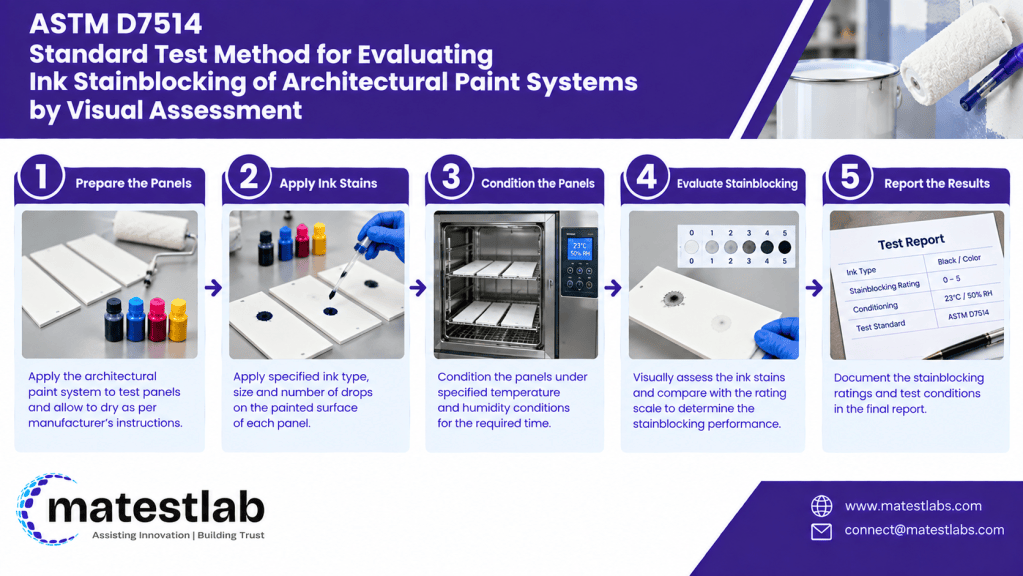
     The image shows ASTM D7514 steps covering, preparing painted test panels, applying specified ink stains, conditioning the panels under controlled temperature and humidity, visually evaluating stain visibility using a rating scale, and documenting the results.
    ASTM D7514 Evaluation of Ink Stain Blocking of Architectural Paint Systems

    Common Challenges and Troubleshooting

    If the film thickness is not even during drawdown, it may result in false readings and lead to early breakthrough of ink into thin film. Additionally, when the laboratory does not control the relative humidity, drying periods vary, and therefore the polymer network formation and barrier density also vary. Operators need to troubleshoot these errors by using the automated drawdown machines to achieve absolute coating uniformity on the whole panel.

    ASTM D7514 Analysis Results and Interpretation

    The final analytical evaluation converts visually observed surface attributes into objective measurements of stain-blocking performance. The level of topcoat discoloration is compared with unaltered sections of the topcoat to determine ratings.

    Read more

    • Technicians visually examine the coated test panels for ink bleed-through and compare the appearance with the agreed evaluation criteria. Analysts record the stain-blocking rating for each tested ink or writing implement.
    • Technicians document whether ink discoloration appears in the topcoat and whether the stain remains blocked beneath the finish. They record the location and extent of visible bleed-through to support consistent interpretation.
    • Analysts use spectrophotometric or colorimetric measurements only as supplementary data when included in the agreed test plan. These measurements do not replace the method’s visual assessment.
    • Engineers compare stain-blocking ratings among tested paint systems, substrates, and ink types. They interpret differences in the context of the tested primer/topcoat combination rather than treating the results as a universal ranking of waterborne and solvent-borne formulations.

    Link to ASTM D7514

    FAQ

    How do I submit a sample or request an ASTM D7514 quote?
    You can submit product samples by filling out an online request form via an accredited laboratory’s testing portal, providing complete coating details, safety data sheets, and target wet film thickness specifications.
    Laboratories utilize calibrated film drawdown applicators, standardized ink-staining writing instruments, controlled environmental drying rooms, and visual assessment viewing booths to measure bleeding resistance under standard SI units.
    Testing providers maintain formal ISO/IEC 17025 accreditations, ensuring all architectural paint evaluations strictly conform to the parameters established by ASTM International Committee D01.
    Yes, accredited testing facilities routinely process coating samples from international manufacturers, handling global logistics, custom sample preparation, and digital reporting in full compliance with international testing standards.

    Updated on November 5, 2026

    Malhar Khole
    About Author
    Malhar Khole is a Material Testing Associate at Matestlab Inc. and holds a postgraduate degree in Material Science and Technology from IIT (BHU), Varanasi.
    Know More
    Testimonials
    Real results
    Engineers trust us with what matters most
    Why Choose Matestlab?
    Matestlab is a unified testing services partner based in the USA. Matestlab offers raw material and product testing services through accredited, expert laboratories primarily based in the USA. Matestlab supports physical, thermal, chemical, electrical, mechanical, environmental, and characterization testing needs through its global network of 2200+ accredited testing laboratories. Matestlab's in-house materials science experts curate and design comprehensive testing programs matched to the sample material and specific testing need, with regulatory requirements and confidentiality in mind.

    If you are looking for a managed and trusted testing partner to achieve your research goals, feel free to schedule a meeting with us or send us a request at connect@matestlabs.com to learn more about our services. For a quick quote, call us at (302)244-7710. We are happy to serve you.
    Start Your Testing
    Project Today
    Define your requirements and get access to
    specialized laboratories ready to deliver results
    Partners with us
    Clients
    Vendors
    Process for testing
    • STEP 01

      You share your testing requirements

    • STEP 02

      You share your sample(s)

    • STEP 03

      We deliver your test reports

    Get your testing done

    Let us know your testing requirements and we will be right back with a solution.

      Let us root for each other. Collaborate to grow, expand, and accelerate our businesses.

      Partner with us