ASTM D7359 Total Fluorine, Chlorine, and Sulfur in Aromatic Hydrocarbons
What is ASTM D7359?
ASTM D7359 is a standard test method for determining total fluorine, chlorine, and sulfur in aromatic hydrocarbons and their mixtures. The technique is known as oxidative pyrohydrolytic combustion and detection by ion chromatography, or combustion ion chromatography (CIC). In the test, fluorine, chlorine, and sulfur compounds are converted to measurable ionic species in high-temperature combustion with oxygen and water. The combustion products pass through an absorption system and then through an ion chromatograph for separation and measurement. ASTM D7359 (Standard Test Method for Total Fluorine, Chlorine, and Sulfur in Aromatic Hydrocarbons and Their Mixtures by Oxidative Pyrohydrolytic Combustion followed by Ion Chromatography Detection (Combustion Ion Chromatography-CIC)) covers concentrations from 0.10 to 10 mg/kg for each element.
Get Certified ASTM D7359 Testing for Reliable Elemental Control
ASTM D7359 testing allows a laboratory to determine trace amounts of total fluorine, chlorine, and sulfur in aromatic hydrocarbon products. Correct elemental analysis is used to detect contaminants that may cause emissions, harm the catalyst, or cause corrosion. Laboratories can use the results for quality control, product specifications, process monitoring, and compliance evaluations when the applicable authority accepts the method.
What is the scope of ASTM D7359?
The total amount of fluorine, chlorine, and sulfur in aromatic hydrocarbons and mixtures are determined by ASTM D7359. The standard applies to samples with 0.10–10 mg/kg of each element. Laboratories may dilute samples outside this range if they check solubility and method performance after dilution.
The method involves oxidative pyrohydrolytic combustion and detection with ion chromatography. Laboratories must control contamination and carryover when limits are below 1.0 mg/kg.
The scope of ASTM D7359 includes:
Material type: Aromatic hydrocarbons and their mixtures.
Purpose: Determine total fluorine, chlorine, and sulfur.
Elements measured: Fluorine, chlorine, and sulfur.
Method: Oxidative pyrohydrolytic combustion with ion chromatography detection.
Concentration range: 0.10 to 10 mg/kg of each element.
Extended range: If a sample falls outside the range, the analyst may dilute it to check the method’s solubility and performance.
Low level: Below 1.0 mg/kg, contamination, carryover, and system background must be carefully controlled.
Applications: Product quality control, contamination monitoring, process control, catalyst protection, corrosion control, and specification or compliance evaluation.
What are the uses of ASTM D7359 testing?
ASTM D7359 testing offers a single method for the determination of trace halogens and sulfur in aromatic hydrocarbon matrices. The method is specific for aromatic hydrocarbons and mixtures of aromatic hydrocarbons. This standard-
Determine elemental impurity levels and identify sulfur and halogen contaminants that can harm catalytic processes.
Monitor elements that can contribute to corrosive conditions and assist with sulfur and halogen emissions evaluation.
Monitor contamination during chemical processing and refining.
Which Materials Can Be Tested Under ASTM D7359?
The method is specific for aromatic hydrocarbons and mixtures of aromatic hydrocarbons. It is especially useful when laboratories require overall levels of fluorine, chlorine, and sulfur rather than compound-specific levels.
Why is ASTM D7359 important?
Fluorine, chlorine, and sulfur may impact industrial processes at low levels. These elements may cause emissions, interfere with catalysts, and cause corrosion. ASTM D7359 combines high-temperature combustion with ion chromatography to measure these elements as ion species and quantify them individually.
ASTM D7359 Equipment and Sample Preparation Guide
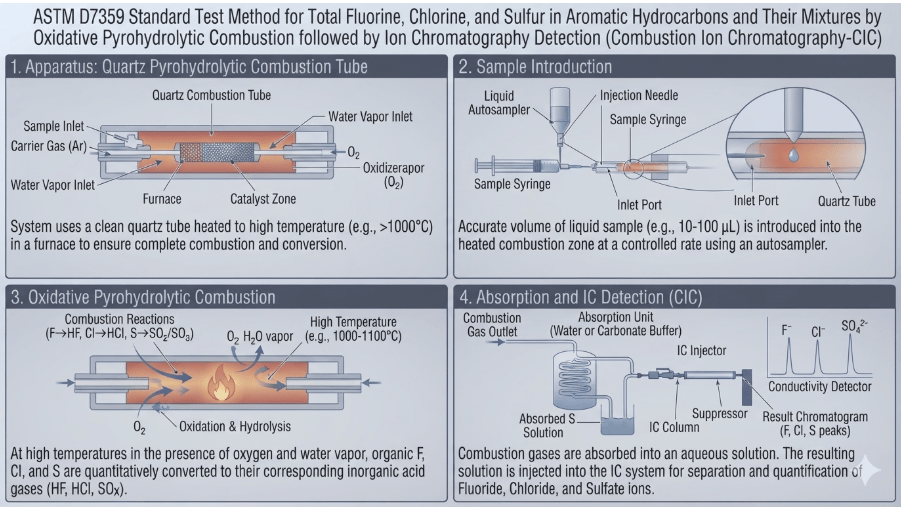
The combustion system should provide controlled sample introduction and complete oxidation. ASTM D7359 calls for a combustion tube of quartz pyrohydrolytic material that can be used to achieve temperatures of up to 1100°C. For the efficient separation, suppression, and detection of ions in the ion chromatograph, the appropriate separation, suppression, detection, and data-processing characteristics are needed.
Technicians first take a liquid aromatic hydrocarbon or aromatic hydrocarbon mixture. The method analyzes approximately 0.10–10 mg/kg of fluorine, chlorine, and sulfur in the sample.
Specimen Preparation
Technicians then homogenize the sample and transfer a known volume using a gas-tight sampling syringe or automated liquid sampler. They then dilute samples outside the working range with an appropriate solvent after confirming solubility and method performance.
Specimen Dimensions
ASTM D7359 does not specify fixed solid specimen dimensions because the method analyzes liquid samples. A typical sample introduction uses 10–100 µL in a sample boat.
Instrumentation
Combustion system with a quartz pyrohydrolytic combustion tube, a quartz or ceramic sample boat, a humidified carrier-gas system, an analytical balance, a gas-tight syringe or autosampler, an absorption system, an ion chromatograph, an anion separation column, a suppressor, a detector, and a data-acquisition system.
Testing Procedures and Requirements for ASTM D7359
The test is carried out under a controlled sequence from the introduction of the sample, combustion, absorption, ion separation, detection, and calculation. Other reference ASTM documents include D1193, D3437, D3505, D6809, E29, E177, E288, E691, and E969. The complete procedure of ASTM D7359 is given as:
Technicians introduce a known liquid sample volume, typically 10–100 µL, into a quartz or ceramic sample boat using a gas-tight syringe or autosampler.
Oxidative Pyrohydrolytic Combustion
They then transfer the sample into the heated quartz combustion zone and use oxygen and humidified carrier gas to promote complete combustion and pyrohydrolysis.
Absorption and IC Detection
Skilled personnel capture combustion products in the absorption system and transfer the resulting solution to the ion chromatograph, separate the target anions, detect their peaks, and calculate fluorine, chlorine, and sulfur concentrations.
ASTM D7359 Testing Process and Data Collection
Technicians first prepare the CIC system, establish a clean analytical background, and introduce a measured sample volume into the combustion system. High-temperature oxidative pyrohydrolytic combustion converts the fluorine, chlorine, and sulfur compounds into combustion products. The system absorbs these products into an absorption solution. The ion chromatograph then separates the resultant anions and quantifies the chromatograph response. Calibration standards define the relationship between peak response and elemental concentration. Once the calibration and blank corrections have been applied, the laboratory can calculate the concentration in the original sample.
ASTM D7359 Testing Procedure Using Quartz Pyrohydrolytic Combustion Tube
Common Challenges and Troubleshooting
Careful control is necessary in ASTM D7359 testing, as this can be easily contaminated and carry over to the elemental analysis results. Typical problems are carryover, high blank, incomplete combustion, lack of chromatographic resolution, sample solubility issues, low-level instability, and anion interference. Technicians should carefully prepare specimens and use the appropriate method to minimize false-positive results.
ASTM D7359 Analysis Results and Interpretation
The report summarizes the concentrations of fluorine, chlorine, and sulfur measured in the tested sample. The results help analysts quantify these elements, evaluate concentrations within the method’s applicable range, and compare the reported values with specification requirements.
The laboratory reports fluorine, chlorine, and sulfur concentrations in mg/kg, with the method covering a nominal range of 0.10 to 10 mg/kg for each element.
Analysts determine concentrations outside the stated range when appropriate dilution, low-level controls, or other applicable method-performance requirements support reliable measurement.
Analysts record the measured concentration for each element and identify the sample and relevant analytical conditions associated with the reported results.
The analyst rounds the reported results in accordance with ASTM E29 when the values are used to determine conformance with applicable specifications.
Engineers compare the reported elemental concentrations with applicable specification limits or reference values to evaluate the sample against the required criteria.
How Should the Results Be Interpreted?
The higher the fluorine, chlorine, or sulfur, the higher the total amount of that element in the aromatic hydrocarbon sample. Laboratories compare each result to the relevant product specification, process limit, or regulation.
The higher the fluorine, chlorine, or sulfur, the higher the total amount of that element in the aromatic hydrocarbon sample. Laboratories compare each result to the relevant product specification, process limit, or regulation.
FAQ
What does ASTM D7359 measure?
Measures total fluorine, total chlorine, and total sulfur for aromatic hydrocarbons and their mixtures separately.
What concentration range does ASTM D7359 cover?
The standard covers 0.10 to 10 mg/kg of each element.
What technique does ASTM D7359 use?
It employs oxidative pyrohydrolytic combustion and ion chromatography detection (CIC).
What is the primary laboratory unit?
Laboratories report fluorine, chlorine, and sulfur concentrations in mg/kg.
Dr. Ruchika Yogesh is a serial entrepreneur, material science and AI/ML enthusiast, medicinal chemistry subject matter expert (SME), scientific/medical copyeditor, and a researcher. Know More
Testimonials
Real results
Engineers trust us with what matters most
“We had a great experience working with this company for our ASTM E84 testing. They were the first company to respond to our inquiry within just a few minutes of submitting it. From start to finish, the communication was excellent, and the entire process was swift, straightforward, and hassle-free.”
Ivars FancyWalls
United States
“Very good communication, testing associates were very patient with delays on our end. Reasonable turnaround time for results and nicely detailed report. Analysts were also quick to answer any follow-up questions. Happy with results.”
Skye Henderson
United States
“Matestlab connected us with an accredited lab within days, cutting weeks off our product validation timeline.”
Rebecca Kozodoy-Pins
United States
Start Your Testing Project Today
Define your requirements and get access to specialized laboratories ready to deliver results