
ASTM D7264 Flexural Properties of Polymer Matrix Composite Materials

    ASTM D7264 Introduction

    ASTM D7264 (Standard Test Method for Flexural Properties of Polymer Matrix Composite Materials) provides guidelines for controlled-loading flexural testing of polymer-matrix composites. The flexural test measures a material’s flexibility, which helps engineers understand its stiffness, strength, and deformation characteristics. Furthermore, the method was specifically designed for continuous-fiber-reinforced polymer composites and a conventional span-to-thickness ratio of 32:1. This test method is for long-beam flexural behavior, unlike the plastics-based tests (ASTM D790 and ASTM D6272). Thus, ASTM D7264 can be used for material qualification, quality control, research, and evaluation of structural design in advanced composite applications.

    Read more

    Get Certified ASTM D7264 Testing for Reliable Composite Material Performance

    The flexural properties are directly related to the durability and structural reliability of composite parts. So it’s important to test accurately to determine the right materials for tough applications. Additionally, certified laboratory testing enhances quality control and minimizes the risk of structural failure. 
    Scope of ASTM D7264 Test Standard

    • Measures the flexibility of polymer matrix composites
    • Measures the resistance to bending forces.
    • Describes the three-point and four-point loading procedures
    • Compares the deflection of long beams under flexural loads
    • Provides for testing that involves structures and design

    Equipment and Sample Preparation

    Universal Testing MachineApplies controlled flexural loading during three-point or four-point bending tests.
    Flexural FixtureSupports specimens with defined loading and support span geometry.
    Composite Test SpecimenPrepared with specified dimensions and conditioned before testing.

    Use of ASTM D7264 

    • Performs the qualification of composite materials
    • Participates in quality control programs
    • Helps compare structural composite systems
    • Comprehends the impact of the environment on composites
    • Supports design applications for the aerospace and automotive sectors.

    Why does ASTM D7264 use a 32:1 span-to-thickness ratio?

    The use of the 32:1 span-to-thickness ratio in ASTM D7264 provides an accurate assessment of the long-beam flexural properties. This geometry minimizes the effects of shear stress and the distribution of bending stress through the specimen. Therefore, the engineers can obtain more representative flexural strength and stiffness values for continuous-fiber-reinforced composites.

    Read more

    What Is the Difference Between Procedure A and Procedure B?

    In procedure A, a single loading point is applied during 3-point bending. On the other hand, Procedure B employed two loading points, located at one-half of the support span. Thus, the flexural property values obtained from the two procedures are slightly different. Engineers need to follow the same process in every case to compare.

    Common Challenges and Troubleshooting 

    Technicians can experience misalignment of specimens, early edge failure, and improper span configuration during testing. Therefore, these problems can influence the flexural strength and stiffness measurements. Also, if the specimen is not prepared properly, data obtained from the load-deflection curves may not be uniform. In laboratories, these problems can be reduced by careful positioning of fixtures, accurate calibration of equipment, and control of specimen dimensions.

    Testing Technique, Process, and Data Collection

    The first step in testing is to prepare the specimen, followed by a check of the dimensions. The technicians then place the specimen on the support fixture. Then, the testing machine sets a continuous flexural load and records the force and the deflection. Finally, the flexural strength, stiffness, and load deflection properties are calculated from the data recorded. Standard testing conditions increase the likelihood of reproducibility and reliability in results.

    Testing Procedure and Requirements

    The test standard specifies flexural properties through either three-point or four-point loading. Both Procedures (A) and (B) involve center loading on a simply supported beam. The machine applies a continuous load during the test until the specimen fails or the preprogrammed test sequence is completed. 

    Read more

    Loading ProcedureProcedure A uses three-point bending, while Procedure B uses four-point bending.
    Span-to-Thickness RatioThe standard uses a 32:1 span-to-thickness ratio for composite specimens.
    Flexural MeasurementThe test records flexural strength, stiffness, and load-deflection behavior.
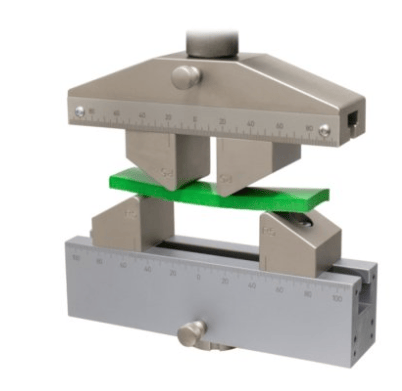
    The image shows a flexural test fixture that determines the flexural properties of composite materials using a four-point bending test as described in ASTM D7264.
    ASTM D7264 Flexural Test Fixture

    ASTM D7264 Analysis Results and Interpretation

    ASTM D7264 reports flexural properties in either SI units or inch-pound units. The units for flexural strength are MPa or psi, and flexural modulus is reported in GPa or ksi. Load and deflection data enable the engineer to assess the structure’s stiffness and its response to bending loads. The higher the flexural values, the better the resistance to deformation and failure.

    Read more

    Updated on June 5, 2026

    Rohit Dhembare
    About Author
    Rohit Dhembare is an Operations Associate at Matestlab Inc., holds a postgraduate degree in Organic Chemistry and is trained in Materials Science testing techniques.
    Know More
    Testimonials
    Real results
    Engineers trust us with what matters most
    Why Choose Matestlab?
    Matestlab is a unified testing services partner based in the USA. Matestlab offers raw material and product testing services through accredited, expert laboratories primarily based in the USA. Matestlab supports physical, thermal, chemical, electrical, mechanical, environmental, and characterization testing needs through its global network of 2200+ accredited testing laboratories. Matestlab's in-house materials science experts curate and design comprehensive testing programs matched to the sample material and specific testing need, with regulatory requirements and confidentiality in mind.

    If you are looking for a managed and trusted testing partner to achieve your research goals, feel free to schedule a meeting with us or send us a request at connect@matestlabs.com to learn more about our services. For a quick quote, call us at (302)244-7710. We are happy to serve you.
    Start Your Testing
    Project Today
    Define your requirements and get access to
    specialized laboratories ready to deliver results
    Partners with us
    Clients
    Vendors
    Process for testing
    • STEP 01

      You share your testing requirements

    • STEP 02

      You share your sample(s)

    • STEP 03

      We deliver your test reports

    Get your testing done

    Let us know your testing requirements and we will be right back with a solution.

      Let us root for each other. Collaborate to grow, expand, and accelerate our businesses.

      Partner with us