By Rohit Dhembare | Last updated 18th May 2026

ASTM D696 Standard Test Method for Coefficient of Linear Thermal Expansion of Plastics Between −30°C and 30°C with a Vitreous Silica Dilatometer

ASTM D696 describes a standard test method for determining the coefficient of linear thermal expansion (CLTE) of plastics between -30°C and 30°C using a vitreous silica dilatometer. This is a method used to evaluate the dimensional stability of plastic materials under temperature variations in industry. The method records changes in specimen length during controlled heating and cooling. Test reports include the coefficient of linear thermal expansion, temperature range, and dimensional change values and are usually expressed in µm/(m.°C). Manufacturers use these results to choose stable plastics for engineering, automotive, and electrical use.

Read More

GET STARTED

    Share your requirements *

    Provide your contact information *

    ASTM D696 Introduction

    ASTM D696 (Coefficient of Linear Thermal Expansion of Plastics Between -30°C and 30°C with a Vitreous Silica Dilatometer) is a standard method of determining the coefficient of linear thermal expansion of plastic materials. Linear thermal expansion is the change in length of a material as its temperature changes. Hence, this property is important for product designing, dimensional stability, and material compatibility. ASTM D696 is used for plastics with a coefficient greater than 1µm/m.°C, and is measured with a vitreous silica dilatometer. Furthermore, the technique is helpful to engineers when considering plastics for automotive body parts, electrical applications, industrial equipment, and structural assemblies. The data on expansion under thermal loading conditions help make proper material selection, reducing the plastic’s dimensional instability under service conditions.

    Get Certified ASTM D696 Testing for Accurate Thermal Expansion Analysis

    Dimensional changes often occur in plastic parts during heating and cooling. Thus, precise thermal expansion information can prevent warping, stress, and failure during assembly for manufacturers. Laboratory testing also enhances material comparison and quality assurance. In addition, tests are conducted under controlled conditions, which also boost confidence in the product’s reliability and long-term performance.

    Service NameRemarks
    ASTM D696 Testing
    Contact US

    Testing Procedure and Requirements

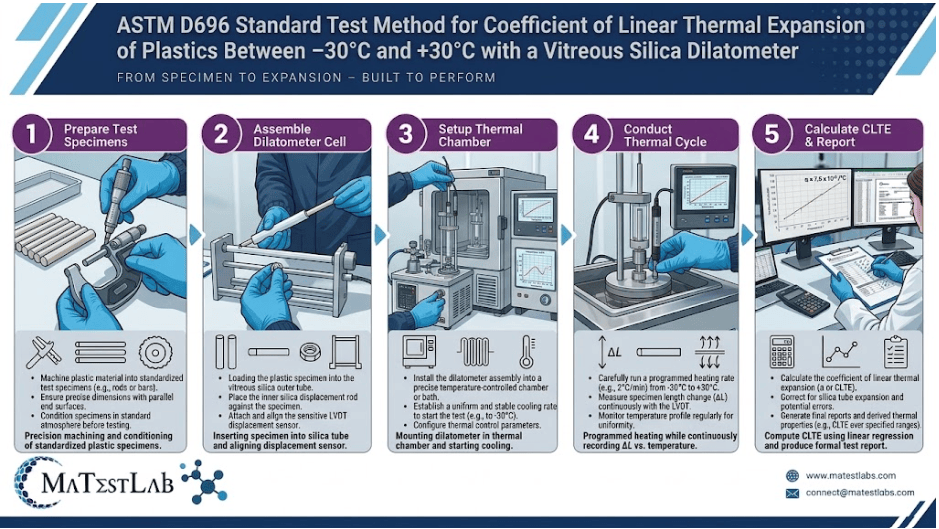
    The technician places a plastic sample within the vitreous silica dilatometer and then applies incremental heating or cooling steps from -30°C to 30°C. The technician calculates the coefficient of thermal expansion based on these measured data points.

    Test Temperature RangeThe method measures thermal expansion over the range -30°C to 30°C.
    Test PrincipleThe test method measures the linear thermal expansion of plastics by exposing a sample to controlled temperature variations and measuring dimensional changes. The method computes the coefficient of linear thermal expansion (CLTE) by comparing the specimen’s change in length with its initial length over the given temperature range.
    Measurement TechniqueA vitreous silica dilatometer records dimensional changes during controlled temperature exposure.
    Image shows a vitreous silica dilatometer used to determine the Coefficient of Linear Thermal Expansion (CLTE) of plastic materials between -30°C and 30°C, as described in ASTM D696.
    ASTM D696 Vitreous Silica Dilatometer

    Scope of ASTM D696 Test Standard

    • Determines the coefficient of linear thermal expansion of plastics
    • Applies to materials with expansion values greater than 1 µm/(m.°C)
    • Applies a vitreous-silica dilatometer to measure dimensions.
    • Ensures testing on the range of temperatures from -30°C to 30°C
    • Excludes materials that have very low expansion coefficients

    Equipment and Sample Preparation

    Vitreous Silica DilatometerMeasures specimen length change during temperature variation.
    Temperature Control SystemMaintains the required testing range between −30°C and 30°C.
    Measuring DeviceRecords the dimensional changes required for expansion calculations.

    Use of ASTM D696 

    • Analyzes the stability of plastics in terms of dimensions.
    • Assists in the design and analysis of products and systems
    • Helps to choose plastics for temperature-sensitive uses
    • Supports comparing the properties of thermal expansion of materials

    Why Is Thermal Expansion Important in Plastic Materials?

    Plastic substances change in size in response to temperature changes. This could result in cracking, warping, or misalignment during assembly if the expansion is not controlled. ASTM D696 supports engineers in making accurate predictions of these dimensional changes. In addition, thermal expansion data ensures safe material selections in automotive, aerospace, and electrical applications.

    Why Does ASTM D696 Use a Vitreous Silica Dilatometer?

    A dilatometer made of vitreous silica offers a stable and precise dimensional measurement in the course of the thermal exposure. Besides, vitreous silica has very low thermal expansion, which reduces measurement interference. This setup enhances the accuracy of the expansion calculation of plastic samples in the specified temperature range.

    Common Challenges and Troubleshooting 

    Moisture variation, stress release, curing effects, or phase changes can cause errors during testing. These factors may therefore affect accuracy and dimensional measurements. Also, plastics that exhibit creep or elastic strain properties can yield inaccurate expansion values. Thus, it is necessary to keep specimens under controlled laboratory conditions and to use well-conditioned specimens. Certain plastics exhibit transition temperature values that are not within the normal testing range. In such instances, smaller temperature increments or the use of thermomechanical analysis methods will aid in determining the transition temperatures.

    Testing Technique, Process, and Data Collection

    The first step in testing is to prepare the specimen and measure its dimensions at the reference temperature. Then, technicians put the specimen into the vitreous silica dilatometer. Then, the instrument measures the difference in length of the specimens as the temperature is changed from -30°C to 30°C. Finally, the difference between the measured dimensions and the temperature change is used to calculate the coefficient of linear thermal expansion. Proper temperature control and correct measurements enhance the repeatability.

    Analysis Results and Interpretation

    ASTM D696 specifies the coefficient of linear thermal expansion in SI units, µm/(m.°C). The calculation is based on the change in specimen length between temperatures T1 and T2. The higher the expansion values are, the more the material will expand when heated. Lower values indicate better dimensional stability. Engineers use these results to determine suitability for temperature-dependent applications and material compatibility requirements.

    Factors to Consider For the ASTM D696 Testing

    • Speed: Efficient testing procedures ensure that manufacturers receive thermal expansion results promptly without compromising measurement accuracy.
    • Expertise: During testing, experienced technicians enhance the reliability of specimen preparation, temperature control, and dimensional measurements.
    • Cost: Affordable thermal expansion testing allows the evaluation of materials and assists manufacturers in the control of quality assurance costs.

    Link to ASTM D696 Standard

    FAQ's

    Where can I get the astm d696 tested?

    You can share your astm d696 testing requirements with MaTestLab. MaTestLab has a vast network of material testing laboratories, spread across the USA and Canada. We support your all material testing needs ranging from specific astm d696 test to various testing techniques.

    How much do I need to pay for the astm d696 test?

    Please contact us for a detailed quote for your astm d696 testing needs. Cost incurred to carry out different astm d696 testing methodology depends on the type of raw material; number of samples, coupons, or specimens; test conditions, turn around time etc. Costs of some ASTM testing methods start from $100 and the final value depends upon the factors listed above. Please contact us for the best and latest prices.

    How many samples are required for astm d696?

    The required number of samples or specimens should comply with the procedure given in the astm d696 standard. However, the MaTestLab operations team can assist you for your special requirements once you share your testing details with us.

    How much discount can I get on the astm d696 test?

    MaTestLab has a vast testing laboratory network, hence we bring you the best testing facilities in a cost-effective way. We offer considerable discounts (15-20%) to our returning customers based on test volume and frequency.

    How many days will it take to complete the astm d696 test?

    The turnaround time for astm d696 test methodology depends upon the test procedure mentioned in the standard test document. However, we at MaTestLab understand your research requirements and hence try to get your test completed within the least possible time.

    Where can I get the astm d696 tested?

    You can share your astm d696 testing requirements with MaTestLab. MaTestLab has a vast network of material testing laboratories, spread across the USA and Canada. We support your all material testing needs ranging from specific astm d696 test to various testing techniques.

    POPULAR TESTS
    ONE-STOP FOR ALL
    MATERIAL TESTING NEEDS
    MaTestLab Inc. offers accessible, quick, and affordable material testing, product testing, and failure analysis services. We support your on-demand testing and expert consultation needs with the help of our extensive network of material testing laboratories situated in the US and other parts of the world.
    MATERIAL TESTING
    We offer destructive and non-destructive tests over a range of mechanical, electrical, chemical, thermal, optical, corrosion, radiation, and biological testing methodologies defined by ASTM, ISO and other organizations.
    PRODUCT TESTING
    We help you evaluate and ensure your product quality and performance with standard and custom-made testing solutions. All the tests are done at well-equipped testing laboratories using standard testing methods for best output and satisfaction.
    FAILURE ANALYSIS
    Failure analysis ensures high levels of quality in every manufacturing process. We help you with getting the best failure or root cause analysis to determine the cause of the failure. The results help you identify means to prevent failure recurrences.
    Process for testing
    • STEP 01

      You share your testing requirements

    • STEP 02

      You share your sample(s)

    • STEP 03

      We deliver your test reports

    Get your testing done

    Let us known your testing requirements and we will be right back with a solution.

      Let us root for each other. Collaborate to grow, expand, and accelerate our businesses.

      Partner with us

        close

        Please share your requirement with us

          ×

          Contact Us

          Discover more from MaTestLab

          Subscribe now to keep reading and get access to the full archive.

          Continue reading