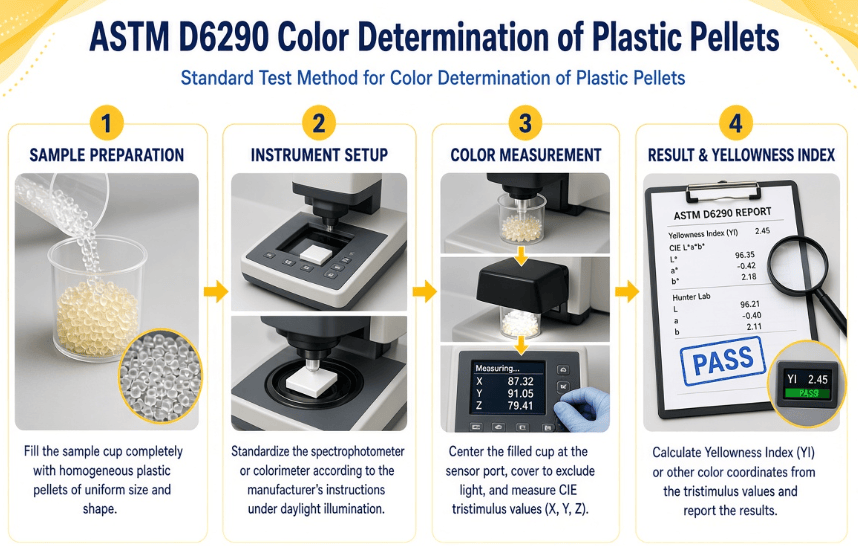
ASTM D6290 Standard Test Method for Color Determination of Plastic Pellets
What is ASTM D6290?
ASTM D6290 is a standard test method to measure the instrumental color properties of plastic pellets. ASTM D6290 (Standard Test Method for Color Determination of Plastic Pellets) is used to determine the degree of yellowness or the change in yellowness when illuminated by daylight. This method involves measuring tristimulus values from homogeneous, nearly colorless, or nearly white plastic pellets using a spectrophotometer or colorimeter.
Get Certified ASTM D6290 Testing for Reliable Plastic Pellet Color Measurement
ASTM D6290 testing provides a standardized approach for comparing the color of plastic resins in pellet form. No molding or extrusion of specimens is required, making it convenient to compare the color of pellets. Therefore, engineers can evaluate color attributes using the Yellowness Index, CIE X, Y, Z, Hunter L, a, b, or CIE L*, a*, b* values.
What is the Scope of the ASTM D6290 Test Standard?
ASTM D6290 is the standard for instrumental color measurement of pelletized transparent or nearly white, translucent or opaque plastics of homogeneous materials that are nearly colorless but not fluorescent. The measurement is based on tristimulus values measured by a spectrophotometer or a colorimeter. The scope of ASTM D6290 includes:
Purpose: Instrumental determination of plastic pellet color.
Primary property: Degree of yellowness or change in yellowness.
Illumination: Daylight illumination.
Material appearance: Nearly colorless, transparent or nearly white, translucent or opaque plastics.
Measurement principle: Tristimulus color measurement.
Instrumentation: spectrophotometer or tristimulus colorimeter.
Color values: Yellowness Index (YI), CIE X, Y, Z, Hunter L, a, b, and CIE L*, a*, b*.
Color system: CIE 1976 X, Y, Z and CIELAB 1976 color space.
Units: SI units are the standard units where applicable.
Comparison requirement: Samples should have similar pellet shape, size, texture, and degree of translucency.
Application: Color comparison of resin in pellet form.
What are the Uses of ASTM D6290 Testing?
ASTM D6290 is used to compare the instrumental color properties of plastic pellets that have similar physical properties. The method provides quantitative color data without molding or extruding the pellets. The ASTM D6290 standard:
Measures the degree of yellowness of plastic pellets.
Compares the differences in yellowness between similar samples of pellets.
Generates CIE X, Y, Z tristimulus values.
Calculates the a, b color values and Hunter L of the color.
Calculates CIE L*, a*, b* color values.
Measures Yellowness Index based on Practice E313.
Helps compare resin pellets.
Permits color comparison without molding or extruding test specimens.
Assists in making color comparisons between similar pellet samples.
Assists instrumental characterization of plastic resins in terms of color.
Which materials can be tested under ASTM D6290?
ASTM D6290 is applicable to nearly colorless, transparent or nearly white, translucent or opaque plastic pellets that are homogeneous and nonfluorescent. The method should be used to compare pellets of similar shape, size, texture, and translucency since these can affect the color measured. So it’s important for technicians to compare samples that have similar physical appearance, not dissimilar forms of pellets.
Why is ASTM D6290 Important?
ASTM D6290 is significant because it offers a simple instrumental approach to comparing the color of plastic resins in pellet form. The method eliminates the need for specimen preparation (e.g., molding or extrusion), enabling the engineer to assess the color of the pellets directly. The actual pellet color measured does not, however, necessarily reflect the color of the final molded, cast, or extruded product, as processing conditions, pellet shape, and pellet size can influence the final product appearance.
ASTM D6290 Equipment and Sample Preparation Guide
ASTM D6290 requires a spectrophotometer or tristimulus colorimeter with the proper optical geometry, calibration tiles, and a clear glass sample cup. The standard specifies several acceptable groups of instruments, such as 0/45 and 45/0 geometries and diffuse geometry with an integrating sphere. The sample cup should be at least 50 mm deep; there should be an opaque cover or a light-exclusion device to prevent the influence of external light on the measurement.
Plastic pellets of similar shape, size, texture, and translucency for meaningful color comparison.
Specimen Preparation
A clear glass sample cup is filled to the top with pellets by technicians before being placed for measurement.
Specimen Dimensions
The clear glass sample cup has a minimum depth of 50 mm and should be larger than the instrument port.
Instrumentation
Spectrophotometer or tristimulus colorimeter, calibrated tiles, clear glass sample cup and opaque light-exclusion cover.
Testing Procedures and Requirements for ASTM D6290
Color of plastic pellets is measured by ASTM D6290, which involves controlled presentation of the instrument and the plastic pellet sample to determine tristimulus values. The following is the procedure used in ASTM D6290:
Technicians standardize the spectrophotometer or colorimeter according to the manufacturer’s recommendations.
Sample Preparation
A representative sample of plastic pellets is loaded into the clear glass sample cup. Then, technicians align the sample cup containing the pellets to the instrument sensor port using a centering device.
Light Exclusion
Technicians cover the sample cup with an opaque cover or light-exclusion device to prevent external illumination.
Color Measurement
Analysts measure the required CIE X, Y, Z tristimulus values using the specified illuminant and observer combination.
Yellowness Index
Analysts calculate Yellowness Index according to Practice E313 when YI measurement is required.
Other Color Values
Analysts can set the instrument to provide either Hunter L, a, b values or CIE L*, a*, b* values if needed.
Result Reporting
Engineers report the color values that apply and state the measurement conditions used for comparison.
ASTM D6290 Testing Process and Data Collection
ASTM D6290 testing starts with the color measurement instrument being standardized based on the manufacturer’s instructions. Technicians then fill a clear glass sample cup full of plastic pellets and place the cup in the middle of the sensor port. Later, the technicians cap the sample to prevent outside light from reaching it. Analysts take the necessary tristimulus measurements and calculate and/or record the corresponding color values. The specified combination of CIE illuminant and standard observer is used for Yellowness Index measurements. The method can also be used to deliver CIE X, Y, Z, Hunter L, a, b, or CIE L*, a*, b* values. This allows comparison of the color characteristics of tested pellets with similar shape, size, texture, translucency, and measurement conditions.
ASTM D6290 Color Determination of Plastic Pellets
Common Challenges and Troubleshooting
Consistent pellet characteristics, instrument standardization, sample positioning, and light control are crucial to obtaining accurate ASTM D6290 results. Technicians should thus compare pellets of similar shape, size, texture and translucency. If there is a significant difference in the form of the pellets being compared, the color measurements may not be a meaningful comparison of materials. Externally applied light can affect measurements, too, especially if pellets are not protected from strong light sources prior to testing. Hence, the specified light-exclusion cover (opaque light) should be used and unnecessary exposure at the measurement port should be avoided. When results are compared between measurements, they should also be taken from similar optical groups.
ASTM D6290 Analysis Results and Interpretation
ASTM D6290 results are instrumental color characteristics of plastic pellets under the specified measurement conditions. These values can be used by engineers to compare similar resin pellets or to assess changes in yellowness or other color characteristics.
The significance of ASTM D6290 is that it offers a method to instrumentally measure the color and yellowness of plastic pellets under controlled conditions.
What is ASTM D6290 used for?
Color measurement of plastic pellets is done with the Yellowness Index, CIE X, Y, Z, Hunter L, a, b and CIE L*, a*, b*, according to ASTM D6290.
What is measured during ASTM D6290 testing?
ASTM D6290 is used to quantify tristimulus color value and other color characteristics such as Yellowness Index and CIE or Hunter color coordinates.
Dr. Ruchika Yogesh is a serial entrepreneur, material science and AI/ML enthusiast, medicinal chemistry subject matter expert (SME), scientific/medical copyeditor, and a researcher. Know More
Testimonials
Real results
Engineers trust us with what matters most
“We had a great experience working with this company for our ASTM E84 testing. They were the first company to respond to our inquiry within just a few minutes of submitting it. From start to finish, the communication was excellent, and the entire process was swift, straightforward, and hassle-free.”
Ivars FancyWalls
United States
“Very good communication, testing associates were very patient with delays on our end. Reasonable turnaround time for results and nicely detailed report. Analysts were also quick to answer any follow-up questions. Happy with results.”
Skye Henderson
United States
“Matestlab connected us with an accredited lab within days, cutting weeks off our product validation timeline.”
Rebecca Kozodoy-Pins
United States
Why Choose Matestlab?
Matestlab is a unified testing services partner based in the USA. Matestlab offers raw material and product testing services through accredited, expert laboratories primarily based in the USA. Matestlab supports physical, thermal, chemical, electrical, mechanical, environmental, and characterization testing needs through its global network of 2200+ accredited testing laboratories. Matestlab's in-house materials science experts curate and design comprehensive testing programs matched to the sample material and specific testing need, with regulatory requirements and confidentiality in mind.
If you are looking for a managed and trusted testing partner to achieve your research goals, feel free to schedule a meeting with us or send us a request at connect@matestlabs.com to learn more about our services. For a quick quote, call us at (302)244-7710. We are happy to serve you.
Start Your Testing Project Today
Define your requirements and get access to specialized laboratories ready to deliver results