ASTM D6252/D6252M Standard Test Method for Peel Adhesion of Pressure-Sensitive Label Stocks at a 90° Angle
What is ASTM D6252/D6252M?
ASTM D6252/D6252M provides a standardized test method for measuring the peel adhesion of pressure-sensitive label stocks at a 90° angle. This method tests the bonding strength of a pressure-sensitive label stock to a standard steel surface or to another surface of interest. It provides a quantitative measure that laboratories can use to assess the relative bond strength and uniformity of label stocks. The method can be used to compare within a sheet or roll, across sheets or rolls, and production lots. The method is used principally for quality assurance and can be used for comparing the peel adhesion measured with a minimum or maximum acceptance criterion. ASTM D6252/D6252M (Standard Test Method for Peel Adhesion of Pressure-Sensitive Label Stocks at a 90° Angle) also allows laboratories to use panels that represent the intended application surface instead of the standard stainless steel panel. The method may also produce highly variable results for label stocks with stiff backings or backings that stretch significantly at low forces.
Get Certified ASTM D6252/D6252M Testing for Reliable Peel Adhesion Evaluation
The ASTM D6252/D6252M test determines the peel adhesion of pressure-sensitive label stocks at a specified 90° angle. Skilled technicians use a standardized substrate, application procedure, and peel-testing system. The test is used to assess bond strength and adhesion uniformity in the laboratory. Results are used for quality assurance, acceptance criteria, and to compare stocks on labels. Laboratories can also evaluate adhesion to application-specific substrates when required.
What is the scope of ASTM D6252/D6252M?
ASTM D6252/D6252M specifies methods for measuring the peel adhesion of pressure-sensitive label stocks. The method provides a measure of label adherence to a standard steel substrate or another surface of interest. It also provides a way to assess the uniformity of adhesion within and between sheets, rolls, or production lots. The method is mainly used for quality assurance tasks in which laboratories compare the peel adhesion value obtained to the set limit.
Material: Pressure-sensitive label stocks that include a pressure-sensitive adhesive and a backing or liner system appropriate for peel adhesion testing.
Objective: Determine the peel adhesion of a pressure-sensitive label stock when technicians separate it from a substrate at a 90° angle.
Property measurement: Force to peel label stock off a standard steel substrate or other selected surface.
Method: Labels are applied to a controlled substrate, and the peel force is measured in a 90° peel configuration.
Result: Gives quantitative peel-adhesion information, which allows laboratories to compare against specified minimum and/or maximum acceptance criteria.
Test limitations: Variations in face stock and adhesive can influence the response, while stiff backings or backings that stretch at low forces may produce high variability.
Environmental conditions: Label stock and test material should be conditioned under the controlled laboratory conditions specified in the method and referenced in the conditioning practices.
Applications: Quality assurance, production-lot comparison, adhesion-uniformity assessment, material evaluation, and adhesion-comparison to a standard or application-specific substrate.
What are the uses of ASTM D6252/D6252M testing?
ASTM D6252/D6252M offers a practical quality assurance technique to assess the adhesive strength of pressure-sensitive label stocks to the substrate. Laboratories can use the measured peel force with established acceptance criteria to assess whether a label stock meets its intended requirements. This standard-
Measures are taken to peel label stocks with pressure sensitivity.
Supports quality assurance and acceptance testing.
Compares the relative bond strength of a standard surface or an application-specific surface.
Assesses uniformity of adhesion between and within sheets, rolls, and production lots.
Compares the performance of the label stock to the different surface materials and textures
Which Materials Can Be Tested Under ASTM D6252/D6252M?
ASTM D6252/D6252M covers pressure-sensitive label stocks to be evaluated for peel adhesion. The laboratories can test the label stock against the standard stainless-steel substrate or use representative panels when they require testing adhesion to a particular surface of interest.
Why is ASTM D6252/D6252M Important?
ASTM D6252/D6252M offers a uniform method for measuring the adhesion of pressure-sensitive label stocks. When the same substrate, application, conditioning, and test conditions exist, a controlled 90° peel configuration can provide similar data for laboratories. The method also helps manufacturers monitor adhesion uniformity and evaluate label-stock performance against acceptance criteria.
ASTM D6252/D6252M Equipment and Sample Preparation Guide
Skilled personnel use a peel-adhesion testing system capable of maintaining a 90° peel angle throughout the test. Accurate and reliable results require proper substrate preparation, specimen cutting, label application, and controlled pressure.
The test specimen consists of pressure-sensitive label stock prepared for application to a standard stainless-steel panel or another representative substrate.
Sample Preparation
Technicians prepare the substrate surface, apply the label stock under controlled conditions, and use the specified pressure/application procedure to establish consistent contact.
Specimen Dimension
The test uses a label strip with a nominal 25.4 mm (1 in.) width. The specimen length should provide sufficient bonded and free length for the complete 90° peel measurement.
Instrumentation
The laboratory uses a tensile or peel-testing machine with a 90° peel fixture or sliding table, together with a suitable pressure/application roller and prepared substrate panel. The test operates at approximately 300 mm/min (12 in./min).
Testing Procedures and Requirements for ASTM D6252/D6252M
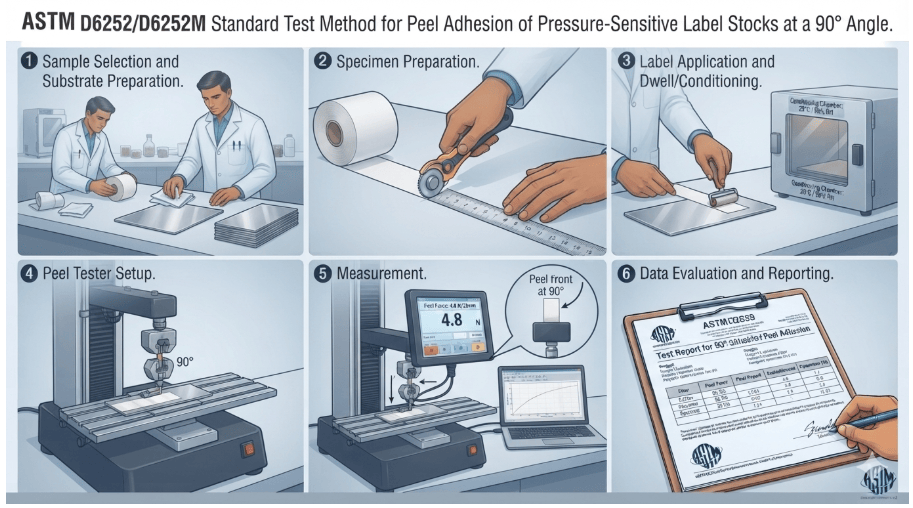
ASTM D6252/D6252M integrates controlled specimen preparation, substrate application, dwell or conditioning requirements, and the 90° peel measurement. Skilled experts should control the substrate condition, application pressure, peel angle, and test rate because these factors can influence the measured adhesion. The complete procedure for ASTM D6252/D6252M is given below:
Technicians select representative pressure-sensitive label-stock specimens according to the applicable sampling plan. Analysts prepare the standard stainless-steel panel or another representative substrate. They keep a smooth and uniform surface without having contamination that adds other variation.
Specimen Preparation
Technicians cut the label stock to the required width and prepare the adhesive surface for application. They avoid wrinkles, bubbles, contamination, or other defects that could affect the bonded area.
Label Application and Dwell/Conditioning
Skilled personnel apply the label specimen to the substrate using the specified application procedure and pressure roller. Constant pressure ensures similar adhesion to the substrate. Analysts maintain the applicable dwell or conditioning period required by the test plan before beginning the peel measurement.
Peel Tester Setup and Measurement
Technicians install the specimen in the 90° peel fixture and align the test system so that the peel angle remains at 90° throughout the measurement. The testing machine pulls the label stock at approximately 300 mm/min (12 in./min) while the fixture maintains the 90° peel geometry. The system records the force required to separate the label from the substrate.
Data Evaluation and Reporting
Analysts evaluate the recorded peel-force response and determine the applicable average or representative peel-adhesion value according to the standard’s calculation and reporting requirements. Laboratories report the peel-adhesion result together with specimen identification, substrate information, relevant conditioning or dwell information, and other test conditions required for interpretation.
ASTM D6252/D6252M Testing Process and Data Collection
In ASTM D6252/D6252M testing, technicians will place the pressure-sensitive label stock on the test substrate and pull the label apart at a controlled 90° angle. The testing system captures the force needed to tear the label away from the substrate and assesses the adhesive strength and uniformity. Laboratories use this method to compare acceptance criteria and compare label stocks or production lots. Analysts must record the substrate, application conditions, dwell time, peel rate, specimen identification, and observed failure behavior, as these factors can influence the measured peel response.
ASTM D6252 Test Method for Peel Adhesion of Pressure-Sensitive Label Stocks at a 90° Angle
Common Challenges and Troubleshooting
Results may vary due to substrate cleanliness, label application pressure, dwell time, peel angle, test speed, specimen dimensions, and backing properties. Technicians should ensure that the substrate is kept clean and consistent, specimens are applied evenly, and the fixture maintains a true 90° peel angle throughout the test. Analysts should also recognize that stiff or highly extensible backings can increase variability and that changes in face stock or adhesive properties can influence the response.
ASTM D6252/D6252M Analysis Results and Interpretation
ASTM D6252/D6252M provides the peel adhesion data to assist a laboratory in evaluating the bond strength of the pressure-sensitive label stocks to a standard steel substrate or a desired surface. Analysts interpret the measured force according to the specimen, substrate, test configuration, and applicable acceptance criteria.
Laboratories report the measured peel adhesion or peel force per unit width in N/100 mm or N/mm.
Technicians record the representative peel-adhesion result together with specimen identification, substrate type, and relevant test conditions.
Analysts record the 90° peel configuration, application method, dwell or conditioning conditions, test rate, the condition of the substrate, and separation behavior observed.
Engineers and analysts compare measured adhesion with applicable minimum or maximum acceptance criteria and evaluate differences between sheets, rolls, production lots, or substrates.
Dr. Ruchika Yogesh is a serial entrepreneur, material science and AI/ML enthusiast, medicinal chemistry subject matter expert (SME), scientific/medical copyeditor, and a researcher. Know More
Testimonials
Real results
Engineers trust us with what matters most
“We had a great experience working with this company for our ASTM E84 testing. They were the first company to respond to our inquiry within just a few minutes of submitting it. From start to finish, the communication was excellent, and the entire process was swift, straightforward, and hassle-free.”
Ivars FancyWalls
United States
“Very good communication, testing associates were very patient with delays on our end. Reasonable turnaround time for results and nicely detailed report. Analysts were also quick to answer any follow-up questions. Happy with results.”
Skye Henderson
United States
“Matestlab connected us with an accredited lab within days, cutting weeks off our product validation timeline.”
Rebecca Kozodoy-Pins
United States
Start Your Testing Project Today
Define your requirements and get access to specialized laboratories ready to deliver results