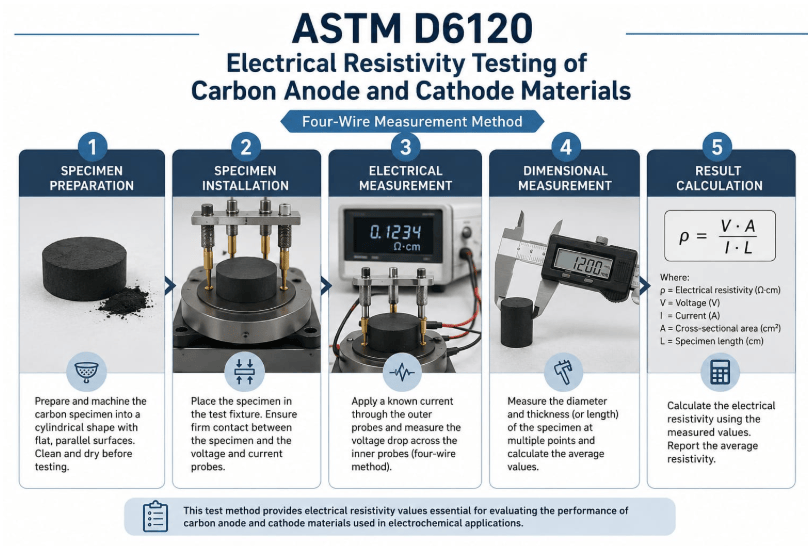
ASTM D6120 determines the electrical resistivity at room temperature of solid cylindrical specimens cut from commercial-sized carbon anodes and cathodes. The standard describes specimen preparation, test procedures, and result calculations. The standard-
- Covers the determination of electrical resistivity of carbon anodes and cathodes at room temperature.
- Applies to solid cylindrical specimens taken from commercial-sized carbon anodes and cathodes.
- Applies to specimens taken from laboratory-prepared carbon blocks.
- Expresses test results in SI units.
- Provides electrical resistivity measurements that can be used as a quality parameter for evaluating the performance of carbon materials in aluminum reduction cells.
- Supports the evaluation and quality control of the electrical conductivity-related properties of carbon anode and cathode materials.
What are the Uses of ASTM D6120 Testing?
ASTM D6120 testing gives laboratories information on the electrical resistivity of carbon anode and cathode materials. Manufacturers and engineers use the results for quality control, material selection, and process optimization. This standard-
- Measures electrical resistivities of carbon anode and cathode materials.
- Evaluates the efficiency of the available carbon electrodes.
- Assists with quality control in the manufacturing of alu smelting electrodes.
- Analyzes materials for electrochemical cells and battery electrode uses.
- Assists in minimizing energy losses in electrical systems.
- Enables comparison of different carbon material formulations.
- Helps to optimize manufacturing processes for carbon block and graphite components
Which Materials Can Be Tested Under ASTM D6120?
ASTM D6120 applies to the carbon-based anode and cathode materials that can be cored into a solid cylinder. The method can be applied to the commercial-size carbon anodes and cathodes for aluminum smelting. The method can also be used for samples taken from laboratory-made carbon blocks. All analysts should identify the type of carbon material to be analyzed, prepare specimens properly, and confirm that specimens are both dimensionally correct and of adequate size for accurate analysis.
Why is ASTM D6120 Important?
ASTM D6120 is a standard method for measuring the electrical resistivity of carbon anode and cathode materials at room temperature. For efficient operation of the aluminum cell, the electrical resistivity of the anode and cathode carbon material is important. It is a quality parameter that is related to the suitability of an anode/cathode to be used in an aluminum cell. Lower resistivity reduces energy losses, improves system efficiency, and ensures stable performance in electrochemical processes such as smelting or batteries. The test results are useful for manufacturers and engineers to verify the quality of materials, to compare the carbon products, and to guarantee the uniformity of performance.