
ASTM D6112 describes a standard test method for measuring the creep and creep-rupture behavior of plastic lumber and shapes when placed in compression or flexure under specified environmental conditions. The method is based on the as-manufactured specimens and thus measures the performance of the manufactured plastic product rather than treating the result solely as a material property. The standard applies mainly to plastic lumber and plastic shapes manufactured from recycled plastics, but it also applies to similar products made from virgin resins when the manufactured product has a nonhomogeneous cross-section.
ASTM D6112 Standard Test Methods for Compressive and Flexural Creep and Creep-Rupture of Plastic Lumber and Shapes
What is ASTM D6112?
What is the Scope of ASTM D6112?
ASTM D6112 specifies methods for determining the creep and creep-rupture characteristics of plastic lumber and shapes under compression or flexure and specified environmental conditions.This standard-
- Determines creep properties of plastic lumber and shapes.
- Calculates creep-rupture characteristics under given loading conditions.
- Covers compression and flexural loading.
- Uses specimens as manufactured.
- Evaluates manufactured product instead of a conventional homogeneous material specimen.
- This applies mainly to plastic lumber and plastic shapes produced from recycled plastics.
- Also applicable to similar nonhomogeneous manufactured products using virgin resins.
What are the Uses of ASTM D6112 Testing?
ASTM D6112 testing enables the laboratory to characterize the long-term response of plastic lumber and shapes under a sustained load. The resulting data can support product comparison, fabricated-part design, performance evaluation over time, and certain specification requirements. This standard-
- Supports an assessment of the long-term deformation of materials.
- Assists in comparing plastic lumber products.
- Supplies information to design fabricated components.
- Aids in the analysis of long-term performance under a steady load.
- Supports specification evaluations for the applicable product specification that requires the method.
What Materials Can Be Tested Under ASTM D6112?
ASTM D6112 applies to plastic lumber and plastic shapes tested in the as-manufactured condition. The standard mainly covers products made from recycled plastics but also applies to similar manufactured products made from virgin resins when the product has a nonhomogeneous cross-section.
Why is ASTM D6112 Important?
ASTM D6112 is significant because it provides creep and creep-rupture data to help engineers assess the performance of plastic lumber under long-term loading. The data support prediction of creep modulus and strength and help assess dimensional changes that may occur as a result of sustained loading. The method also enables laboratories to test the true manufactured product since the specimens are tested in their as-manufactured condition. This distinction makes the results useful when engineers need product-level performance information rather than only basic material-property data.
ASTM D6112 Equipment and Sample Preparation Guide
ASTM D6112 requires loading equipment appropriate for compression or flexure testing, measurement equipment to measure deformations, and environmental control. The test setup also controls vibration because creep measurements respond sensitively to shock and vibration.
| Sample and Specimen Details | Technicians use plastic lumber or shapes in the “as-manufactured” form. The specimen must represent the product being tested. |
| Specimen Preparation | Technicians prepare test specimens from the plastic lumber or shape without modifying the as-manufactured surfaces. They measure specimen dimensions and verify that the specimen meets the requirements for compressive or flexural testing. |
| Specimen Dimensions | Compression specimens require a height of 2 times the minimum width. Flexural specimens use the full as-manufactured cross-section with a support span of 16 times the specimen depth. |
| Instrumentation | Technicians use a creep testing machine that applies constant load, an environmental chamber that controls temperature and humidity, deflection measuring equipment, and timing devices that record creep deformation over time |
Testing Procedures and Requirements for ASTM D6112
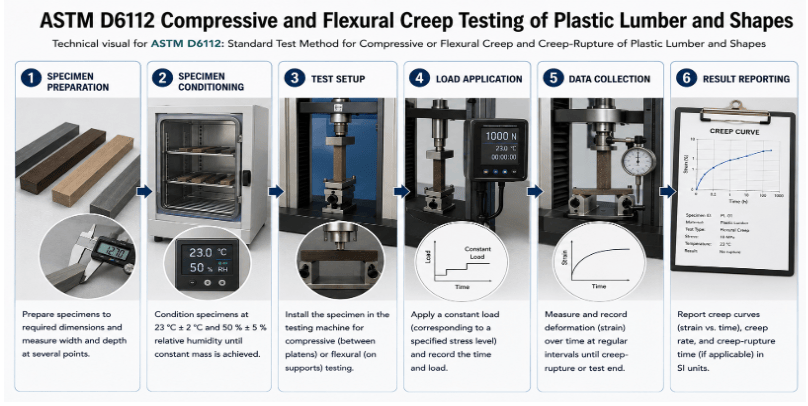
Technicians prepare the specimens from the as-manufactured product and apply the specified compressive or flexural load under the specified environmental conditions. The standard calls for a minimum of two specimens at each stress for creep testing at a single stress temperature. Technicians take two or more specimens per stress level and temperature for creep rupture testing. The standard sets the stress levels designed to give rupture at 1, 10, 30, 100, 300, 1000, and 3000 h.
| Specimen Verification and Mounting | Technicians verify specimen dimensions and mount the specimen in the creep testing machine with the appropriate loading configuration for compression or flexure testing. |
| Load Application | Technicians apply the specified constant load to the specimen and maintain it under controlled environmental conditions. |
| Deformation Monitoring | Technicians measure and record creep deformation at specified time intervals throughout the test duration. |
| Creep-Rupture Testing | For creep-rupture testing, technicians continue the test until the specimen fails and record the time to rupture. |
| Result Reporting | Laboratories report creep deformation data, creep modulus values, creep-rupture time, applied stress levels, and testing conditions in inch-pound units as the standard. |
ASTM D6112 Testing Process and Data Collection
Technicians prepare the plastic lumber or shape-as-manufactured plastic sections and insert them into the appropriate compression or flexural test setup. They apply the selected load and maintain the specified environmental conditions during the test. In creep tests, the laboratory measures deformation as a function of time. During the creep-rupture test, technicians note the stress level, temperature, and time to rupture. These measurements describe long-term creep behavior, creep-rupture performance, and possible dimensional changes under sustained loading.
Common Challenges and Troubleshooting
Accurate creep measurements require stable loading, proper specimen preparation, and effective vibration control. ASTM indicates that the test apparatus and mounting must isolate the specimen from significant vibration during a creep test because shock and vibration are highly sensitive. Technicians prepare compressive specimen ends carefully so that the surfaces remain smooth, flat, and parallel. In the case of a creep-rupture test, the laboratory offers proper protection from the impact of a falling load in case of specimen failure.
ASTM D6112 Analysis Results and Interpretation
The laboratory provides the creep and creep-rupture data for the tested plastic lumber or shape, under the specified loading and environmental conditions.
- The technician records the specimen’s deformation as a function of time during the creep test.
- The analyst compares the measured deformation and applied stress to determine the long-term creep properties of the material under test.
- The technician records the stress level, environmental condition, and time to rupture during creep-rupture testing.
- The engineer uses the measured creep and creep-rupture information to determine the long-term behavior and dimensional stability and to compare the performance of plastic lumber or shapes under sustained load.
- Engineers use the data to support product comparisons, design fabricated parts, track long-term performance, and meet applicable specification requirements.
Get Certified ASTM D6112 Testing for Reliable Plastic Lumber Analysis
ASTM D6112 sets a standard method for testing the ability of plastic lumber and plastic shapes to be deformed over time under constant loading. Creep and creep-rupture data help laboratories determine long-term behavior and evaluate potential dimensional changes under sustained loads. Testing generates data to compare plastic lumber products; to demonstrate the quality of fabricated parts; to demonstrate that a constant load is sustained for a long period of time; and, as applicable, to support product specifications.
FAQ
What does ASTM D6112 apply to?
This test method applies to plastic lumber and plastic shapes which are primarily produced using recycled plastics. The method can also be used for similar manufactured plastic products, which have a non-homogeneous cross-section including virgin resins.
What property of a material is measured in this test method?
The test method describes methods for determining the compressive and flexural creep and creep-rupture characteristics of plastic lumber and shapes, such as creep deformation, creep modulus, and creep-rupture time under constant load.
Why is this method of testing important?
Data from creep and creep-rupture tests help engineers predict the creep modulus and strength of materials under long-term loads and predict dimensional changes that have the potential to occur as a result of such loads
Updated on September 6, 2026

Testimonials
Real results
Engineers trust us with what matters most
“We had a great experience working with this company for our ASTM E84 testing. They were the first company to respond to our inquiry within just a few minutes of submitting it. From start to finish, the communication was excellent, and the entire process was swift, straightforward, and hassle-free.”

“Very good communication, testing associates were very patient with delays on our end. Reasonable turnaround time for results and nicely detailed report. Analysts were also quick to answer any follow-up questions. Happy with results.”
“Matestlab connected us with an accredited lab within days, cutting weeks off our product validation timeline.”
Start Your Testing
Project Today
Project Today
Define your requirements and get access to
specialized laboratories ready to deliver results
specialized laboratories ready to deliver results
Start Testing
Partners with us
Clients
Vendors