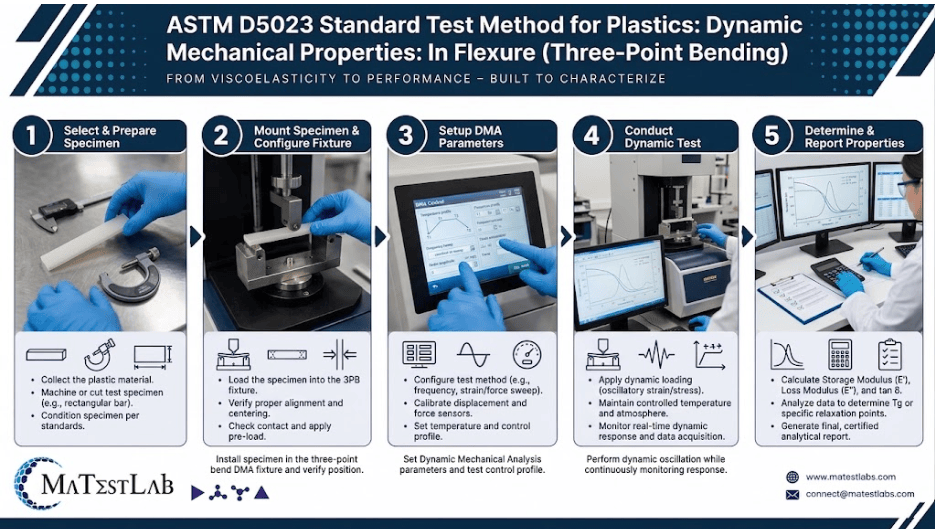
ASTM D5023 applies to the use of dynamic mechanical instrumentation for the determination and reporting of viscoelastic properties of thermoplastic and thermosetting resins and composite systems using rectangular specimens in three-point bending. It employs nonresonant, forced vibration techniques and produces modulus and tan delta as function of frequency, time, or temperature. ASTM D5023 normally covers the frequency range from 0.01 Hz to 100 Hz. The scope of ASTM D5023 includes:
- Material: Thermoplastic and thermosetting resins, plastics, and composite systems.
- Specimen form: Rectangular bars molded directly or cut from sheets, plates, or molded shapes.
- Test mode: Dynamic three-point bending using nonresonant forced vibration.
- Frequency: Typically 0.01 Hz to 100 Hz.
- Measured properties: Storage modulus, loss modulus, complex modulus, and tan delta.
- Variables: Dynamic mechanical properties can be evaluated as functions of temperature, frequency, or time.
- Applications: Quality control, research and development, processing optimization, and engineering design.
- Limitations: Because instrumentation compliance can affect measurements, results are intended to indicate relative rather than necessarily absolute property values.
What are the Uses of ASTM D5023 Testing?
The controlled three-point bending method described in ASTM D5023 can be used to assess the dynamic mechanical and thermomechanical properties of plastic materials. Thus, the results can be used by engineers to characterize the material response and explore changes that can be related to temperature, frequency, processing, formulation, and reinforcement. The ASTM D5023 standard-
- Measures the storage modulus of plastic materials under flexural dynamic load.
- Measures loss modulus and damping of plastic compounds.
- Measures the complex modulus and tan delta at the test conditions.
- Evaluates the modulus as a function of temperature or frequency.
- Determines the influence of material processing conditions on material response.
- Evaluates relative resin characteristics: cure and damping.
- Assesses the impact of the type of substrate and the orientation of the material on the modulus.
- Discusses the effects of fillers and formulation additives on modulus and glass-transition behavior.
- Helps with quality control, research and development, and optimization of processing conditions.
- Offers thermomechanical information that can be used to aid engineering design.
Which materials can be tested under ASTM D5023?
ASTM D5023 is applicable to thermoplastic and thermosetting resins and composite systems which can be fabricated into appropriate rectangular bars for three-point bending. Specimens can be molded to the desired size and shape or simply cut from sheets, plates, or molded shapes. When applicable, the material specification should be checked prior to testing, as the specimen preparation, specimen conditioning, dimensions, and/or testing parameters are of higher priority. Representative sampling is extremely important for meaningful dynamic mechanical results for small specimen geometries.
Why is ASTM D5023 Important?
The stiffness and damping of plastic materials can be highly sensitive to temperature, frequency, time, processing, and formulation. ASTM D5023 establishes a controlled method to characterize these changes by performing dynamic three-point bending measurements. The method is used to measure elastic and loss response and is able to identify changes in thermomechanical performance through changes in modulus and tan delta. The information obtained aids the analysts in understanding the material behavior under certain conditions and in comparing between different plastic materials with the same test parameters. Since the values measured are influenced by the experimental conditions and the potential compliance of the instrumentation, it is crucial that the test conditions are reported in full for meaningful interpretation.