
ASTM D5017 provides a standard test method for determining the composition of linear low-density polyethylene (LLDPE) using carbon-13 nuclear magnetic resonance (¹³C NMR) spectroscopy. The method identifies the molecular structure of polyethylene using the carbon-13 signal emitted from the polymer sample. Laboratories use these NMR measurements to identify structural characteristics related to LLDPE composition and to characterize the material. The method applies to LLDPE materials that can be characterized by the specified NMR analysis. Engineers use ASTM D5017 (Standard Test Method for Determination of Linear Low-Density Polyethylene (LLDPE) Composition by Carbon-13 Nuclear Magnetic Resonance) to obtain consistent compositional information for quality control, research, material development, and comparison of polyethylene products. The laboratory then prepares the polymer solution under the given conditions and investigates it with a suitable carbon-13 NMR spectrometer. The resulting spectral data provides information about the polymer composition and molecular structure.
ASTM D5017 Standard Test Method for Determination of Linear Low Density Polyethylene (LLDPE) Composition by Carbon-13 Nuclear Magnetic Resonance
What is ASTM D5017?
What is the scope of ASTM D5017?
This standard uses carbon-13 NMR spectroscopy to determine LLDPE composition. The method analyzes the polymer’s carbon-13 NMR spectrum to obtain compositional information. The ASTM D5017 standard:
- Analyzes linear low-density polyethylene (LLDPE).
- Uses carbon-13 nuclear magnetic resonance spectroscopy.
- Determines polymer compositional characteristics from NMR signals.
- Requires controlled sample preparation and NMR measurement conditions.
- Supports polymer characterization and quality control.
What are the uses of ASTM D5017 testing?
ASTM D5017 testing helps laboratories characterize the composition of LLDPE materials. Manufacturers can use the results to:
- Evaluate LLDPE composition and compare different polyethylene materials.
- Support polymer formulation development and monitor raw-material consistency.
- Perform quality-control testing, characterize polymer structure, and support research and development.
Which Materials Can Be Tested Under ASTM D5017?
ASTM D5017 covers linear low-density polyethylene (LLDPE) materials suitable for carbon-13 NMR analysis. Laboratories prepare representative polymer samples according to the method and analyze the resulting solution using ¹³C NMR spectroscopy.
Why is ASTM D5017 important?
ASTM D5017 offers a standard method for compositional analysis of LLDPE by carbon-13 NMR. The technique gives molecular-level data useful for characterizing polyethylene materials. Standard preparation methods, controlled NMR conditions, and proper spectral interpretation enable laboratories to obtain comparable compositional information.
ASTM D5017 Equipment and Sample Preparation Guide
ASTM D5017 requires a carbon-13 NMR system and suitable equipment for preparing and handling the polymer solution. Technicians should prepare representative LLDPE samples and follow the dissolution and NMR measurement conditions below.
| Sample and Specimen Details | Technicians take a representative LLDPE polymer sample prepared for carbon-13 NMR analysis. |
| Specimen Preparation | Technicians dissolve the LLDPE sample in the specified NMR solvent under controlled conditions and prepare the solution for spectral analysis. |
| Specimen Dimensions | ASTM D5017 does not specify a fixed solid specimen dimension because the method analyzes a prepared polymer solution by NMR spectroscopy. |
| Instrumentation | Carbon-13 NMR spectrometer, appropriate NMR probe and sample tube, controlled-temperature equipment, analytical balance, heating/stirring equipment, and suitable sample-preparation equipment. |
Testing Procedures and Requirements for ASTM D5017
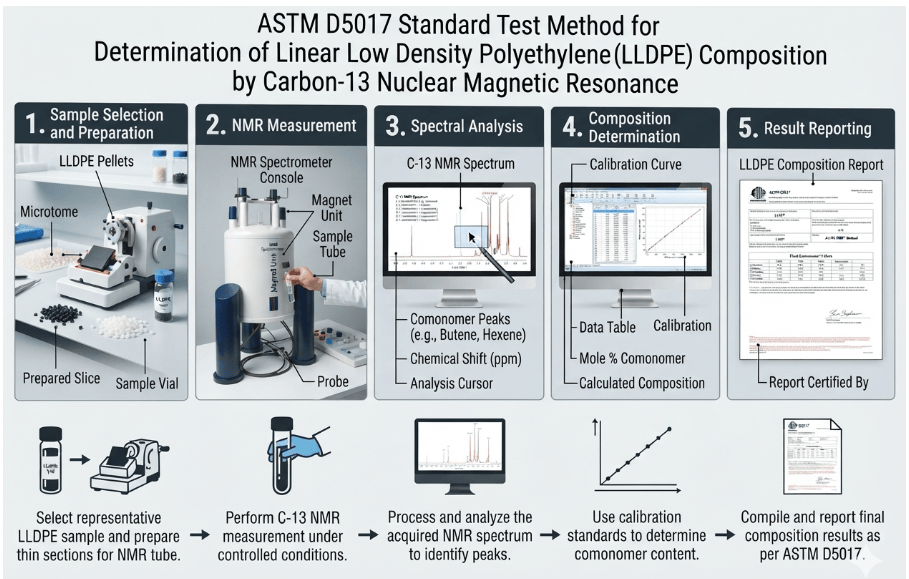
According to ASTM D5017, technicians must prepare the LLDPE sample and obtain a carbon-13 NMR spectrum under controlled conditions. Other reference documents include E177, E380, E386, and E691. The testing procedure of ASTM D5017 is given below:
| Sample Selection and Preparation | Technicians first select a representative LLDPE sample, weigh it, and dissolve the polymer using the specified NMR sample-preparation conditions. |
| NMR Measurement | They then place the prepared solution in the NMR tube and acquire the carbon-13 spectrum under controlled conditions. |
| Spectral Analysis | Analysts identify and evaluate the relevant carbon-13 NMR signals associated with the polymer composition. |
| Composition Determination | Analysts calculate the applicable compositional values from the NMR data according to the standard procedure. |
| Result Reporting | Technicians record the calculated composition, NMR conditions, sample information, and observations that are relevant. |
ASTM D5017 Testing Process and Data Collection
Technicians first take a representative LLDPE sample and prepare it for NMR analysis. They dissolve the polymer under the specified conditions and transfer the resulting solution into an NMR tube. The operator then obtains the carbon-13 NMR spectrum under controlled instrument conditions. Engineers analyze the relevant spectral signals and calculate the corresponding composition values. Engineers document spectral data, sample information, measurement conditions, calculated composition, and observations.
Common Challenges and Troubleshooting
Numerous factors are crucial to obtaining accurate ASTM D5017 results, such as sample preparation and the reliability of the NMR measurements. Common errors are the failure to dissolve the polymer completely, failing to sample the appropriate concentration, contaminating the sample for NMR, failing to keep good temperature control, poor spectral resolution, failure to identify the right peaks, and issues with the instrument calibration. Technicians should make sure that the sample is completely dissolved, measure under constant conditions, and pretest the NMR system for measurement.
ASTM D5017 Analysis Results and Interpretation
The report summarizes the compositional information obtained from the carbon-13 NMR analysis of the tested LLDPE. The results help laboratories characterize polymer composition from the measured NMR spectral signals and calculated composition values.
- The laboratory reports the applicable LLDPE composition values as percentages (%) based on the measured ¹³C NMR data.
- The analyst evaluates characteristic ¹³C NMR spectral signals to determine the relevant compositional information.
- Analysts record the NMR spectrum, sample preparation conditions, measurement conditions, and calculated composition values.
- The technician documents relevant observations associated with the NMR measurement and sample analysis.
- Engineers compare the calculated composition values with applicable material specifications, reference data, or formulation requirements to evaluate LLDPE composition.
Get Certified ASTM D5017 Testing for Reliable LLDPE Composition Analysis
ASTM D5017 helps manufacturers and laboratories characterize LLDPE composition by carbon-13 NMR. The test can be used to guide polymer formulation, quality control, research and development, and to compare different LLDPE materials. ASTM
FAQ
Updated on September 6, 2026


Project Today
specialized laboratories ready to deliver results