
ASTM D4889 Standard Test Methods for Polyurethane Raw Materials: Determination of Viscosity of Crude or Modified Isocyanates

    What is ASTM D4889?

    ASTM D4889 describes two standard test methods for determining the viscosity of crude or modified isocyanates used as polyurethane raw materials. The standard covers products made from toluene diisocyanate (TDI), methylene di (phenyl isocyanate) (MDI), and polymeric methylene diphenyl diisocyanate. Test Method A determines dynamic viscosity using a rotational instrument, and Test Method B determines kinematic viscosity. Laboratories use this ASTM D4889 (Standard Test Methods for Polyurethane Raw Materials: Determination of Viscosity of Crude or Modified Isocyanates) for research, quality control, and specification testing of isocyanates used in polyurethane products. Because some isocyanates can show non-Newtonian behavior, laboratories should maintain the same spindle/speed combination for rotational measurements and the same tube size for kinematic measurements when comparing results.

    Read more

    Get Certified ASTM D4889 Testing for Reliable Isocyanate Viscosity Evaluation 

    Viscosity provides important information about the flow behavior of crude and modified isocyanates used in polyurethane manufacturing. ASTM D4889 provides laboratories with standardized procedures for measuring dynamic or kinematic viscosity. Manufacturers can use the results for raw material quality control, formulation specification testing, comparisons, and process monitoring. 
    What is the scope of ASTM D4889? 

    ASTM D4889 determines the viscosity of crude or modified isocyanates used as polyurethane raw materials. These standard test methods-

    Read more

    • Determine dynamic viscosity using a rotational instrument. 
    • Calculate kinematic viscosity according to the correct capillary-viscosity method.
    • Apply to isocyanates made from TDI, MDI, and polymeric MDI.
    • Support research, quality-control, and specification testing.
    • Require laboratories to use consistent measurement conditions for comparative results.

    What are the uses of ASTM D4889 testing? 

    ASTM D4889 testing assists a laboratory in characterizing isocyanates in rubber or polyurethane products. These methods-

    • Determine dynamic viscosity, kinematic viscosity, and material consistency.
    • Compare crude and modified isocyanates and support raw-material quality control.
    • Compare polyurethane raw-material formulations, support research and development, and perform specification testing.

    Which Materials Can Be Tested Under ASTM D4889? 

    ASTM D4889 is for crude or modified isocyanates derived from toluene diisocyanate, methylene diisocyanate (phenyl isocyanate), and polymeric methylene diphenyl isocyanate.

    Why is ASTM D4889 important? 

    ASTM D4889 specifies the test methods for the measurement of flow resistance of isocyanate raw materials. Viscosity can affect material handling, processing, mixing, and polyurethane formulation.

    ASTM D4889 Equipment and Sample Preparation Guide 

    ASTM D4889 uses different equipment for dynamic and kinematic viscosity measurements. Isocyanate samples must also be protected from moisture in the atmosphere, since organic isocyanates react with moisture.

    Read more

    Sample and Specimen DetailsTechnicians test representative samples of crude or modified isocyanates used as polyurethane raw materials.
    Specimen PreparationTechnicians mix the sample thoroughly, measure temperature, prevent contamination and air bubbles, and protect it from moisture in the atmosphere with dry air or dry N2.
    Specimen DimensionsNo fixed solid-specimen dimensions apply because ASTM D4889 tests liquid isocyanate samples. The applicable sample volume depends on the selected viscosity instrument.
    InstrumentationRotational viscometer for dynamic viscosity, suitable capillary viscometer for kinematic viscosity, temperature-control equipment, sample container, thermometer, and dry-air or nitrogen protection system.

    Testing Procedures and Requirements for ASTM D4889 

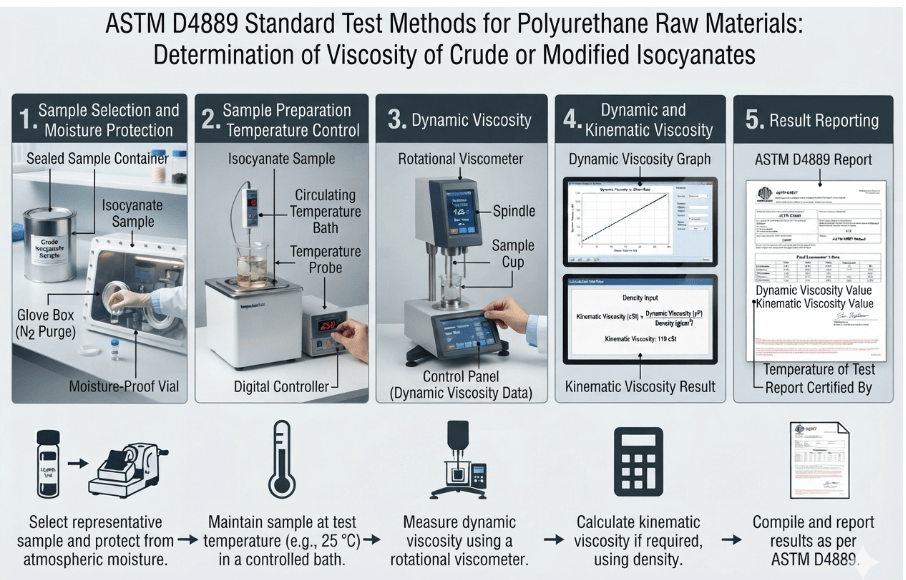
    ASTM D4889 provides two viscosity procedures, dynamic viscosity and kinematic viscosity. Other reference ASTM documents include D445, D883, and E2251. The testing procedure for ASTM D4889 is given as:

    Read more

    Sample Selection and Moisture ProtectionTechnicians select a representative crude or modified isocyanate sample and protect the sample from atmospheric moisture during sampling and testing.
    Sample Preparation and Temperature Control They mix the sample thoroughly and remove conditions that can introduce air bubbles or contamination and bring the sample and equipment to the required test temperature.
    Dynamic and Kinematic ViscosityAnalysts measure viscosity using the specified rotational instrument, spindle, and speed combination and kinematic viscosity using the applicable capillary-viscosity procedure.
    Result ReportingAnalysts record viscosity, test temperature, instrument conditions, and applicable specimen information.

    ASTM D4889 Testing Process and Data Collection 

    Analysts first collect a representative isocyanate sample, take precautions against atmospheric moisture, mix it, and adjust the temperature for measurement. They then measure dynamic viscosity using rotational instruments, spindles, and speed, and use the appropriate capillary-viscosity procedure for kinematic viscosity. Laboratories document the viscosity value, test temperature, instrument conditions, and other observations. Standard test conditions enable laboratories to more accurately compare various isocyanate samples.

    This image depicts a rotational viscometer used for viscosity determination as per ASTM D4889.
    ASTM D4889 Testing Procedure Using Rotational Viscometer

    Common Challenges and Troubleshooting 

    Careful sampling, moisture protection, temperature control, and consistent instrument settings are all important for accurate viscosity results. Common challenges include moisture contamination, air bubbles in the sample, inadequate sample mixing, incorrect test temperature, contamination from sampling equipment, incorrect spindle or speed selection, and incorrect capillary tube selection. The sampling technique should avoid atmospheric moisture and ensure that all materials are measured under the same conditions.

    ASTM D4889 Analysis Results and Interpretation 

    • Engineers report the results of ASTM D4889 based on either the dynamic or kinematic viscosity procedure. 
    • The standard assesses the viscosity of crude and modified isocyanates as raw materials for producing polyurethane. 
    • Analysts measure dynamic viscosity in a laboratory using a rotational instrument and kinematic viscosity using an appropriate capillary-viscosity procedure.
    • Laboratories report dynamic viscosity in Pa·s and kinematic viscosity in m²/s or mm²/s.

    Link to ASTM D4889

    Read more

    FAQ

    What is ASTM D4889?
    ASTM D4889 provides test methods for determining the dynamic and kinematic viscosity of crude or modified isocyanates used as polyurethane raw materials.
    The standard applies to crude or modified isocyanates of TDI, MDI, and polymeric MDI.
    The standard includes dynamic viscosity using a rotational instrument and kinematic viscosity using a capillary-viscosity procedure.
    Dynamic viscosity can be expressed in Pa·s or mPa·s, and kinematic viscosity can be expressed in m²/s or mm²/s (cSt).
    Rohit Dhembare
    About Author
    Rohit Dhembare
    Rohit Dhembare is an Operations Associate at MaTestLab Inc. and holds a postgraduate degree in Organic Chemistry.
    Testimonials
    Real results
    Engineers trust us with what matters most
    Start Your Testing
    Project Today
    Define your requirements and get access to
    specialized laboratories ready to deliver results
    Partners with us
    Clients
    Vendors
    Process for testing
    • STEP 01

      You share your testing requirements

    • STEP 02

      You share your sample(s)

    • STEP 03

      We deliver your test reports

    Get your testing done

    Let us known your testing requirements and we will be right back with a solution.

      Let us root for each other. Collaborate to grow, expand, and accelerate our businesses.

      Partner with us

        Contact Us

        Discover more from MaTestLab

        Subscribe now to keep reading and get access to the full archive.

        Continue reading