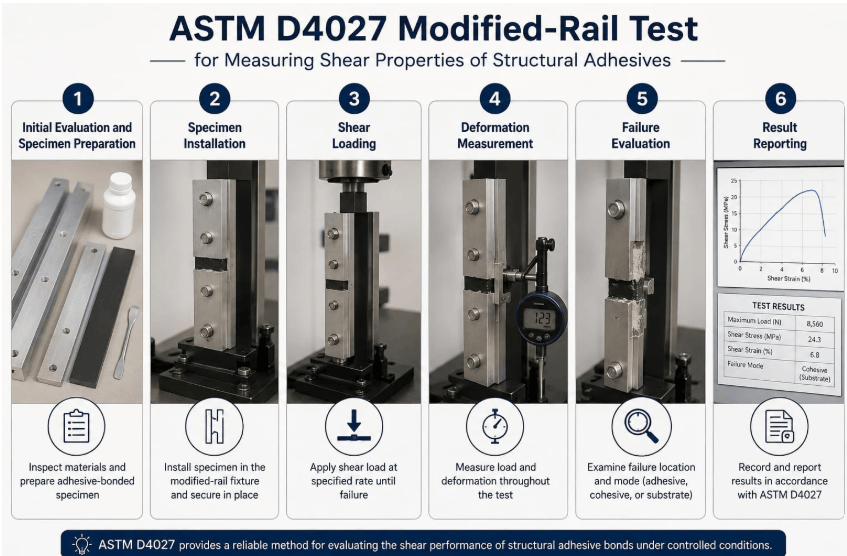
ASTM D4027 describes a standard test method that uses a thick-adherend metal specimen to determine an adhesive’s static shear strength. The test assesses an adhesive joint’s performance under controlled shear loading conditions. It provides information on the adhesive’s ability to maintain a strong bond under static shear force. ASTM D4027 (Standard Test Method for Measuring Shear Properties of Structural Adhesives by the Modified-Rail Test) provides a comparative method for evaluating adhesive performance, assessing bonding quality, and guiding the selection of appropriate adhesives for industrial applications. The procedure loads specimens under controlled conditions until breakage occurs and helps identify the shear strength of the adhesive bond.
Get Certified ASTM D4027 Testing for Reliable Structural Adhesive Performance
To validate the shear performance of structural adhesives for critical engineering applications, manufacturers must test them according to the Nationally Recognized Structural Adhesive standard ASTM D4027. This standard specifies the method for the modified-rail test to measure the shear modulus and shear strength of an adhesive between rigid adherends, preferably with high-density wood as the adherend. This method is used to determine the practical maximum adhesive shear modulus at around 690 MPa (1 × 10⁵ psi), and can be used for bondline thicknesses from 0.15 to 3.18 mm. The certification process highlights quality control, compliance with regulatory requirements, offers confidence in the structural performance of adhesive assemblies, and generates data for structural design.