
ASTM D3749 describes a standard test method for determining residual vinyl chloride monomer (RVCM) in poly(vinyl chloride) (PVC) homopolymer and copolymer resins using a gas chromatographic headspace technique. The method quantifies unreacted vinyl chloride monomer in the resin after polymerization. ASTM D3749 (Standard Test Method for Residual Vinyl Chloride Monomer in Poly(Vinyl Chloride) Resins by Gas Chromatographic Headspace Technique) specifies the method for manufacturing control and for specification acceptance. The method establishes the equilibrium between the residual VCM in the PVC resin and the vapor phase in a closed container. After equilibration, a sample of the headspace vapor is injected into a gas chromatographic system in which the VCM is separated from other components and quantified.
ASTM D3749 Standard Test Method for Residual Vinyl Chloride Monomer in Poly(Vinyl Chloride) Resins by Gas Chromatographic Headspace Technique
What is ASTM D3749?
What is the Scope of ASTM D3749?
ASTM D3749 provides a method for determining residual vinyl chloride monomer in PVC homopolymer and copolymer resins. The ASTM D3749 standard-
- Determines residual vinyl chloride monomer in PVC resin.
- Covers both homopolymer and copolymer resins.
- Possesses an interlaboratory-evaluated range from 0.1 to 400 ppm RVCM.
- Adjustable to a PVC copolymer if the Henry’s Law constant at 90°C is known.
- Applies to gas chromatography headspace.
- Provides an alternative method to EPA Method 107 for dry-resin samples.
What are the Uses of ASTM D3749 Testing?
ASTM D3749 testing helps determine the amount of residual, unreacted vinyl chloride monomer in PVC resin. The method gives a measurement that can be used in manufacturing control and specification acceptance. This standard-
- Calculates the concentration of the VCM remaining after processing.
- Supports PVC resin manufacturing control.
- Assists in the assessment of specification acceptance.
- Provides quantitative analysis of trace VCM.
- Supports quality-control testing of PVC resins.
- Supports laboratories in testing for residual monomers in dry resin samples.
What Materials Can Be Tested Under ASTM D3749?
ASTM D3749 is designed for PVC homopolymer and copolymer resins. The procedure is adapted for a PVC copolymer when the Henry’s Law constant at 90°C for the particular copolymer is known. This technique examines resin samples as opposed to finished polymer articles in fused form.
Why is ASTM D3749 Important?
Minimization of residual or free vinyl chloride monomer in PVC resin is desirable. ASTM D3749 includes a standard analytical procedure for quantifying this residual monomer and then obtaining results for use in manufacturing control or for specification acceptance. The headspace technique is also a sensitive method of measuring low levels of VCM. The analytical response comes from the vapor phase rather than from directly introducing the solid PVC resin into the chromatographic column.
ASTM D3749 Equipment and Sample Preparation Guide
ASTM D3749 requires equipment capable of preparing the resin sample, providing controlled headspace conditions, and is capable of measuring VCM by gas chromatography. It is important to seal it properly, as vinyl chloride is volatile. Sample preparation minimizes losses before the headspace analysis begins.
| Sample and Specimen Details | Technicians use representative samples of PVC homopolymer or copolymer resins in dry powder form. |
| Specimen Preparation | Technicians weigh 0.2 to 4 g of PVC resin into a headspace vial and record the exact mass. They add 2 drops of deionized water and immediately seal the vial with a septum and cap. |
| Specimen Dimensions | The method uses a measured mass of resin (0.2 to 4 g) rather than a fixed specimen dimension. |
| Instrumentation | The test uses a gas chromatograph equipped with a flame ionization detector (FID), photoionization detector (PID), or Hall electrolytic conductivity detector (HED). A headspace autosampler or thermostatted turntable is required for sample heating and injection. Additional equipment includes headspace vials, septa, caps, and an analytical balance. |
Testing Procedures and Requirements for ASTM D3749
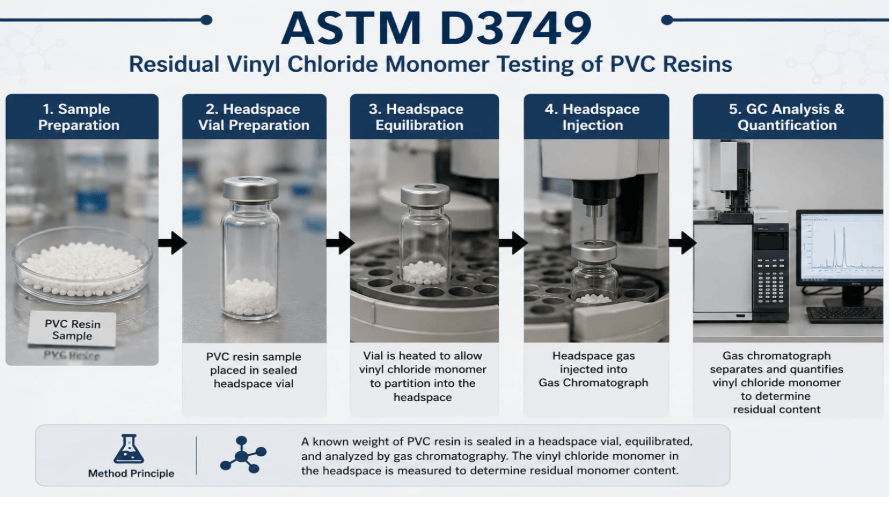
The ASTM D3749 procedure establishes vapor equilibrium between the residual VCM in the PVC resin and the air in the closed sample vessel. Once equilibrium is reached, a fixed quantity of headspace vapor is added to a gas chromatographic column. The VCM travels through the column with the carrier gas and is then separated from the other components that are present. The resulting detector signal indicates the relative concentration of VCM and its retention time.
Other referenced ASTM documents include ASTM D3680, D4443, D4526, and E691.
| Specimen Preparation | Technicians weigh 0.2 to 4 g of PVC resin into a headspace vial, record the exact mass, add 2 drops of deionized water, and immediately seal the vial. |
| Headspace Equilibration | Technicians place the sealed vials on a thermostatted turntable and heat them at 90 ± 1°C for 1 to 5 hours to allow VCM to volatilize into the headspace. |
| GC Analysis | Technicians inject a portion of the headspace gas into the gas chromatograph using the headspace sampler. The GC separates VCM from other volatile components. |
| Detection and Quantification | The detector (FID, PID, or HED) measures the VCM concentration. Technicians compare the detector response with a calibration curve prepared from VCM standard gases (typically 5, 50, and 500 ppm). |
| Result Reporting | Laboratories report the RVCM concentration in parts per million (ppm) by mass in SI units as the standard. |
ASTM D3749 Testing Process and Data Collection
The first step is to identify and prepare the PVC resin sample for analysis. The prepared sample is then sealed and exposed to controlled conditions to allow the remaining VCM to partition into the headspace. The analyst then injects the headspace vapor into the gas chromatograph for analysis. The chromatographic system responds to the VCM in the sample headspace. The desired relationship is used to assess the response, and the dry resin concentration of the VCM is determined as the residual. Analysts record the sample identification, calibration data, chromatographic response, test conditions, and calculated RVCM result. These records provide the information needed for reviewing and reporting the analytical result.
Common Challenges and Troubleshooting
Results depend on sample preparation, the ability to seal the test vessel, sample equilibration, appropriate calibration, and stable gas chromatograph operation. The obtained results vary due to loss of VCM during sample handling, insufficient sealing, temperature fluctuations, calibration issues, instrument instability, or interference from other sample components. It is important to keep the time between sample preparation and sealing as short as possible, keep the test conditions constant, and check the chromatographic system before the analysis. Laboratory personnel conduct the testing in accordance with the health, environment, and handling procedures and under appropriate safety controls when handling vinyl chloride. The analyst compares the reported value to the product specification, manufacturing requirement, and/or other acceptance criterion.
ASTM D3749 Analysis Results and Interpretation
The report presents the residual vinyl chloride monomer concentration measured in the PVC resin. The method typically reports results in parts per million by mass (ppm by weight) of dried resin. The analyst compares the reported value to the product specification, manufacturing requirement, and other acceptance criteria.
- Results are presented as the residual concentration of VCM in the dry resin.
- The standard method uses ppm by weight (mg/kg) for the reported RVCM concentration.
- The relevant result used in conjunction with sample identification and test conditions.
- The measured concentration is not, in itself, a universal pass/fail limit and acceptance depends on the specification or requirement to which it is being compared.
- Proper calibration and controlled test conditions are essential when interpreting low-level results.
Get Certified ASTM D3749 Testing for Reliable PVC Resin Analysis
ASTM D3749 testing offers laboratories a standard way to determine the amount of residual vinyl chloride monomer in PVC resin. Reliable analysis requires controlled sample preparation, proper headspace equilibration, suitable calibration, and stable gas chromatographic conditions. It is especially useful for measuring low concentrations of residual VCM regularly for quality control, manufacturing, or specification purposes. Under optimum conditions, the method detects about 2 ppm by volume of VCM in the headspace vapor.
FAQ
Updated on September 1, 2026


Project Today
specialized laboratories ready to deliver results