ASTM D3641 Standard Practice for Injection Molding Test Specimens of Thermoplastic Molding and Extrusion Materials

    What is ASTM D3641? 

    ASTM D3641 describes a standard practice for the injection molding of test specimens from thermoplastic molding and extrusion materials. The practice contains general guidelines for describing the injection molding steps and reporting the molding conditions used to produce test specimens. Different molding conditions can affect the properties of thermoplastic specimens. ASTM D3641 (Standard Practice for Injection Molding Test Specimens of Thermoplastic Molding and Extrusion Materials) establishes a standardized specimen-preparation procedure and allows technicians to adjust molding parameters based on the thermoplastic material being molded. 

    Read more

    Get Certified ASTM D3641 Testing for Reliable Thermoplastic Test Specimens 

    ASTM D3641 testing helps laboratories prepare uniform thermoplastic test specimens for physical and mechanical property assessment. Technicians set the relevant molding conditions and document the conditions used when making the specimens. Manufacturers and laboratories apply this practice for material development, quality control, research, and evaluation of the injection-molding process. 
    What is the Scope of the ASTM D3641 Test Standard? 

    ASTM D3641 covers general principles for injection molding test specimens from thermoplastic molding and extrusion materials. The ASTM D3641 standard-

    Read more

    • Provides general principles for preparation of injection-molded thermoplastics test specimens. 
    • Promotes the uniform descriptions of injection-molding steps and molding conditions.
    • Enables technicians to optimize the molding parameters for individual thermoplastic materials.
    • Gives precedence to applicable material specifications when they provide specific requirements.

    What are the Uses of ASTM D3641 Testing? 

    ASTM D3641 provides a method for preparing injection-molded thermoplastic test specimens for material testing. The practice provides a consistent pattern for controlling and recording the molding process. This standard-

    • Assists in the preparation of thermoplastic test specimens.
    • Helps laboratories maintain consistency between specimens.
    • Facilitates the subsequent physical and mechanical property tests.
    • Assists in material research and development.
    • Supports quality control and injection-molding process evaluations. 

    Which materials can be tested under ASTM D3641? 

    ASTM D3641 covers thermoplastic molding and extrusion materials used in laboratories to obtain injection-molded test specimens. The practice avoids setting one set of molding conditions for all thermoplastics, since each material requires different processing conditions. Technicians check the corresponding material specification or referenced document before determining molding conditions. If the applicable instructions lack specimen-preparation guidance, technicians consult the material supplier. 

    Why is ASTM D3641 Important? 

    ASTM D3641 helps laboratories control the injection-molding process when preparing thermoplastic test specimens. Different processing conditions produce specimens with different properties. It helps technicians to follow particular practices in order to maintain consistency and record the conditions under which specimens are produced. This method facilitates more uniform subsequent material property testing. 

    ASTM D3641 Equipment and Sample Preparation Guide 

    ASTM D3641 helps technicians use a reciprocating-screw injection-molding machine to produce thermoplastic test specimens. The technicians choose the equipment and preparation conditions based on the material and applicable specimen requirements. 

    Read more

    Sample and Specimen DetailsTechnicians use thermoplastic molding and extrusion materials to prepare injection-molded test specimens 
    Specimen PreparationTechnicians prepare and injection-mold the material according to the requirements of the particular thermoplastic. 
    Specimen DimensionsTechnicians follow the dimensions specified for the applicable test specimen. ASTM D3641 molds tensile bars (165×19×3.2 mm), flexural bars (127×12.7×3.2 or 6.4 mm), and shrinkage discs/plaques (60×60×2 mm).
    InstrumentationThe test uses reciprocating screw injection molding machines, appropriate molds, temperature control systems, pressure control systems, and conditioning equipment  

    Testing Procedures and Requirements for ASTM D3641 

    ASTM D3641 prepares test specimens through injection molding rather than measuring one specific material property. Technicians select the molding conditions according to the particular thermoplastic material and applicable requirements.  Other referenced ASTM documents include ASTM D256, D570, D638, D648, D790, D883, D955 and D957. The testing procedure is as follows-

    Read more

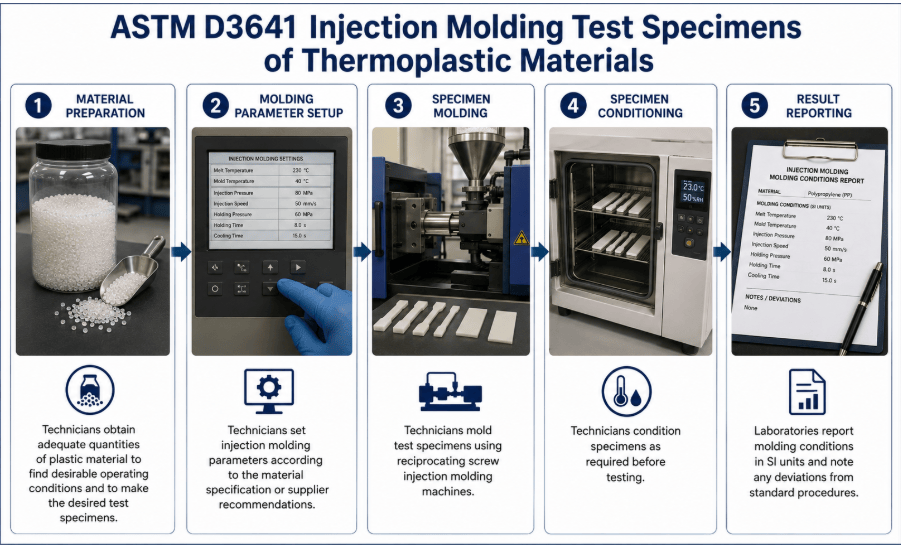
    Material Preparation Technicians obtain adequate quantities of plastic material to find desirable operating conditions and to make the desired test specimens. 
    Molding Parameter Setup Technicians set injection molding parameters according to the material specification or supplier recommendations.  
    Specimen Molding Technicians mold test specimens using reciprocating screw injection molding machines. 
    Specimen Conditioning Technicians condition specimens as required before testing. 
    Result Reporting Laboratories report molding conditions in SI units and note any deviations from standard procedures. 

    ASTM D3641 Testing Process and Data Collection

    Technicians first determine the thermoplastic material and check out the material specification or referenced document. They then select the appropriate molding conditions for the material. Technicians process the material in a reciprocating screw injection molding machine and prepare it. They monitor the relevant processing parameters during molding and document the processing parameters that they use to produce the specimens. Technicians can condition the specimens after molding, when required by the applicable test method. They can then test the specimens according to the relevant test standards for physical or mechanical properties. 

    The image shows technicians injection molding thermoplastic material into test specimens under controlled processing conditions for subsequent laboratory evaluation.
    ASTM D3641 Injection Molding Test Specimens of Thermoplastic Materials

    Common Challenges and Troubleshooting 

    Preparing accurate specimens involves proper material preparation, appropriate molding conditions, and reliable injection-molding equipment. Variations in the molding conditions alter the characteristics of thermoplastic specimens and influence the subsequent test outcomes. Technicians review the applicable material requirements before they begin molding. They examine the injection-molding machine, set up appropriate operational conditions, and then document the process parameters. Consistent material preparation and molding conditions produce consistent, functional test specimens. 

    ASTM D3641 Analysis Results and Interpretation 

    ASTM D3641 provides details on specimen preparation and injection-molding conditions, rather than single material-property results. Technicians use the recorded information to produce the test specimens. 

    Read more

    • ASTM D3641 records the injection-molding conditions that technicians use to prepare specimens.
    • Technicians choose molding conditions based on the type of thermoplastic material.
    • Technicians follow the specimen dimension specifications.
    • Laboratories perform the subsequent physical and mechanical tests under relevant test methods.
    • Stable molding environments enable technicians to minimize variability between test samples.                                                                  

    What Factors Should You Consider for ASTM D3641 Testing? 

    Expertise: Proficient technicians choose appropriate conditions of the molding, prepare materials, use the injection-molding machines, and record the results.

    Speed: Testing time varies based on the material, the number of specimens, the molding process, and the property tests.

    Cost: Testing costs depend on the amount of material, the type of specimen used, equipment usage, molding time, and the complexity of the testing program.

    Confidentiality: MaTestLab holds total confidentiality in the course of the testing procedure, and only gives out the results to the relevant stakeholders. 

    Link to ASTM D3641

    Updated on August 28, 2026

    Suyog Kamble
    About Author
    Suyog Kamble is an Operations Associate at Matestlab Inc. Suyog holds a postgraduate degree in organic chemistry and is trained in material science topics.
    Know More
    Testimonials
    Real results
    Engineers trust us with what matters most
    Start Your Testing
    Project Today
    Define your requirements and get access to
    specialized laboratories ready to deliver results
    Partners with us
    Clients
    Vendors
    Process for testing
    • STEP 01

      You share your testing requirements

    • STEP 02

      You share your sample(s)

    • STEP 03

      We deliver your test reports

    Get your testing done

    Let us know your testing requirements and we will be right back with a solution.

      Let us root for each other. Collaborate to grow, expand, and accelerate our businesses.

      Partner with us

        Discover more from Matestlab

        Subscribe now to keep reading and get access to the full archive.

        Continue reading