
ASTM D3419 Standard Practice for In-Line Screw-Injection Molding Test Specimens from Thermosetting Compounds

    What is ASTM D3419? 

    ASTM D3419 is a standard practice for in-line screw-injection molding test specimens from thermosetting molding compounds. The method enables laboratories and manufacturers to prepare uniform specimens from thermosetting compounds in an injection molding process. It emphasizes controlling molding conditions to ensure the technician can mold specimens for subsequent physical and mechanical testing. The practice covers important molding variables such as mold temperature, injection pressure, injection time, cure time, and screw-injection conditions. ASTM D3419 (Standard Practice for In-Line Screw-Injection Molding Test Specimens from Thermosetting Compounds) can be used in the laboratory to measure properties of thermosetting compounds and to compare materials under controlled processing conditions. The practice also minimizes variations arising from the inconsistencies in specimen preparation and offers a repeatable technique for generating test specimens from thermosetting molding materials.

    Read more

    Get Certified ASTM D3419 Testing for Consistent Thermosetting Test Specimens 

    Thermosetting compounds are made from controlled molding and curing. Some changes in molding temperature, pressure, injection conditions, and cure time may influence the specimen and the properties measured. ASTM D3419 offers a standardized in-line screw-injection molding practice to assist manufacturers and laboratories in producing uniform specimens for subsequent testing. The practice is used for quality control, comparing materials, developing processes, and analyzing thermosetting molding compounds.
    What is the scope of ASTM D3419? 

    ASTM D3419 provides a practice for preparing test specimens from thermosetting molding compounds using an in-line screw-injection molding process. The practice provides a standard specimen-molding procedure for laboratories to minimize specimen-preparation variations. This standard-

    Read more

    • Covers thermosetting molding compounds, uses an in-line screw-injection molding process, and produces specimens for subsequent testing.
    • Controls molding temperature, processing, injection conditions, and curing conditions.
    • Supports consistent specimen preparation and helps laboratories compare thermosetting compounds.
    • Supports quality-control and material-evaluation programs.

    What are the uses of ASTM D3419 Practice? 

    ASTM D3419 assists laboratories and manufacturers in creating uniform thermoset specimens for material testing. This practice is especially useful when specimen preparation can affect the measured performance of the molding compound. Thisstandard practice-

    • Prepares thermosetting test specimens and supports physical-property and mechanical-property testing.
    • Helps compare thermosetting molding compounds and supports quality-control programs.
    • Helps evaluate processing conditions and supports material development.
    • Improves consistency between molded specimens and provides a controlled specimen-preparation procedure.

    Which Materials Can Be Tested Under ASTM D3419? 

    ASTM D3419 applies to thermosetting molding compounds that can undergo the specified in-line screw-injection molding process. The laboratory should verify the compound and its processability for the molding equipment and test specimen used.

    Why is ASTM D3419 Important? 

    ASTM D3419 is important because specimen preparation can significantly influence the results of subsequent material testing. Thermosetting compounds are sensitive to molding temperature, injection conditions, pressure, and curing conditions.

    ASTM D3419 Equipment and Sample Preparation Guide 

    Laboratories should choose molding equipment and processing conditions based on the thermosetting compound type and the desired test specimen. Technicians should ensure that molding conditions are consistent and that specimens are made without causing defects that would impact subsequent testing. The complete procedure for ASTM D3419 is given as:

    Read more

    Sample and Specimen DetailsTechnicians first select thermosetting molding compounds suitable for processing through an in-line screw-injection molding machine.
    Specimen PreparationTechnicians condition and prepare the molding compound, load it into the injection-molding machine, control the molding conditions, inject the compound into the test mold, and allow the material to cure before removing the specimens.
    Specimen DimensionsSpecimen geometry and dimensions depend on the test specimen required for the subsequent property evaluation. Laboratories must use the dimensions defined by the relevant test method.
    InstrumentationIn-line screw-injection molding machine, heated test mold, temperature-control system, pressure-control system, timing controls, specimen-removal equipment, and dimensional measurement equipment.

    Testing Procedures and Requirements for ASTM D3419 

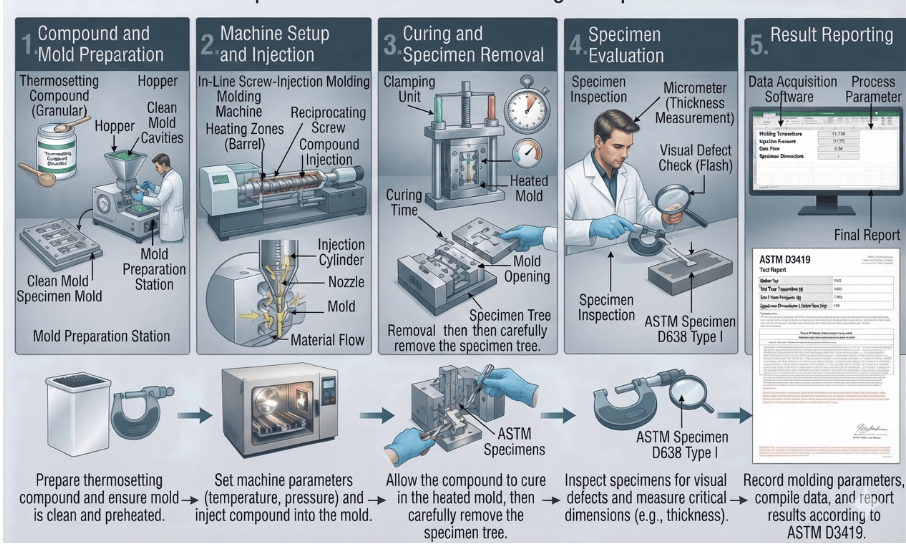
    ASTM D3419 focuses on creating test specimens through controlled screw-injection molding, not directly measuring a material property. The technician sets the molding conditions, injects the thermosetting compound, cures the material, and then removes the molded specimens for inspection. Other reference ASTM documents include D883 and D3641. The complete procedure of ASTM D3419 is given as:

    Read more

    Compound and Mold PreparationTechnicians first prepare the thermosetting molding compound for injection molding. Set the mold and establish the required molding temperature.
    Machine Setup and Injection Analysts set up the screw-injection molding equipment and required processing conditions and inject the thermosetting compound into the test mold under controlled conditions.
    Curing and Specimen Removal Technicians maintain the specified conditions to allow the thermosetting compound to cure, remove the molded specimens carefully, and inspect them for visible defects.
    Specimen EvaluationAnalysts condition and test the specimens according to the applicable ASTM property test method.
    Result ReportingEngineers record the molding conditions, specimen information, and subsequent test results.

    ASTM D3419 Testing Process and Data Collection 

    The laboratory identifies the thermosetting compound and test specimen needed for the next evaluation. Technicians prepare the molding equipment and set the mold temperature and processing conditions. They then introduce the compound into the in-line screw-injection molding machine and inject it into the prepared mold. Technicians then cure the specimen under the necessary conditions before removing it from the mold. They examine the specimen and note molding data. The specimens are then conditioned and tested according to the appropriate ASTM test method, and the corresponding results are recorded along with the molding conditions.

    Alt text: This image depicts an inline screw-injection molding machine used for thermosetting compounds as per ASTM D3419.
    ASTM D3419 Testing procedure using an in-line screw-injection molding machine

    Common Challenges and Troubleshooting 

    Several factors can affect the consistency of specimens produced under ASTM D3419. Common challenges include incorrect mold temperature, inconsistent injection conditions, incorrect curing time, improper machine setup, inadequate compound preparation, poor mold condition, and incorrect specimen removal. Before further testing, technicians should check the specimen quality, curing conditions, injection conditions, mold temperature, and equipment settings.

    ASTM D3419 Analysis Results and Interpretation 

    • ASTM D3419 information is reported based on the thermosetting compound, molding conditions, specimen configuration, and subsequent test method.
    • ASTM D3419 focuses on specimen preparation by in-line screw-injection molding rather than producing a single universal material-property result.
    • The physical or mechanical results obtained from the molded specimens depend on the applicable ASTM test method used after specimen preparation.

    Link to ASTM D3419

    Read more

    FAQ

    What is ASTM D3419?
    ASTM D3419 is a practice for preparing test specimens from thermosetting molding compounds using an in-line screw-injection molding process.
    The practice covers thermosetting molding compounds that are suitable for the specified screw-injection molding process.
    The practice uses an in-line screw-injection molding machine and suitable heated molding equipment, together with temperature and processing controls.
    Rohit Dhembare
    About Author
    Rohit Dhembare
    Rohit Dhembare is an Operations Associate at MaTestLab Inc. and holds a postgraduate degree in Organic Chemistry.
    Testimonials
    Real results
    Engineers trust us with what matters most
    Start Your Testing
    Project Today
    Define your requirements and get access to
    specialized laboratories ready to deliver results
    Partners with us
    Clients
    Vendors
    Process for testing
    • STEP 01

      You share your testing requirements

    • STEP 02

      You share your sample(s)

    • STEP 03

      We deliver your test reports

    Get your testing done

    Let us known your testing requirements and we will be right back with a solution.

      Let us root for each other. Collaborate to grow, expand, and accelerate our businesses.

      Partner with us

        Contact Us

        Discover more from MaTestLab

        Subscribe now to keep reading and get access to the full archive.

        Continue reading