ASTM D3367 Standard Test Method for Plasticizer Sorption of Poly (Vinyl Chloride) Resins Under Applied Centrifugal Force

    What is ASTM D3367? 

    ASTM D3367 provides a test method for determining the plasticizer sorption of polyvinyl chloride (PVC) resins under applied centrifugal force. The method determines the amount of liquid plasticizer absorbed by PVC resin under controlled conditions. Plasticizer sorption affects the processing and performance of PVC compounds because the plasticizer must be absorbed and incorporated into the resin during formulation. The test gives comparative data regarding the interaction between PVC resin particles and liquid plasticizers. The data can be used in the laboratory to assess resin quality, compare various PVC resin formulations, and aid compound development. ASTM D3367 (Standard Test Method for Plasticizer Sorption of Poly (Vinyl Chloride) Resins Under Applied Centrifugal Force) involves controlled sample preparation, addition of plasticizer, centrifugal force, and weighing to determine the quantity of plasticizer sorbed by the resin.

    Read more

    Get Certified ASTM D3367 Testing for Reliable PVC Resin Evaluation

    Get Certified ASTM D3367 Testing for Reliable PVC Resin Evaluation. ASTM D3367 testing helps PVC manufacturers determine the sorption of liquid plasticizer by a resin. The results help in the selection of resin for formulation development, quality control, and comparison of PVC materials. Testing also enables manufacturers to detect any variations in resin properties that can impact compounding and processing. 
    What is the scope of ASTM D3367? 

    ASTM D3367 determines the plasticizer sorption of PVC resins under applied centrifugal force. The method is based on the interaction between PVC resin and liquid plasticizer and offers a controlled basis for comparing the sorption characteristics of resin samples. This standard-

    Read more

    • Evaluates plasticizer sorption of PVC resin using applied centrifugal force and measures the interaction between resin and liquid plasticizer.
    • Supports comparison of different PVC resins, provides data for PVC formulation development, and supports resin quality-control programs.
    • Helps evaluate characteristics that influence PVC compounding and provides quantitative sorption data for laboratory comparison.

    What are the uses of ASTM D3367 testing? 

    Laboratories can use ASTM D3367 testing to characterize PVC resins before or during formulation and processing. Manufacturers can use plasticizer sorption data to make decisions about resin selection and to ensure consistent performance of plastic compounds.

    Some applications include:

    • Evaluates plasticizer sorption in PVC resins and compares different PVC resin grades.
    • Supports PVC formulation development and resin quality monitoring.
    • Supports raw material quality control and investigation of resin behavior changes.
    • Supports compound-processing evaluations and provides comparative data for resin selection.

    Which Materials Can Be Tested Under ASTM D3367? 

    ASTM D3367 tests the sorption of liquid plasticizer under centrifugal force for polyvinyl chloride (PVC) resins. Laboratories should use the resin and plasticizer specified or selected according to the applicable testing requirements.

    Why is ASTM D3367 Important? 

    ASTM D3367 offers a controlled technique to assess PVC resin compatibility with liquid plasticizers. Plasticizer sorption is an important factor in PVC compounding because the plasticizer must be sorbed into the resin particles to impart the desired compound properties. Variations in sorption can influence formulation consistency, processing, and product properties.

    ASTM D3367 Equipment and Sample Preparation Guide 

    ASTM D3367 specifies PVC resin, a specific liquid plasticizer, controlled sample preparation, and centrifugal equipment that can provide the necessary force.

    Read more

    Sample and Specimen DetailsTechnicians select PVC resin representative of the material being evaluated, combined with the specified liquid plasticizer.
    Specimen PreparationTechnicians prepare the PVC resin, add the required plasticizer, mix the components as specified, and prepare the sample for centrifugal separation.
    Specimen DimensionsASTM D3367 uses a specified quantity of PVC resin and plasticizer rather than a fixed molded specimen geometry.
    InstrumentationCentrifuge, centrifuge tubes or containers, analytical balance, mixing equipment, measuring equipment, and controlled laboratory equipment for sample preparation.

    Testing Procedures and Requirements for ASTM D3367 

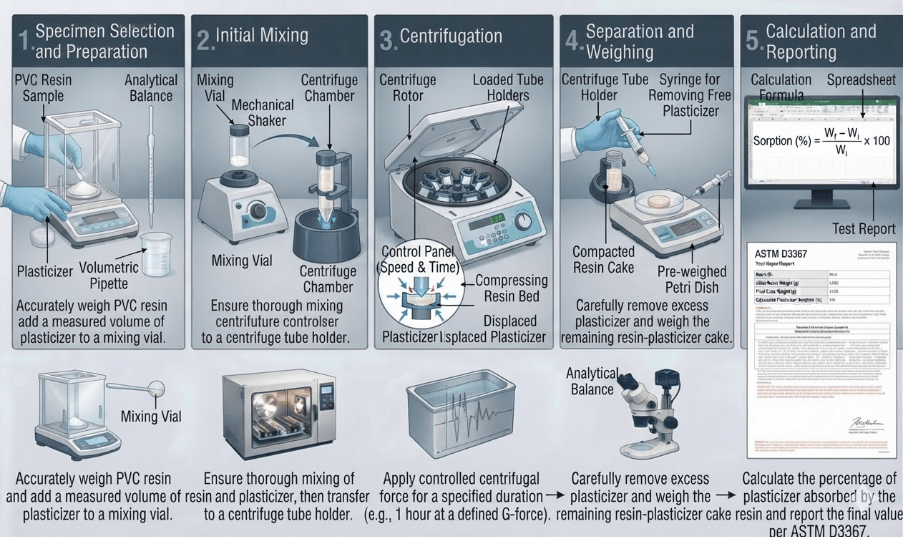
    ASTM D3367 tests plasticizer sorption by applying controlled centrifugal force to PVC resin, thereby exposing it to a liquid plasticizer. Technicians prepare the resin-plasticizer mixture, set centrifugal conditions, separate unabsorbed plasticizer, and determine the mass of plasticizer sorbed. Other reference ASTM documents include D883 and D1600. The complete ASTM D3367 procedure is given as: 

    Read more

    Sample Preparation and Plasticizer AdditionTechnicians prepare a representative PVC resin sample and the specified plasticizer. They then add the required plasticizer to the PVC resin under controlled conditions.
    Mixing and Centrifugation Analysts mix the resin and plasticizer to establish the required contact between the components and apply the specified centrifugal force and test conditions.
    Separation and WeighingTechnicians separate excess or unsorbed plasticizer from the resin and determine the relevant mass before and after the test.
    CalculationThe technician calculates plasticizer sorption from the measured mass values according to the applicable procedure.
    Result ReportingAnalysts record sorption results, sample information, and test conditions.

    ASTM D3367 Testing Process and Data Collection 

    Analysts first prepare a representative PVC resin sample and the required plasticizer. Technicians mix the material under controlled conditions and apply the required centrifugal force. Then they separate them after centrifugation and determine the pertinent mass. Analysts use the measured values to calculate plasticizer sorption and record the sample identification, test conditions, and calculated result.

    This image represents a centrifuge machine used for applying centrifugal force as per ASTM D3367.
    ASTM D3367 Testing Using Centrifuge Machine

    Common Challenges and Troubleshooting 

    To achieve accurate plasticizer-sorption results, consistent sample preparation, mixing, centrifugal conditions, separation, and weighing are required. Common problems include inconsistent resin sampling, inconsistent plasticizer amounts, inconsistent mixing, inconsistent centrifugal force and time, failure to completely separate the unsorbed plasticizer, and plasticizer loss during handling. The technicians should ensure a clean environment, make sure to accurately weigh samples, ensure the environment is consistent, and control centrifugal conditions.

    ASTM D3367 Analysis Results and Interpretation 

    • ASTM D3367 results are reported based on the plasticizer sorption of the PVC resin tested. 
    • This method determines the amount of liquid plasticizer absorbed by PVC resin under controlled centrifugal conditions.
    • Results are reported as plasticizer sorbed per unit mass of PVC resin, commonly expressed in parts of plasticizer per 100 parts of resin (phr).
    • The lab reports resin identification, plasticizer, centrifugal conditions, and the calculated sorption value with the result.

    Link to ASTM D3367

    Read more

    FAQ

    What is ASTM D3367?
    ASTM D3367 is a test method for determining the plasticizer sorption of PVC resins under applied centrifugal force.
    The method tests polyvinyl chloride (PVC) resins for their ability to sorb liquid plasticizer.
    The test determines the quantity of liquid plasticizer absorbed by PVC resin when subjected to specified centrifugal forces.

    Updated on September 7, 2026

    Dr Ruchika Yogesh
    About Author
    Dr. Ruchika Yogesh is a serial entrepreneur, material science and AI/ML enthusiast, medicinal chemistry subject matter expert (SME), scientific/medical copyeditor, and a researcher.
    Know More
    Testimonials
    Real results
    Engineers trust us with what matters most
    Start Your Testing
    Project Today
    Define your requirements and get access to
    specialized laboratories ready to deliver results
    Partners with us
    Clients
    Vendors
    Process for testing
    • STEP 01

      You share your testing requirements

    • STEP 02

      You share your sample(s)

    • STEP 03

      We deliver your test reports

    Get your testing done

    Let us know your testing requirements and we will be right back with a solution.

      Let us root for each other. Collaborate to grow, expand, and accelerate our businesses.

      Partner with us

        Discover more from Matestlab

        Subscribe now to keep reading and get access to the full archive.

        Continue reading