
ASTM D3364 Standard Test Method for Flow Rates for Poly(Vinyl Chloride) with Molecular Structural Implications

    What is ASTM D3364? 

    ASTM D3364 is a standard test method for measuring the flow rate of poly(vinyl chloride) (PVC) compounds and detecting flow-related polymer instabilities. The technique builds on ASTM D1238 and tests PVC behavior at low shear rates, near 1 s⁻¹. It allows laboratories to evaluate the effect of plasticizer content, polymer molecular weight, thermal stability, rheological stability, shear instability, and overall polymer composition.  ASTM D3364 (Standard Test Method for Flow Rates for Poly(Vinyl Chloride) with Molecular Structural Implication) involves extruding PVC through a special die and requires tighter temperature control because PVC flow responds strongly to temperature. Laboratories can use the results for quality control, formulation comparison, and processing-behavior evaluation.

    Read more

    Get Certified ASTM D3364 Testing for Reliable PVC Flow Characterization 

    PVC manufacturers can use ASTM D3364 testing to characterize flow behavior and identify changes in polymer structure or stability. The test compares PVC compounds, monitors PVC formulation, and correlates PVC flow characteristics with processing conditions such as extrusion, injection molding, milling, and mixing.
    What is the scope of ASTM D3364?

    ASTM D3364 measures the flow rates of PVC compounds while detecting and controlling polymer instabilities associated with flow. The method specifically addresses PVC and provides information about processing behavior and molecular-structural changes. This standard-

    Read more

    • Measures PVC compound flow rate, detects thermal instability, and evaluates shear instability.
    • Identifies rheological instability and helps assess molecular-structural changes.
    • Supports PVC quality-control testing and provides information relevant to processing conditions.

    What are the uses of ASTM D3364 testing?

    ASTM D3364 helps laboratories characterize PVC compounds with varying melt viscosities and assess changes that may affect processing. The method offers valuable data for quality control and formulation assessment. This standard-

    • Measures PVC flow rate and compares PVC compound formulations.
    • Supports quality-control programs and evaluates plasticizer-related effects.
    • Helps assess polymer molecular-weight effects and detect thermal and rheological instability.
    • Supports extrusion and molding process evaluation and helps predict changes in PVC processing behavior.

    Which Materials Can Be Tested Under ASTM D3364? 

    ASTM D3364 applies specifically to polyvinyl chloride (PVC) compounds. Laboratories can use the method for PVC formulations with a wide range of melt viscosities and compositions. The method can detect effects related to plasticizer content, molecular weight, polymer stability, shear instability, and composition.

    Why is ASTM D3364 Important? 

    ASTM D3364 offers a controlled way to measure PVC flow and reveals polymer instabilities that may affect processing. PVC compounds may be very sensitive to temperature, shear, molecular-weight distribution, plasticizer content, and thermal history. This method provides laboratories with more information than a simple flow-rate measurement.

    Sample and Specimen DetailsTechnicians first take a representative sample of the PVC compound under evaluation.
    Specimen PreparationTechnicians prepare and charge the PVC compound into the heated plastometer while controlling the specified test conditions.
    Specimen DimensionsThe method specifies the required material charge and uses a specialized die rather than a conventional specimen with fixed external dimensions.
    Instrumentation Extrusion plastometer, specialized PVC die, thermoregulator, thermometer, piston, and appropriate weighing equipment.

    Testing Procedures and Requirements for ASTM D3364 

    ASTM D3364 extends the ASTM D1238 melt-flow approach specifically for PVC compounds. Technicians adjust temperature, piston load, material charge, and die configuration before measuring extruded material. Under standard conditions, the standard temperature is 175°C, the total piston load is 20000 g, the pressure is about 2758 kPa, and the charge is 2.15 ± 0.05 g. Other reference ASTM documents include D883, D1238, D3835, E177, and E691. The testing procedures and requirements for ASTM D3364 are given as-

    Read more

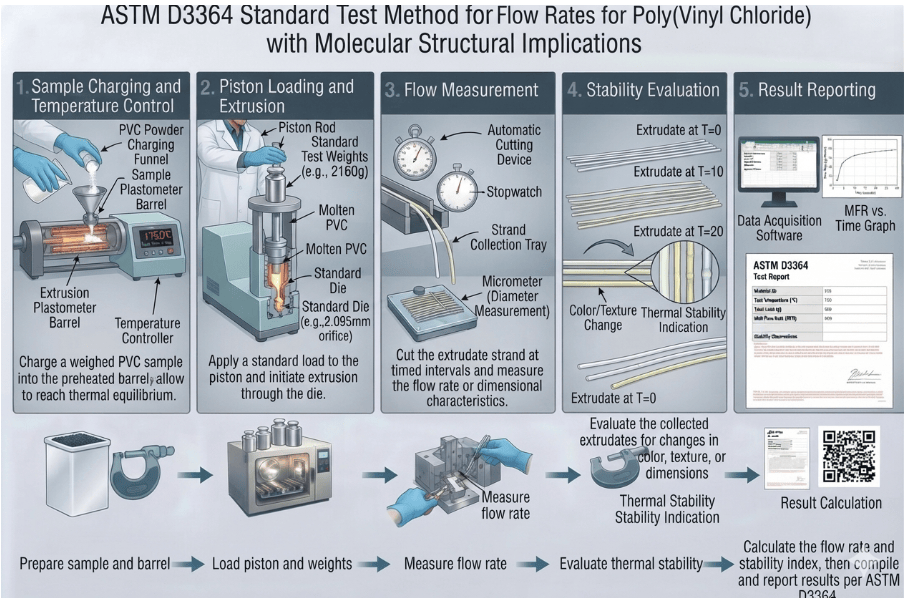
    Sample Charging and Temperature ControlTechnicians place the specified PVC compound charge into the heated plastometer, and operators maintain the specified test temperature with accurate regulation.
    Piston Loading and ExtrusionAnalysts apply the specified piston load, which pressures the PVC compound, and molten PVC flows through the specialized die.
    Flow MeasurementLaboratories measure the extruded material to determine the flow rate.
    Stability EvaluationAnalysts examine flow behavior for thermal, shear, and rheological instability.
    Result ReportingLaboratories record the flow rate and relevant test conditions.

    ASTM D3364 Testing Process and Data Collection

    A representative PVC compound is prepared in a laboratory, and the necessary plastometer conditions are set. Technicians then heat the material to the set temperature, apply the required piston pressure, and extrude the compound through the special die. The laboratory measures the resulting flow and records the test conditions. Analysts can also evaluate changes associated with thermal, shear, and rheological instability.

     This image depicts an extrusion plastometer used to determine flow rate as per ASTM D3364.
    ASTM D3364 Testing Using Extrusion Plastometer

    Common Challenges and Troubleshooting 

    PVC flow measurements require careful temperature and equipment control because small temperature changes can significantly affect flow results. According to ASTM information, tighter temperature control is needed than ASTM D1238. Common challenges include inaccurate temperature control, incorrect material charge, incorrect piston loading, improper die configuration, inconsistent sample preparation, thermal degradation during testing, shear instability, and rheological instability. Technicians should strictly follow the guidelines in compliance with ASTM D3364.

    ASTM D3364 Analysis Results and Interpretation 

    • The laboratory reports the PVC extrusion flow rate in g/10 min under the specified test conditions.
    • The analyst records the test temperature in °C along with the measured flow rate to provide the conditions used for the evaluation.
    • The laboratory compares extrusion flow-rate results among PVC formulations to evaluate differences in processing and flow behavior.
    • The analyst uses changes in flow behavior to identify potential thermal, shear, or rheological instability in the tested PVC material.

    Link to ASTM D3364

    Read more

    FAQ

    What is ASTM D3364?
    ASTM D3364 is a test method for measuring the flow rates of PVC compounds while detecting polymer instabilities associated with flow.
    The method employs a temperature-control device, a specialized die, a loading device, a measurement device, and a plastometer for extrusion.
    The method uses an extrusion plastometer, a specialized die, temperature-control equipment, a thermometer, and associated loading and measurement equipment.
    The lab reports the PVC flow rate in g/10 min (SI units are standard).
    Laraib Hashmi
    About Author
    Laraib Hashmi
    Laraib Hashmi is an aspiring research enthusiast and science content professional with a strong interdisciplinary skill set, holding a postgraduate degree in Applied Microbiology from KIIT Bhubaneshwar, Odisha.
    Testimonials
    Real results
    Engineers trust us with what matters most
    Start Your Testing
    Project Today
    Define your requirements and get access to
    specialized laboratories ready to deliver results
    Partners with us
    Clients
    Vendors
    Process for testing
    • STEP 01

      You share your testing requirements

    • STEP 02

      You share your sample(s)

    • STEP 03

      We deliver your test reports

    Get your testing done

    Let us known your testing requirements and we will be right back with a solution.

      Let us root for each other. Collaborate to grow, expand, and accelerate our businesses.

      Partner with us

        Contact Us

        Discover more from Matestlab Inc

        Subscribe now to keep reading and get access to the full archive.

        Continue reading