
By Laraib Hashmi | Last updated 15th May 2026

ASTM D3835 Determination of Properties of Polymeric Materials by Means of a Capillary Rheometer

ASTM D3835 uses a capillary rheometer to determine the properties of polymeric materials. The test provides essential information about the flow behavior and processing characteristics of polymers, which is crucial for optimizing manufacturing processes and ensuring product quality and performance. This test method supports quality control testing on both reinforced and unreinforced thermoplastics, cure cycles for thermosetting materials, and other polymeric materials with a wide range of melt viscosities.

Read More

GET STARTED

    Share your requirements *

    Provide your contact information *

    ASTM D3835 Introduction

    ASTM D3835 outlines a consistent and reliable procedure for evaluating the flow properties of polymeric materials using a capillary rheometer. The test subjects the polymer to controlled shear rates and temperatures to assess its viscosity, melt flow rate, and other rheological properties. Industries such as plastics, rubber, and polymer processing rely on these properties to ensure precise control of material flow during production. This test method facilitates quality control for both reinforced and unreinforced thermoplastics, cure cycles of thermosetting materials, and other polymeric materials with a wide range of melt viscosities. Engineers and manufacturers use ASTM D3835 to predict and optimize the behavior of polymeric materials during molding, extrusion, and other manufacturing processes.

    Get Certified ASTM D3835 for Reliable Testing of Polymeric Materials 

    Since polymer melt behavior directly influences processing efficiency and final product performance, materials are evaluated under standardized rheological testing conditions to ensure reliable flow characteristics and consistent quality. ASTM D3835 supports precise and reproducible assessment of polymer viscosity and processing behavior. Qualified laboratory testing helps manufacturers optimize production performance and maintain specification compliance. One can consult MaTestLab for more information and professional testing support. 
    Service NameRemarks
    ASTM D3835 Testing
    Contact US
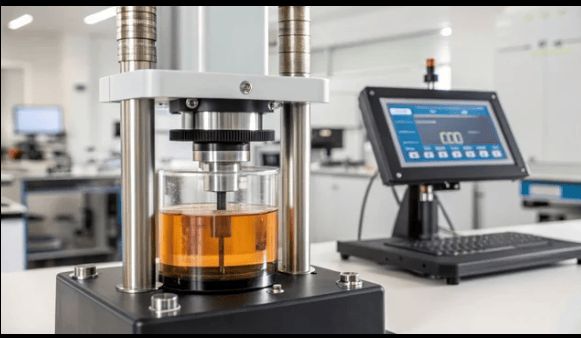
     The image shows the Capillary Rheometer used to evaluate polymeric compounds by ASTM D3835.
    Capillary Rheometer 

    Scope of ASTM D3835

    • Measures flow behavior and viscosity of thermoplastics under controlled shear.
    • Evaluates shear stress, shear rate, and melt viscosity relationships.
    • Supports quality control and material characterization in polymer processing.
    • Applies to thermoplastics in extrusion, molding, and related processes.
    • Compares processing characteristics across polymer materials and formulations.

    ASTM D3835 Test Method

    The ASTM D3835 test method utilizes a capillary rheometer to characterize the flow properties of polymeric materials. The test is conducted as follows:

    Capillary Rheometer A barrel, a capillary die, and a piston make up the capillary rheometer. The analyst loads the polymeric material into the capillary rheometer barrel and subjects it to a controlled shear rate at a specified temperature. The shear rate represents the velocity gradient experienced by the material as it flows through the capillary die.
    Rheological PropertiesThe capillary rheometer measures the pressure drop and flow rate of the polymer through the capillary die to calculate the material’s viscosity and melt flow rate, as well as shear stress, shear rate sensitivity, and apparent viscosity.

    ASTM D3835 Equipment and Sample Preparation

    Specimen detailsASTM D3835 specimens are prepared as granules or pellets.
    Specimen dimensionsThe dimensions of the specimens are consistent and representative of the material used in the intended application.
    Specimen preparationSpecimens are injection-molded, machine-operated, or cut from materials in sheet, plate, slab, or similar form.

    Applications of ASTM D3835

    • Polymer and plastic manufacturing industries for material evaluation.
    • Quality control testing of thermoplastic resins and compounds.
    • Research and development of new polymer formulations.
    • Extrusion and injection molding process optimization.
    • Evaluation of melt flow behavior for processing equipment design.
    • Comparative analysis of polymer viscosity and shear performance.

    Technique, Process, and Data Collection

    During the procedure, the analyst heats a polymer sample to a controlled temperature and forces the molten material through a precision capillary die using a capillary rheometer. The instrument measures the relationship between applied pressure, shear stress, shear rate, and melt viscosity under specified testing conditions. Analysts carefully maintain temperature stability, specimen preparation, and calibration throughout the analysis. Technicians typically collect data, including melt viscosity, shear rate, shear stress, temperature conditions, flow characteristics, and rheological behavior of the polymer material during processing simulations.

    Analysis Results and Interpretation

    The data obtained from ASTM D3835 provides valuable insights into the flow behavior and processing characteristics of polymeric materials. It enables adjustment of processing parameters to achieve the desired product properties and dimensions, and to avoid defects such as flow lines, air traps, or uneven distributions. High-viscosity materials can create challenges during extrusion or molding, while extremely low viscosity can lead to poor dimensional stability. The consistent flow behavior across shear rates signifies uniform molecular weight distribution and stable processing performance. Data can be compared across batches or to reference polymers to ensure quality assurance and detect thermal degradation or contamination during production.

    Common Challenges and Troubleshooting

    Inconsistent temperature control, die wear, and material degradation during testing result in inaccurate viscosity measurements. Troubleshooting requires recalibrating the capillary rheometer, verifying die measurements, and ensuring stable thermal conditions.

    Factors to Consider for ASTM D3835

    Speed
    ASTM D3835 provides an efficient method for evaluating the rheological behavior and melt flow properties of polymeric materials under controlled processing conditions.

    Expert
    Skilled technicians are required to operate the capillary rheometer, maintain precise temperature and shear-rate conditions, and accurately interpret viscosity and flow-behavior data.

    Cost
    ASTM D3835 is a cost-effective testing approach for assessing polymer processing characteristics, helping manufacturers optimize material performance, reduce production defects, and improve quality control during polymer processing applications.

    Direct link to the PDF 

    FAQ's

    Where can I get the astm d3835 tested?

    You can share your astm d3835 testing requirements with MaTestLab. MaTestLab has a vast network of material testing laboratories, spread across the USA and Canada. We support your all material testing needs ranging from specific astm d3835 test to various testing techniques.

    How much do I need to pay for the astm d3835 test?

    Please contact us for a detailed quote for your astm d3835 testing needs. Cost incurred to carry out different astm d3835 testing methodology depends on the type of raw material; number of samples, coupons, or specimens; test conditions, turn around time etc. Costs of some ASTM testing methods start from $100 and the final value depends upon the factors listed above. Please contact us for the best and latest prices.

    How many samples are required for astm d3835?

    The required number of samples or specimens should comply with the procedure given in the astm d3835 standard. However, the MaTestLab operations team can assist you for your special requirements once you share your testing details with us.

    How much discount can I get on the astm d3835 test?

    MaTestLab has a vast testing laboratory network, hence we bring you the best testing facilities in a cost-effective way. We offer considerable discounts (15-20%) to our returning customers based on test volume and frequency.

    How many days will it take to complete the astm d3835 test?

    The turnaround time for astm d3835 test methodology depends upon the test procedure mentioned in the standard test document. However, we at MaTestLab understand your research requirements and hence try to get your test completed within the least possible time.

    Where can I get the astm d3835 tested?

    You can share your astm d3835 testing requirements with MaTestLab. MaTestLab has a vast network of material testing laboratories, spread across the USA and Canada. We support your all material testing needs ranging from specific astm d3835 test to various testing techniques.

    POPULAR TESTS
    ONE-STOP FOR ALL
    MATERIAL TESTING NEEDS
    MaTestLab Inc. offers accessible, quick, and affordable material testing, product testing, and failure analysis services. We support your on-demand testing and expert consultation needs with the help of our extensive network of material testing laboratories situated in the US and other parts of the world.
    MATERIAL TESTING
    We offer destructive and non-destructive tests over a range of mechanical, electrical, chemical, thermal, optical, corrosion, radiation, and biological testing methodologies defined by ASTM, ISO and other organizations.
    PRODUCT TESTING
    We help you evaluate and ensure your product quality and performance with standard and custom-made testing solutions. All the tests are done at well-equipped testing laboratories using standard testing methods for best output and satisfaction.
    FAILURE ANALYSIS
    Failure analysis ensures high levels of quality in every manufacturing process. We help you with getting the best failure or root cause analysis to determine the cause of the failure. The results help you identify means to prevent failure recurrences.
    Process for testing
    • STEP 01

      You share your testing requirements

    • STEP 02

      You share your sample(s)

    • STEP 03

      We deliver your test reports

    Get your testing done

    Let us known your testing requirements and we will be right back with a solution.

      Let us root for each other. Collaborate to grow, expand, and accelerate our businesses.

      Partner with us

        close

        Please share your requirement with us

          ×

          Contact Us

          Discover more from MaTestLab

          Subscribe now to keep reading and get access to the full archive.

          Continue reading