
ASTM D3275 Standard Classification System for E-CTFE-Fluoroplastic Molding, Extrusion, and Coating Materials

    What is ASTM D3275?

    ASTM D3275 describes a standard classification for melt-processible ethylene-chlorotrifluoroethylene (E-CTFE) fluoroplastic materials for molding, extrusion, and coating purposes. E-CTFE is a copolymer of ethylene and chlorotrifluoroethylene, containing about 80% chlorotrifluoroethylene by weight. The classification system identifies and classifies E-CTFE materials based on their physical appearance and melt flow rate. It also includes a series of tests for key material characteristics such as melting endotherm peak, specific gravity, tensile properties, dissipation factor, dielectric constant, and oxygen index. ASTM D3275 provides laboratories, manufacturers, engineers, and users of E-CTFE materials with a classification system and test requirements that allow them to compare the materials.

    Read more

    Get Certified ASTM D3275 for Reliable E-CTFE Fluoroplastic Material Performance 

    The chemical resistance, thermal stability, and desirable mechanical properties of E-CTFE fluoroplastic materials make them useful for demanding applications. ASTM D3275 provides a standard for classifying E-CTFE fluoroplastic molding, extrusion, and coating materials. The classification system uses the composition, properties, and processing characteristics of the materials. Laboratories and manufacturers use ASTM D3275 to consistently identify and classify E-CTFE materials. Engineers use the classification system to compare different material grades, select suitable materials for specific applications, support quality control, and improve communication with material suppliers and users. ASTM D3275 also helps manufacturers and engineers specify characteristics for E-CTFE fluoroplastic molding, extrusion, and coating materials.

    What is the Scope of the ASTM D3275 Standard?

    ASTM D3275 specifies melt-processable E-CTFE fluoroplastic materials used for molding, extrusion, and coating. The standard applies to copolymers of ethylene and chlorotrifluoroethylene (E-CTFE) resins. ASTM D3275 classification system –

    Read more

    • Covers melt-processable E-CTFE fluoroplastic materials. 
    • Applies to materials used for coating.
    • Covers molding materials. 
    • Covers materials used for extrusion. 
    • Classifies materials by their appearance. 
    • Further categorizes materials by melt flow rate. 
    • Defines tests for various physical, thermal, mechanical, electrical, and flammability properties. 
    • Uses SI units as the standard units.

    What are the Uses of ASTM D3275?

    ASTM D3275 provides the basis for classifying and comparing E-CTFE fluoroplastic materials. Manufacturers and users use this classification to determine suitable material properties for specific processing and product needs. This standard –

    • Assists in categorizing E-CTFE fluoroplastic materials. 
    • Compares various E-CTFE materials. 
    • Establishes a uniform method for identifying materials. 
    • Supports the assessment of melt flow behavior. 
    • Supports selecting materials for molding, extrusion, and coating. 
    • Represents measurements of key material properties. 
    • Supplies comparable material data to laboratories. 
    • Assists with quality control and material testing.

    Which Materials Can Be Classified Under ASTM D3275?

    ASTM D3275 covers melt-processable molding, extrusion, and coating materials that contain E-CTFE fluoroplastics. The standard uses a resin copolymer of ethylene and chlorotrifluoroethylene, containing about 80% chlorotrifluoroethylene. Manufacturers can provide this material for applications where users mold, extrude, or coat the E-CTFE fluoroplastic. The classification system considers the material’s physical characteristics and melt flow rate to determine the appropriate classification.

    Why is ASTM D3275 Important?

    ASTM D3275 is significant because it provides a standard classification system for E-CTFE fluoroplastic materials. Comparing materials from different sources may be more difficult without a common classification system. The standard includes data on melt flow rate, thermal characteristics, specific gravity, tensile characteristics, electrical characteristics, oxygen index, and other properties. Manufacturers and users use these properties to understand materials and support material comparison and selection. Thus, ASTM D3275 helps manufacturers, laboratories, engineers, and material users understand and work with E-CTFE materials through a consistent classification and test procedure.

    ASTM D3275 Equipment and Sample Preparation Guide

    Technicians shall prepare and test specimens according to the applicable test methods specified in the ASTM D3275 classification system. Technicians select the equipment based on the property they assess.

    Read more

    Sample and Specimen Details  Technicians prepare representative samples of E-CTFE fluoroplastic molding, extrusion, and coating materials for evaluation according to the classification requirements of ASTM D3275.  
    Specimen Preparation Technicians prepare, identify, and condition the E-CTFE specimens according to the individual test methods referenced by ASTM D3275 before testing. 
    Specimen Dimensions  Technicians prepare test moldings with a thickness of 3.18 ± 0.3 mm (0.125 ± 0.012 in.) for ASTM D3275 testing. They use these moldings for the applicable property evaluations specified by the classification system. 
    Instrumentation  The tests use equipment for melt flow, thermal, mechanical, electrical, and limiting oxygen index evaluations, together with appropriate measuring and conditioning equipment. 

    Testing Procedures and Requirements for ASTM D3275

    ASTM D3275 classifies and tests E-CTFE fluoroplastic materials using a standardized approach. The laboratory tests the material to meet the applicable requirements and documents the measurements obtained from each test. 

    Read more

    Other referenced ASTM documents include ASTM D1600, D1708, D2863, D3892, and D4591. 

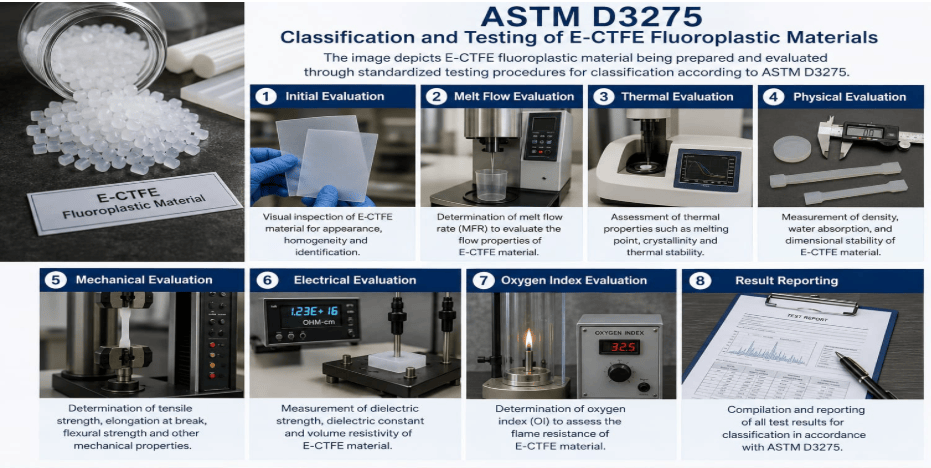
    Initial EvaluationTechnicians identify the E-CTFE material and evaluate its physical appearance before performing the applicable classification and property tests.
    Thermal and Flow Evaluation Analysts determine the melt flow rate and melting endotherm peak to support material classification and thermal characterization.
    Physical and Mechanical Evaluation Technicians determine specific gravity and tensile properties using the applicable test procedures.
    Electrical and Oxygen Index Evaluation Analysts determine the dielectric constant, dissipation factor, and oxygen index under specified test conditions. 
    Result Reporting Analysts record the test results and report the applicable material classification and measured properties. 

    ASTM D3275 Testing Process and Data Collection

    The Analyst first determines the type of E-CTFE fluoroplastic and prepares representative specimens according to the applicable test procedures. The laboratory then compares the material’s physical appearance and measures the melt flow rate as a key classification characteristic. The laboratory then conducts applicable tests for melting endotherm peak, specific gravity, tensile properties, dielectric constant, dissipation factor, and oxygen index. The laboratory records the measurements from each evaluation and ensures that the reported values reflect the appropriate test procedures. The laboratory then uses the collected results to characterize the E-CTFE material and classify it according to the ASTM D3275 requirements.

    The image depicts E-CTFE fluoroplastic material being prepared and evaluated through standardized testing procedures for classification according to ASTM D3275.
    ASTM D3275 Classification and Testing of E-CTFE Fluoroplastic Materials

    Common Challenges and Troubleshooting

    ASTM D3275 results depend on test specimen preparation, equipment maintenance, and proper application of the specified test procedures. The properties measured and the classification obtained will vary with different material preparation methods, specimen dimensions, equipment condition, and test conditions. Technicians should check the condition and calibration of the proper testing equipment before evaluation. Standardized specimen preparation and testing techniques should be used in all laboratories to allow for reliable and comparable results. Technicians should perform melt flow testing carefully because laboratories use the melt flow rate as an important characteristic to classify E-CTFE materials. If the evaluation includes these properties, technicians must also ensure accurate measurements of thermal, mechanical, and electrical properties, as well as the oxygen index.

    ASTM D3275 Analysis Results and Interpretation

    The report summarizes the classification and measured properties of E-CTFE fluoroplastic materials, and compares the results with the applicable requirements. 

    Read more

    • The laboratory measures the melt flow rate using the appropriate test method and reports it in s/g to provide information about the material’s processing and flow behavior. 
    • The laboratory reports the melting endotherm peak in °C and specific gravity as a dimensionless value to provide information about the material’s thermal and physical properties. 
    • The laboratory measures tensile properties and reports them in the appropriate units to describe the material’s mechanical behavior, including tensile strength and elongation. 
    • When applicable, the laboratory measures and reports electrical properties, such as dielectric constant and dissipation factor, to describe the material’s electrical characteristics. The laboratory also reports the oxygen index (%) to describe the material’s combustion behavior. 
    • The report compares the measured results with the applicable ASTM D3275 classification requirements to support material specification and quality-control activities. 

    Link to ASTM D3275

    FAQ

    Where can I get the astm d3275 tested?
    You can share your astm d3275 testing requirements with MaTestLab. MaTestLab has a vast network of material testing laboratories, spread across the USA and Canada. We support your all material testing needs ranging from specific astm d3275 test to various testing techniques.
    Please contact us for a detailed quote for your astm d3275 testing needs. Cost incurred to carry out different astm d3275 testing methodology depends on the type of raw material; number of samples, coupons, or specimens; test conditions, turn around time etc. Costs of some ASTM testing methods start from $100 and the final value depends upon the factors listed above. Please contact us for the best and latest prices.
    The required number of samples or specimens should comply with the procedure given in the astm d3275 standard. However, the MaTestLab operations team can assist you for your special requirements once you share your testing details with us.
    MaTestLab has a vast testing laboratory network, hence we bring you the best testing facilities in a cost-effective way. We offer considerable discounts (15-20%) to our returning customers based on test volume and frequency.
    The turnaround time for astm d3275 test methodology depends upon the test procedure mentioned in the standard test document. However, we at MaTestLab understand your research requirements and hence try to get your test completed within the least possible time.
    Malhar Khole
    About Author
    Malhar Khole
    Malhar Khole is a Material Testing Associate at MaTestLab Inc. and holds a postgraduate degree in Material Science and Technology from IIT (BHU), Varanasi.
    Testimonials
    Real results
    Engineers trust us with what matters most
    Start Your Testing
    Project Today
    Define your requirements and get access to
    specialized laboratories ready to deliver results
    Partners with us
    Clients
    Vendors
    Process for testing
    • STEP 01

      You share your testing requirements

    • STEP 02

      You share your sample(s)

    • STEP 03

      We deliver your test reports

    Get your testing done

    Let us known your testing requirements and we will be right back with a solution.

      Let us root for each other. Collaborate to grow, expand, and accelerate our businesses.

      Partner with us

        Contact Us

        Discover more from MaTestLab

        Subscribe now to keep reading and get access to the full archive.

        Continue reading