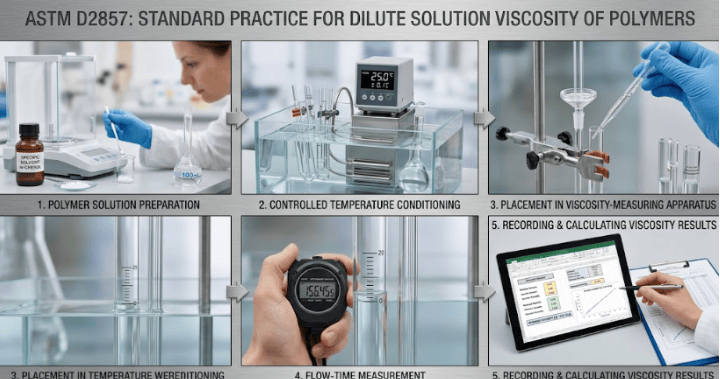
This ASTM D2857 method measures the dilute solution viscosity of polymers under controlled laboratory conditions. The practice is a standard method for preparing polymer solutions, measuring their viscosity, and reporting the data. The practice covers:
- Polymer Solutions: The practice examines a solute in dilute concentrations of a suitable polymer material.
- Solution Viscosity: The practice measures the flow behavior of polymer solutions under specified conditions.
- Flow Measurement: The laboratory determines the time needed for the polymer solution to run through the chosen viscosity apparatus.
- Material Characterization: Engineers use the viscosity data to compare and characterize polymer materials.
- Quality Control: Manufacturers can check batch-to-batch consistency by using consistent viscosity measurements.
What are the uses of ASTM D2857 testing?
ASTM D2857 provides viscosity data that help laboratories characterize polymer materials in dilute solution. Manufacturers and researchers can use the results to compare materials, support quality control, and evaluate polymers. The standard-
- Determines the dilute solution viscosity of polymers.
- Helps compare different polymer materials and grades.
- Supports quality control between production batches.
- Helps monitor changes in polymer material characteristics.
- Supports polymer research and development.
- Provides data for material characterization and process evaluation.
Which materials can be tested according to ASTM D2857?
ASTM D2857 applies to polymers that can be prepared as suitable dilute solutions for viscosity measurement. Laboratories should confirm the polymer type, solvent, concentration, and applicable test conditions before testing. ASTM D2857 applies to-
- Soluble Polymers: Evaluates polymers that can form suitable solutions in the selected solvent.
- Polymer Grades: Allows laboratories to compare viscosity behavior between applicable polymer grades.
- Polymer Formulations: Helps evaluate differences between polymer materials with different formulations or processing histories.
- Production Samples: Supports comparison of representative samples from different production batches.
Why is ASTM D2857 testing important?
Polymer viscosity can provide useful information about material characteristics and consistency. ASTM D2857 offers a standardized method for measuring the viscosity of dilute polymer solutions under controlled conditions. The results enable manufacturers and researchers to compare polymer samples and detect differences between materials or production batches. The data help engineers with polymer characterization, quality control, and product development.