ASTM D1710 Standard Specification for Extruded Polytetrafluoroethylene (PTFE) Rod, Heavy Walled Tubing and Basic Shapes
What is ASTM D1710?
ASTM D1710 is a standard specification for extruded shapes of polytetrafluoroethylene (PTFE) rod, heavy-walled tubing, and basic shapes. It includes PTFE resin as specified by ASTM D4894 and reprocessed PTFE resin as specified by ASTM D7209. The specification requires manufacturers to produce these products entirely from PTFE using good commercial ram-extrusion practices. The specification defines three main material categories: Type I—premium, Type II—general purpose, and Type III—noncritical applications. It further divides these materials into grades and classes according to resin source, dimensional stability, and internal-defect requirements.
Get Certified ASTM D1710 Testing for Reliable PTFE Products
PTFE products offer chemical resistance, electrical insulation, and valuable mechanical properties for challenging applications. Therefore, manufacturers need reliable testing to confirm that their products meet the applicable material requirements. Laboratories measure specific gravity, tensile strength, dielectric strength, dimensional stability, melting point, and workmanship to help in quality control and product qualification.
What is the Scope of ASTM D1710?
ASTM D1710 specification establishes requirements for extruded polytetrafluoroethylene (PTFE) rods, heavy-walled tubing, and basic shapes made from virgin or reprocessed PTFE resin. The specification evaluates properties such as workmanship, specific gravity, tensile strength, elongation, dielectric strength, dimensional stability, and melting point to help manufacturers verify PTFE product quality and performance. Engineers use ASTM D1710 to determine PTFE products intended for electrical, mechanical, and chemical applications. The specification applies to products 1.6 mm (1/16 in.) or thicker and identifies materials by type, grade, and class.
This standard specifies extruded rods, heavy wall tubing, and basic shapes of virgin or reprocessed PTFE resin. The specification applies to products with a wall thickness of 1.6 mm (1/16 in.) or greater. The ASTM D1710 specification-
Covers extruded PTFE rods, heavy wall PTFE tubing, and PTFE basic shapes.
Applies to wall thicknesses of 1.6 mm (1/16 in.) or greater.
Covers products made wholly from PTFE.
Uses PTFE resin covered by ASTM D4894.
Allows qualifying reprocessed PTFE resin defined by ASTM D7209.
Establishes requirements for physical, electrical, dimensional, and appearance characteristics.
What are the Uses of ASTM D1710 testing?
ASTM D1710 testing helps manufacturers verify the quality and performance of extruded PTFE products. The testing offers property data for material qualification, production control, product comparison, and application selection. The ASTM D1710 specification –
Evaluates the quality of extruded PTFE products.
Checks tensile strength and elongation.
Tests electrical insulation capabilities by applying a dielectric-strength test.
Measures specific gravity for material characterization.
Checks dimensional stability where applicable.
Evaluates melting-point characteristics.
Identifies workmanship and appearance defects.
Supports quality control during PTFE production.
Helps manufacturers compare PTFE materials and product classifications.
Supports selection of PTFE products for electrical, mechanical, and chemical uses.
What Materials Can Be Tested Under ASTM D1710?
The ASTM D1710 standard covers extruded PTFE rods, heavy wall PTFE tubing, and basic shapes produced from PTFE resin as specified in ASTM D4894 or qualifying reprocessed PTFE resin in accordance with ASTM D7209. The specification covers products with a wall thickness of 1.6 mm (1/16 in.) or greater.
Why is ASTM D1710 Important?
ASTM D1710 provides consistent requirements for evaluating important PTFE product characteristics. Manufacturers can use these requirements to determine product quality, compare materials, and verify suitability for electrical, mechanical, and chemical applications.
ASTM D1710 Equipment and Sample Preparation Guide
Accurate results require representative PTFE products, proper specimen preparation, and calibrated equipment. Before testing, technicians should identify the required product type, grade, class, dimensions, and properties.
Technicians take representative PTFE rods, heavy wall tubing, or simple components from the production lot.
Specimen Preparation
Technicians prepare specimens based on applicable property tests and examine them for surface condition, workmanship, and internal defects when required.
Specimen Dimensions
The specification covers rods, tubing, and basic shapes with a thickness of 1.6 mm (1/16 in.) or greater.
Instrumentation
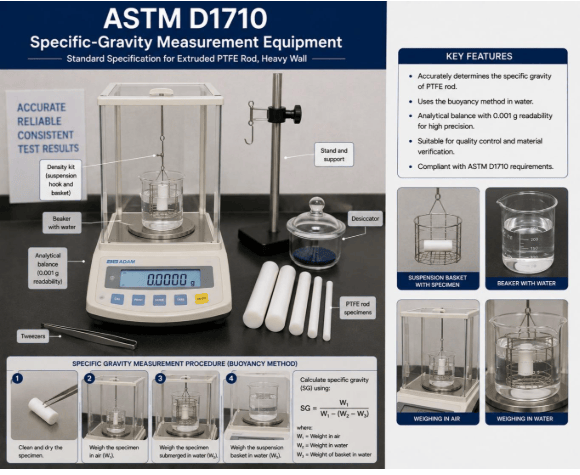
Specific-gravity measurement equipment, a tensile testing machine, dimensional measuring instruments, melting-point equipment, a dielectric-strength tester, and equipment for internal-defect examination.
ASTM D1710 Testing procedure and requirements
ASTM D1710 specifies the physical, electrical, dimensional, and visual properties of PTFE products. Technicians choose the applicable evaluation based on the product type, grade, class, and desired property. The specification determines workmanship and appearance, specific gravity, tensile strength and elongation, dielectric strength, dimensional stability, and melting point.
Technicians check color, finish, general workmanship, and relevant internal defects.
Specific Gravity and Tensile Testing
Technicians measure the specific gravity of the PTFE material, compare it to the requirement, and perform tensile testing to determine the strength of the PTFE material.
Tensile Strength and Elongation
Analysts conduct tensile testing, determine the strength of the PTFE material, and measure the elongation of the specimen during tensile testing.
Dielectric Strength and Dimensional Stability
Laboratories evaluate the electrical insulation capability of applicable PTFE material and evaluate dimensional changes for products that require dimensional-stability classification.
Melting Point
Laboratories determine the melting point based on the applicable test procedures.
ASTM D1710 Testing Process and Data Collection
Technicians take representative PTFE rods, tubing, or basic shapes from the production lot, determine product classification, and identify the properties required for evaluation. Then laboratories examine the product and prepare the specimens for appropriate physical, electrical, and dimensional evaluations. The laboratory determines the specific gravity, tensile strength, elongation, dielectric strength, dimensional stability, and melting point. Lastly, technicians document the specimen identification, dimensions, material classification, test conditions, measured properties, and conformance with the relevant requirements.
ASTM D1710 Analytical Balance with a Hydrostatic Weighing
Common Challenges and Troubleshooting
Laboratories should encounter dimensional variation, surface imperfections, internal defects, and inconsistent mechanical results during PTFE evaluation. Accurate dimensional measurements and correct specimen preparation require reliable results. Technicians should carefully inspect specimens, verify dimensions with calibrated instruments, and select the correct type, grade, and class before testing. Furthermore, laboratories should maintain appropriate equipment and follow the applicable referenced test methods.
ASTM D1710 Analysis Results and Interpretation
ASTM D1710 identifies SI units as the standard measurement system and provides inch-pound values in parentheses for information.
Laboratories report results in tensile strength in MPa, elongation in %, dielectric strength in V/mil, dimensional stability, dimensions in mm, and melting point in ºC.
Laboratories compare measured values with the applicable type, grade, class, and product requirements.
Gokula Srinivasan Selvam is a Material Testing Associate at Matestlab Inc. and holds a postgraduate degree in Ceramic Engineering from IIT (BHU), Varanasi. His academic background and professional experience are centered on advanced ceramic materials, their processing, characterization, and performance evaluation. Know More
Testimonials
Real results
Engineers trust us with what matters most
“We had a great experience working with this company for our ASTM E84 testing. They were the first company to respond to our inquiry within just a few minutes of submitting it. From start to finish, the communication was excellent, and the entire process was swift, straightforward, and hassle-free.”
Ivars FancyWalls
United States
“Very good communication, testing associates were very patient with delays on our end. Reasonable turnaround time for results and nicely detailed report. Analysts were also quick to answer any follow-up questions. Happy with results.”
Skye Henderson
United States
“Matestlab connected us with an accredited lab within days, cutting weeks off our product validation timeline.”
Rebecca Kozodoy-Pins
United States
Start Your Testing Project Today
Define your requirements and get access to specialized laboratories ready to deliver results